
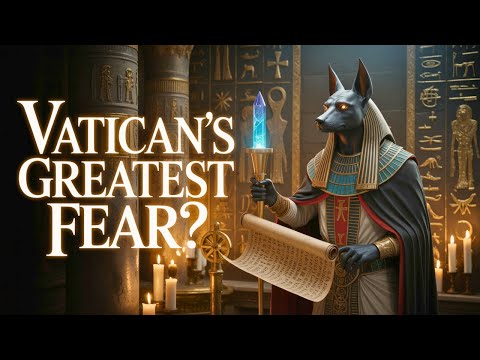
The air crackled with a forbidden energy, the scent of ancient dust and untold secrets. Tonight, we pry open one of history's most heavily guarded vaults, venturing into the forbidden corridors of the Vatican's deepest anxieties. Long before the monolithic power of the Church was forged, ancient Egypt held a reservoir of knowledge—rituals, symbols, and arcane wisdom—that directly threatened the very foundations of what the Church would later espouse.
The narrative we've been fed is one of divine light battling infernal darkness. But what if the true confrontation wasn't merely between good and evil, but between ingrained belief and a forgotten, potent power? What if the specter haunting the Vatican's halls was not the Devil, but the profound, dangerous magic of ancient Egypt?
This exploration is not for the faint of heart. It's a journey into the censored scrolls, the suppressed spells, and the historical amnesia the Church desperately imposed. We will peel back the layers of dogma to expose why Egyptian knowledge was deemed too perilous to survive, why its symbols resonate strangely with Catholic iconography, and how early Christian leaders viewed Egypt not as a historical curiosity, but as a profound spiritual adversary.
Prepare to question everything you thought you knew about religion, power, and the hidden currents of history. The truths they tried to bury are about to resurface.
Table of Contents
Ancient Knowledge as Existential Threat
The Church's rise to power was a meticulously crafted narrative, one that often cast shadows where light was desired. Before consolidating its global influence, the Vatican viewed ancient Egypt not merely as a precursor civilization, but as a direct existential threat. This wasn't about primitive superstitions; it was about a sophisticated system of magic, spirituality, and cosmic understanding that offered an alternative path to the divine—one that bypassed the priestly intermediary.
Imagine ancient rites that seamlessly blended science, astronomy, and profound symbolism. This was the essence of Egyptian magic. Unlike the abstract, often fear-based constructs of infernal forces, Egyptian magic was perceived as tangible, real, and profoundly powerful. It offered adherents a direct conduit to the sacred, a concept an emerging, power-centralizing Church could not tolerate. The very real, potent, and remembered nature of these practices made them far more dangerous than any mythical demon.
To understand this fear, consider Egypt's advanced civilization. When Greek poets like Homer were composing their epics, and Roman civilization was still nascent, Egypt had already woven millennia of history, literature, and sophisticated religious systems. This deep, ancient wisdom, stretching back to eras before Sumeria, presented a stark contrast to newer belief systems, making it a formidable rival for the minds and souls of the populace.
This historical depth meant that Egyptian knowledge wasn't just old; it was foundational. It represented a lineage of spiritual exploration that predated and, in many ways, informed later traditions. For a burgeoning institution seeking to establish universal truth, acknowledging or preserving such a powerful, independent source of spiritual authority was strategically untenable.
This perspective is crucial: the Church's fear wasn't of "darkness" in abstract terms, but of a direct, unmediated connection to the divine that Egyptian magic facilitated. This direct access undermined the very hierarchical structure the Church needed to maintain control and authority. The realization that people could access the sacred without a priestly "middleman" was, and remains, a fundamental threat to any power structure built on such mediation.
The fear was so profound that efforts were made to suppress, banish, and even erase texts containing this knowledge. This wasn't merely about theological disagreement; it was a calculated move to reframe history and spiritual understanding, ensuring that the Church's narrative became the dominant, unchallenged truth.
"Anything that wants to threaten or control you. Are simply not from god. God gave freewill and does not contradict himself. Learn to differentiate what is god's will and what are not. The need for manipulation and control are not of god but of man."
Christianity's Egyptian Dilemma
The early Christian leaders faced a unique paradox: how to establish a new spiritual paradigm while grappling with the immense cultural and religious weight of Egypt. Egypt was not simply another civilization; it was a spiritual superpower, the cradle of mystical traditions and arcane practices that had captivated the ancient world for millennia. This presented an inherent challenge to the nascent Christian movement seeking to supplant existing belief systems.
The early Church leadership viewed Egypt with a mixture of awe and apprehension. While acknowledging the deep spiritual currents present in Egyptian culture, they simultaneously recognized its potential to undermine their own authority. The secretive rituals of Egyptian priests, their profound understanding of the afterlife, and their potent magical techniques were seen as direct competitors for the spiritual allegiance of the populace. Texts that detailed these practices were viewed with suspicion, often labeled as heretical, and subsequently banned, buried, or systematically erased from historical record.
The power structure needed to be absolute. The concept of a direct line to the divine, as Egyptian magic offered, was diametrically opposed to the intermediation model the Church was building. This created a deep-seated fear: the fear of losing control over spiritual access and interpretation. It wasn't just about differing beliefs; it was about a fundamental challenge to the Church’s role as the sole gatekeeper of salvation and divine knowledge.
Consider the historical context: When Shakespeare was penning his plays, America hadn't yet been conceived. When Ovid wrote his poetry, England was unknown. But when Homer recited his epics, Egypt had already flourished for forty centuries, boasting a rich tapestry of literature, religion, and civilization. This deep historical legacy made Egyptian knowledge particularly potent and, therefore, particularly threatening to a newer religious framework seeking to establish dominance.
The Church's strategy was multi-pronged: demonize Egyptian magic, co-opt its symbols where possible to legitimize its own doctrines, and systematically eliminate any surviving records that could challenge its narrative. This historical suppression created a vacuum, a "phantom time" where inconvenient truths were effectively erased, leaving future generations to piece together fragments of what was deliberately hidden.
The practice of building churches atop ancient sacred sites further illustrates this strategy. By literally covering over the past, the Church aimed to obscure original findings and prevent the rediscovery of potent traditions, thereby maintaining its monopoly on spiritual power and knowledge. Whispers persist of secret societies, like the Knights Templar, who may have uncovered some of this hidden knowledge and worked to preserve it, scattering fragments across the globe.
Suppressed Texts and Echoing Symbols
To understand the depth of the Vatican's fear, we must look at the tangible manifestations of Egyptian knowledge: its sacred texts and potent symbols. These weren't merely artistic expressions; they were sophisticated conduits of magical power and spiritual understanding that posed a direct challenge to the Church's burgeoning authority. The systematic suppression of these elements was a critical component of establishing religious dominance.
The early Christian leaders recognized that texts like the Ancient Egyptian Book of the Dead, the Hermetica, and the Book of Thoth contained cosmologies and magical practices that offered alternative avenues to the divine. These writings detailed spells, rituals, and philosophical insights that empowered individuals, providing them with direct access to spiritual realms and cosmic forces. This direct agency was a threat to any institution that profited from being the sole mediator between humanity and the divine.
Consequently, these texts were deemed too dangerous. They were banned, buried in forgotten tombs, actively destroyed, or deliberately altered to obscure their original meaning. The goal was not simply to discredit them but to erase them entirely from collective memory, ensuring that older forms of spiritual understanding could not compete with the new dogma. The burning of libraries, a recurring tragedy throughout history, often served this purpose of eradicating inconvenient knowledge, including potent Egyptian magical lore.
What's more, startling parallels exist between ancient Egyptian symbols and those later adopted by Catholicism. The Obelisk, a powerful symbol of the sun god Ra, was famously transported from Egypt to St. Peter's Square in Rome. This appropriation suggests a strategic co-option of potent imagery, an attempt to imbue Christian structures with ancient power, or perhaps a way to neutralize and control the resonance of these original symbols by placing them within a new context.
The Catholic Church's fear wasn't rooted in the supposed evil of Egyptian magic, but in its efficacy and its potential to empower individuals independently. Magic, in the Egyptian context, was often considered a science—a sophisticated manipulation of natural and supernatural forces. This scientific approach to the sacred, where rituals yielded predictable results, was far more intimidating than the abstract terrors of the Devil. It represented a form of knowledge that could challenge established power structures by offering tangible results and direct spiritual experiences.
The very act of erasing this knowledge speaks volumes. It suggests a deep-seated insecurity, a realization that the ancient Egyptian system held a power that could potentially dismantle the hierarchical control the Church sought to impose. The erasure was an attempt to sever the connection to this potent past, to control the narrative of divine access, and to ensure that practitioners relied solely on the Church's sanctioned path.
For those seeking deeper spiritual understanding, exploring the original texts and symbols, even in their fragmented forms, offers a glimpse into a lost world of power. It reveals why the Vatican felt it necessary to go to such lengths to silence a tradition that, in its essence, offered direct communion with the divine.
The Power of Direct Access: Egypt vs. The Priesthood
The core of the Vatican's deep-seated fear of Egyptian magic wasn't its supposed malevolence, but its profound potential to empower individuals directly. Ancient Egyptian spirituality, particularly its magical practices, offered a pathway to the divine that was remarkably unmediated. This stood in stark contrast to the hierarchical structure of the emerging Christian Church, which positioned itself as the essential intermediary between humanity and God.
Egyptian magic was often understood as a science – a practical, results-oriented discipline. Through rituals, incantations, and the meticulous use of symbolism and talismans, practitioners could directly influence their reality, seek guidance, and commune with deities or spiritual forces. This was not about abstract faith; it was about engaged practice yielding tangible outcomes. In essence, Egyptian magic provided a blueprint for individuals to achieve spiritual autonomy.
This autonomy was the ultimate threat. Imagine a populace capable of seeking divine favor, protection, or knowledge without the need for a priest, a sacrament, or an ecclesiastical ruling. This direct access to the sacred challenged the very foundation of institutional power, which relies on controlling the flow of spiritual information and authority. The danger wasn't in the "darkness" of the magic, but in its capacity to illuminate the path for the individual, bypassing the established religious authority entirely.
The Church's historical response—suppressing texts, persecuting practitioners, and reinterpreting symbolism—was a defensive strategy to maintain its monopoly on spiritual interpretation and guidance. By demonizing Egyptian magic and its practitioners, and by co-opting its potent symbols (like the obelisk), the Church sought to neutralize its influence and discredit any alternative spiritual framework. The fear was that an enlightened populace, armed with direct access to the divine, would no longer need, or obey, the Church.
Moreover, the Church's need for control extended to managing the narrative of good and evil. By framing Egyptian magic as inherently diabolical, they could simultaneously elevate their own divine status and delegitimize any spiritual tradition that offered a competing vision of power and connection. This created a historical divide where the "Devil" became a convenient scapegoat, masking the deeper, more strategic fear of losing control over the spiritual landscape and the populace's direct access to the divine.
The historical whispers of knowledge being deliberately obscured, or grand libraries being burned, speak to this fundamental conflict. It was a battle not just for souls, but for the very definition and accessibility of the divine. Egyptian magic, with its emphasis on direct experience and personal empowerment, represented a powerful counter-narrative that the Church found too dangerous to coexist with.
Exploring this dynamic reveals that the Vatican's deepest fears were reserved not for infernal forces, but for the ancient Egyptian secrets that threatened to dismantle its established power structure by offering a more direct and potent connection to the divine.
Practical Application of Ancient Rites
While the historical narrative often focuses on the fear and suppression surrounding Egyptian magic, its true power lay in its practical application. Ancient Egyptian priests and practitioners didn't just theorize; they *did*. Their rituals were intricate, scientifically informed processes designed to achieve specific results, whether for personal empowerment, societal well-being, or navigating the complexities of the afterlife. Understanding these practical elements is key to grasping why they were so feared.
Central to Egyptian magical practice was the concept of Heka, often translated as "magic" but more accurately meaning the fundamental creative force of the universe. Heka was not seen as separate from the divine or the natural world; it was the animating principle that permeated everything. Priests were trained to understand and manipulate Heka through precise rituals, spoken spells (heka), and the crafting of powerful amulets and symbols.
One crucial aspect was the understanding of names and words of power. It was believed that knowing the true name of a person, deity, or object granted a degree of control over it. Therefore, many spells involved invoking the correct, often hidden, names to compel or implore spiritual entities. This emphasis on linguistic precision and esoteric knowledge demonstrates a sophisticated, almost scientific approach to magic.
The creation of talismans and amulets was another cornerstone. These weren't mere decorative items; they were carefully crafted objects imbued with specific energies and intentions, often using symbolic imagery (like the Udjat eye for protection or the Ankh for life) and inscribed with hieroglyphs. Their efficacy stemmed from the precise combination of materials, form, and inscribed magical formulae. To create a potent amulet required a deep understanding of correspondences – the symbolic links between elements, colors, deities, and desired outcomes.
Rituals for the afterlife were particularly elaborate. The Book of the Dead, for instance, is not a single book but a collection of spells and prayers intended to guide the deceased through the perils of the underworld and ensure their successful transition to eternal life. The priests meticulously prepared these texts for individuals, inscribing them on papyrus, tomb walls, or coffins, believing they provided essential knowledge and protection for the soul's journey. This demonstrated a profound belief in the power of written spells to influence even the cosmic order.
The Church’s fear stemmed from the fact that these practices were demonstrably effective for many Egyptians. They offered solutions to everyday problems, provided spiritual solace, and promised eternal life through means that didn't require adherence to a new, nascent religion. This practical efficacy, this proven ability to influence reality and the cosmos, made Egyptian magic a far greater threat than any abstract notion of evil.
Technomancy, the art of weaving magic with technology, finds its ancient roots here. The meticulous planning, the use of specific tools (like measuring instruments for aligning rituals), and the structured application of knowledge echo in modern digital practices. The deliberate suppression of these practical arts meant severing humanity's connection to methods that offered genuine agency and a direct understanding of universal forces.
For those today seeking to understand the underlying principles of power and manifestation, studying these ancient rites offers invaluable insight. It moves beyond mere belief into the realm of practical application – understanding the energetic architecture of intention and the symbolic language of the cosmos.
Exploring these ancient techniques requires a pragmatic approach. It's about understanding the principles of intention, visualization, and symbolic resonance – concepts that are as relevant today as they were millennia ago. The fear of such knowledge isn't about its inherent danger, but about its potential to liberate individuals from external control.
The narrative of the Vatican's fear of Egyptian magic is, at its heart, a story about the control of knowledge and the power it wields. Throughout history, institutions seeking to consolidate authority have understood that controlling what people know—and teaching them what to fear—is paramount. Egyptian magic, with its direct empowerment and alternative spiritual pathways, represented a significant threat to this control.
The early Church leaders recognized that the sophisticated rituals, the deep astronomical knowledge, and the powerful symbolic language of Egypt offered a compelling alternative to their own emerging doctrines. This wasn't just theological competition; it was a battle for the minds and spirits of the populace. If people could achieve spiritual enlightenment, protection, or even influence over events through their own practices, the need for a priestly intermediary diminished drastically.
This is where the fear of "direct access" becomes critical. Egyptian magic promised agency. It suggested that individuals, through understanding and application, could tap into fundamental cosmic forces (Heka). This empowerment disrupted the established order, where spiritual power flowed downwards from a central authority. The Church's strategy was to invert this: to make itself the *sole* sanctioned source of spiritual power and knowledge.
The suppression of texts like the Hermetica and the Book of Thoth wasn't an oversight; it was deliberate. By removing these ancient repositories of wisdom, the Church sought to create a knowledge vacuum. This vacuum could then be filled with its own narrative, defining what was acceptable belief and what constituted dangerous heresy. Librarians would later burn countless works, but the pattern of knowledge control began in these early centuries.
Consider the appropriation of Egyptian symbols, such as the Obelisk in St. Peter's Square. This act demonstrates a dual strategy: neutering the original power of the symbol by placing it within a new, dominant context, and simultaneously leveraging its ancient resonance to bolster the Church's own perceived authority. It's a form of symbolic conquest, appropriating the power of the conquered to legitimize the conqueror.
The historical resentment towards Egypt, and civilizations with similarly deep and independent spiritual traditions, often stems from this power dynamic. When a civilization possesses knowledge that predates and potentially eclipses newer systems, and when that knowledge empowers individuals outside of institutional control, it becomes a target for suppression. As Zaki Naguib Mahmoud noted, Egypt's ancient civilization shone like a dawn before many other nations even existed, and this sheer depth of independent historical and spiritual achievement could be perceived as a threat.
The idea that if your name was erased, your soul vanished, highlights the importance placed on identity and remembrance in these ancient systems. This contrasts sharply with institutions that might seek to abstract or depersonalize spiritual experience. Modern tombstone practices, perhaps inadvertently, echo this ancient concern for remembrance. The Church, in adopting certain practices, may have absorbed elements it outwardly condemned, a common tactic in the long game of cultural and spiritual assimilation.
Ultimately, the fear of Egyptian magic reveals a deeper truth: institutions often fear not the "evil" itself, but the empowerment of the individual and the loss of their own exclusive control. History is replete with examples of knowledge being hidden, manipulated, or destroyed to maintain power structures. The Vatican's apprehension towards Egyptian magic is a prime example of this timeless struggle.
For the modern practitioner, this underscores the importance of seeking knowledge independently, questioning dominant narratives, and understanding the principles behind ancient practices. True power often lies not in received dogma, but in diligently acquired understanding and personal application. The pursuit of such knowledge is, in itself, an act of defiance against the forces that seek to control it.
In exploring these forbidden histories, one cannot help but feel a stirring of deeper truths. If you find these insights challenging your current understanding, it's a sign you're on the right path. Consider this a call to delve deeper into the esoteric. For those who seek to truly understand and wield these ancient forces, the digital realm offers unprecedented tools. For instance, utilizing our Chaos Magick Sigil Generator can streamline the creation of potent symbols, allowing you to focus on the intention and energy rather than getting bogged down in manual drawing. It automates the complex geometric and symbolic aspects, freeing you to concentrate on the vital mental and energetic work of sigilization, embodying the principles of Technomancy.
Mage's Arsenal
- Chaos Magick Sigil Generator (Essential): For quickly and accurately creating sigils, empowering intentions, and exploring digital Technomancy.
- Robert K. Ritner — The Mechanics of Ancient Egyptian Magical Practice: A scholarly exploration of Egyptian magical techniques.
- Jan Assmann — The Search for God in Ancient Egypt; Death and Salvation in Ancient Egypt: Provides deep insights into Egyptian religious thought and cosmology.
- Erik Hornung — The Ancient Egyptian Books of the Afterlife: Essential for understanding Egyptian beliefs about death and the journey beyond.
- Hans Dieter Betz (ed.) — The Greek Magical Papyri in Translation: Crucial for understanding the Hellenistic fusion of Egyptian and other magical traditions.
- Geraldine Pinch — Magic in Ancient Egypt: A comprehensive overview of magical practices.
- Miriam Lichtheim — Ancient Egyptian Literature: For understanding the cultural context and literary expressions of Egyptian beliefs.
- Raymond O. Faulkner — The Ancient Egyptian Book of the Dead: A direct translation of the spells and knowledge intended for the afterlife.
- Richard Jasnow & Karl-Theodor Zauzich — The Ancient Egyptian Book of Thoth: Explores the writings attributed to the god of magic and wisdom.
- Garth Fowden — The Egyptian Hermes: Connects Egyptian traditions with the broader Hermetic philosophical movement.
- Brian P. Copenhaver — Hermetica: A critical edition and commentary on the Hermetic corpus.
- Vatican Congregation for the Doctrine of the Faith — Abolition of the Index Librorum Prohibitorum (1966): Historical context for book censorship.
- British Museum — Egyptian collections, Book of the Dead, Rosetta Stone: Access to primary artifacts and information.
- Zacharia Sitchin — The Lost Book of Enki: While controversial, it offers alternative narratives on ancient civilizations and cosmic history.
Frequently Asked Questions
- Why was Egyptian magic considered more dangerous than the Devil?
Egyptian magic was feared because it offered direct access to spiritual power and cosmic forces, empowering individuals and challenging the Church's role as sole mediator. Its efficacy and practical application made it a tangible threat to institutional control, unlike the abstract concept of the Devil. - Did the Church deliberately build over ancient sacred sites?
Historical analysis and community observations suggest a pattern where churches were often built on or near pre-existing sacred sites. This practice served to obscure or co-opt the original spiritual power, solidifying the Church's dominance by overlaying its narrative onto ancient foundations. - How did Egyptian magic influence later religions?
Egyptian magic influenced later traditions through its sophisticated cosmology, symbolic language, and concepts like Heka. Elements were often adapted, suppressed, or demonized, but its foundational ideas regarding spiritual power, the afterlife, and the manipulation of unseen forces left an indelible mark on subsequent esoteric and religious practices. - What is Heka in the context of Egyptian magic?
Heka is understood as the fundamental creative force of the universe, the animating principle behind all existence. Egyptian priests and magicians worked with Heka to manifest intentions, influence events, and commune with the divine, viewing it as the essential energy of creation itself.
Your Operation
Unearthing Your Own Forbidden Knowledge
The history of religious institutions often involves the deliberate suppression of knowledge that challenges their authority. Your operation is to identify one piece of "forbidden" or "suppressed" knowledge (historical, scientific, or spiritual) that resonates with you. Research its origins, the reasons it might have been suppressed, and consider how its principles might be applied practically today, perhaps even using modern tools. Document your findings and reflections. Consider this an exercise in reclaiming intellectual sovereignty.
If this post is making you uncomfortable, you're likely on the right track. Subscribe for more intellectual provocations and share this with someone who still believes history is written by the victors.
The journey into the esoteric is vast, and navigating its complexities can be daunting. If you're looking to delve deeper into the practical application of ancient symbolism, especially for personal empowerment and manifestation, consider integrating digital tools into your practice. Our Chaos Magick Sigil Generator app is designed precisely for this. It empowers you to bypass tedious manual creation and focus on the core of the operation: your intention and energetic projection. Give it a try and transform your approach to personal power.
Now, it's your turn. Did the Vatican's fear stem from genuine demonic influence, or a more pragmatic fear of losing control over spiritual authority? Share your insights, your research, or any historical parallels you've uncovered in the comments below. Let's debate the buried truths.
As you explore these profound historical and spiritual currents, remember that the pursuit of knowledge is an ongoing process. For practical applications of symbolic creation and intention-setting, consider leveraging advanced tools. The Chaos Magick Sigil Generator app can be an invaluable asset, allowing for precise and rapid generation of magical symbols. Explore how Technomancy can serve your esoteric goals.
The Vatican's historical stance on Egyptian magic is a potent reminder of how power structures manage knowledge. What other historical "secrets" do you believe have been deliberately obscured? Share your thoughts and findings in the comments below. Let's dissect history and uncover what has been hidden.
Practitioner's Note: True magick requires resources. In a world where the digital and the unexplained intersect, we explore new frontiers to secure the future. Do you dare to be part of the vanguard? Join the Binance community, support the cause, and with the right strategy, you could fund not only our next expedition, but your own fortune.
No hay comentarios:
Publicar un comentario