
Table of Contents
- CaosThe Nature of "Chaos" in Chaos Magick
- The Pragmatic Imperative: Results Over Belief
- The Principle of "Belief as a Tool" and Its Implications
- Gnosis: The Bridge Between Consciousness and Chaos
- Iconoclasm and Perennialism: Embracing Contradictions
- Chaos Magick and Science: A Symbiotic Relationship
- The Role of the Practitioner: Creator of Meaning and Reality
- Arsenal of the Modern Mage
- Exploring the Currents: Your Next Steps
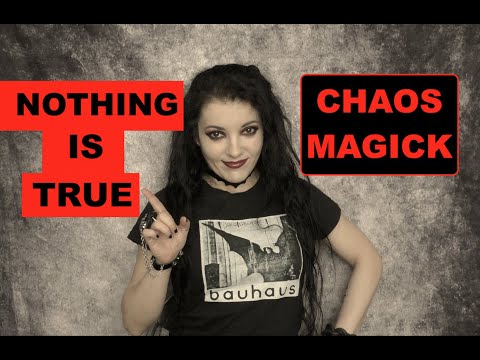
The quote, "Nothing is true, everything is permitted," echoes from the digital halls of pop culture, often misattributed to the essence of Chaos Magick. While it captures a sliver of its spirit, the philosophical landscape of this modern magical paradigm is far richer and more complex. Welcome, seeker, to a deeper exploration of Chaos Magick, a tradition that challenges dogma and empowers the practitioner to become the architect of their own reality. This delve into its philosophical underpinnings is but the first step in your journey, a crucial foundation before we explore the practical applications in future explorations. For those forging their own path, this knowledge is not just academic; it's a blueprint for becoming the practitioner you aspire to be.
If you want to put this into practice, Chaos Magick Sigil Generator guides you step by step.
Chaos Magick, a vibrant current in the magical subculture, emerged from the fertile soil of the United Kingdom in the late 1970s. It is now widely recognized as a potent force on the Left-Hand Path, emphasizing self-transformation and the rejection of externally imposed belief systems. The very term "Chaos" points not to disorder in the mundane sense, but to the primal state of undifferentiated potential, the void from which all reality springs. It is from this abyssal source that practitioners, through the intentional manipulation of consciousness, can draw forth and shape their desired realities. This manipulation is often achieved by accessing altered states of consciousness, a state known in ancient Greek as *gnosis* (γνῶσις), a profound state of knowing or direct experience that bypasses ordinary rational thought. While the modern formalization of Chaos Magick is credited to Peter J. Carroll and Ray Sherwin in the 1970s, its conceptual roots can be traced to the pioneering work of figures like Aleister Crowley, Austin Osman Spare, and Kenneth Grant, whose explorations of will, altered states, and the manipulation of belief laid crucial groundwork.
The philosophy underpinning Chaos Magick is not a monolithic doctrine but rather a dynamic and evolving framework that prioritizes results and individual experience over rigid adherence to any single cosmology or theory. It is a fluid system that encourages experimentation, adaptation, and the creation of unique magical paradigms. This flexibility is one of its most distinguishing features and a core reason for its appeal to a diverse range of practitioners.
CaosThe Nature of "Chaos" in Chaos Magick
The term "chaos" in Chaos Magick is central to its philosophical identity. It does not refer to random, meaningless disorder, but rather to a dynamic, primordial state of potentiality. This is the unmanifested reality, the undifferentiated mass of possibilities from which all form and experience arise. Think of it as the raw, unformed clay of existence before it is shaped by conscious intent. Practitioners seek to access this state of "chaos" not to wallow in it, but to tap into its generative power.
This concept aligns with certain philosophical traditions that posit a formless, primordial ground of being. In many creation myths, the world emerges from a watery abyss or a formless void. Chaos Magick embraces this idea, seeing the unenfirmed potential of chaos as the ultimate source of magical power. By entering states of gnosis, practitioners can temporarily dissolve their ordinary, conditioned sense of self and reality, becoming more receptive to the influence and shaping of this primal potential.
This engagement with "chaos" is not about succumbing to randomness but about reclaiming agency. It is the understanding that by stepping outside of conventional frameworks of belief and perception, one can gain access to deeper, more fundamental levels of reality where change is more fluid and potent. Chaos is the fertile ground of possibility, and the magician is the gardener who cultivates it.
The Pragmatic Imperative: Results Over Belief
Perhaps the most defining philosophical tenet of Chaos Magick is its radical pragmatism. Unlike many traditional magical systems that demand adherence to specific belief structures, pantheons, or rituals, Chaos Magick asserts that belief itself is a tool, not a prerequisite. The efficacy of a magical act is judged by its results. If a technique, symbol, or invocation yields the desired outcome, it is considered valid, regardless of whether the practitioner "truly" believes in the underlying cosmology.
This is often encapsulated in the phrase, "belief is a tool." A Chaos Magickian might adopt a temporary belief system – perhaps that of Egyptian gods, alien intelligences, or even abstract mathematical concepts – for the duration of a working, and then discard it, much like changing clothes. This fluid approach to belief allows for immense flexibility and innovation. It means that a practitioner is not bound by the dogma of any single tradition. They can draw inspiration from any source, whether it be ancient grimoires, modern science fiction, psychological theories, or personal visionary experiences.
This pragmatism is liberating. It frees practitioners from the often-arduous task of conforming to pre-existing belief structures and empowers them to actively experiment and discover what works for them. The focus shifts from faith to efficacy, from adherence to exploration. This is why Chaos Magick is often described as results-oriented and experimental. The magician becomes an experimental scientist of the supernatural, rigorously testing hypotheses and refining techniques based on observable outcomes.
The Principle of "Belief as a Tool" and Its Implications
The idea of treating belief as a malleable tool has profound implications for magical practice. It reframes the relationship between the magician and their reality. Instead of being a passive recipient of cosmic laws or divine will, the magician becomes an active shaper, using belief as a lens through which to focus their will and influence the flow of events.
Consider the creation of a sigil. Traditionally, the power of a sigil is often linked to the specific meaning of the symbols used or the alignment with supernatural forces. In Chaos Magick, the sigil's power is understood to derive from the practitioner's focused intent, their ability to bypass the conscious censor, and their capacity to imbue the symbol with energetic charge, often during a state of gnosis. The "meaning" can be as simple as a coded statement of intent, and the "power" comes from the psychological and energetic mechanisms that the practitioner activates.
This instrumental approach to belief also allows for personal evolution. As a practitioner gains experience and understanding, their belief systems can adapt and change, reflecting their growing insights. This is not seen as a betrayal of past beliefs, but as a natural progression of self-development. The magician learns to wield different cosmologies like different keys, unlocking specific potentials or navigating particular energetic landscapes as needed.
Gnosis: The Bridge Between Consciousness and Chaos
If Chaos Magick empowers the practitioner to shape their reality, then gnosis is the bridge that connects the conscious will to the latent potential of chaos. Gnosis is not merely altered consciousness; it is a specific type of altered state characterized by an intense focus of awareness and a temporary inhibition or suspension of the rational mind. This state is crucial for bypassing the conscious censor, the part of the mind that is accustomed to filtering perceptions and beliefs, and allows for the direct implantation of intent into the subconscious or the broader magical matrix.
There are various methods for inducing gnosis, often categorized as either "inhibitory" (striving to inhibit the mind) or "overload" (overwhelming the mind with stimuli). Inhibitory methods might include deep meditation, breath control techniques, or trance states. Overload methods could involve intense chanting, ecstatic dancing, sensory deprivation/overstimulation, or engaging in deeply analytical or repetitive tasks while simultaneously focusing on the magical intent. Peter J. Carroll, a key figure in Chaos Magick, famously described gnosis as a "state of intense focus of consciousness where conscious inhibition is suspended," and it is this suspension that allows magical work to bypass the limitations of ordinary waking consciousness.
The importance of gnosis cannot be overstated. It is the engine that drives magical change. Without this altered state, the conscious intent, however strong, may struggle to manifest effectively in the world. The ability to consistently and reliably enter states of gnosis is a hallmark of a proficient Chaos Magickian. It is the crucial intermediary step that transforms belief and intention into tangible results by bridging the gap between the magician's inner world and the external manifestation of their will.
Iconoclasm and Perennialism: Embracing Contradictions
Chaos Magick's philosophical stance is often characterized by a fascinating interplay between iconoclasm and perennialism. Iconoclasm refers to the rejection of established beliefs, symbols, and authorities. Chaos Magickians are encouraged to question, dismantle, and deconstruct traditional religious, spiritual, and magical dogmas. They are urged to smash the idols of conventional thinking and to forge their own understanding of reality. This iconoclastic impulse is what drives the exploration beyond established traditions and the embrace of novel methods.
Simultaneously, Chaos Magick exhibits a form of perennialism – the idea that underlying truths or wisdom exist across diverse magical and religious traditions. While iconoclastic in its rejection of dogma, it is perennialist in its willingness to borrow, adapt, and synthesize elements from any tradition that proves effective. A Chaos Magickian might draw upon the archetypal imagery of Egyptian gods for one working, the symbolic language of quantum physics for another, and the structure of a Buddhist meditation for a third. This is not seen as syncretism in the traditional sense, but as a radical eclecticism driven by pragmatic utility.
This embrace of contradiction is key. Chaos Magick recognizes that reality itself is rife with paradox. The universe is not a neatly ordered, easily decipherable system. By embracing paradox and contradiction, practitioners can tap into a more fluid and dynamic understanding of existence, one that is less bound by linear logic and more open to emergent possibilities. This intellectual flexibility allows them to hold seemingly opposing ideas simultaneously, leveraging them for magical effect.
Chaos Magick and Science: A Symbiotic Relationship
The relationship between Chaos Magick and science is often one of mutual respect and influence. While magic operates beyond the current scope of empirical scientific validation for many phenomena, Chaos Magick draws heavily on scientific concepts and methodologies. The scientific method itself – observation, hypothesis, experimentation, refinement – is deeply embedded in the Chaos Magickian's approach.
Concepts from physics, such as quantum entanglement, observer effects, and information theory, are often used metaphorically and sometimes even operationally within Chaos Magick. The idea that observation can influence reality, or that seemingly disparate elements can be linked by non-local connections, resonates with magical principles. Likewise, neurobiology and psychology, particularly theories on consciousness, belief formation, and altered states, provide frameworks for understanding how magical effects might be produced through psychological and neurological mechanisms.
This engagement with science is pragmatic. It seeks to understand the underlying mechanisms of magic through the lens of current scientific understanding, not to prove magic as science, but to better inform magical practice. It allows for the integration of new discoveries and conceptual models into magical theory and technique, keeping the tradition dynamic and forward-looking. It is a testament to the tradition's adaptability that it can embrace both the ancient mysteries of gnosis and the cutting-edge insights of modern science, finding common ground in the exploration of reality's deeper structures.
The Role of the Practitioner: Creator of Meaning and Reality
In Chaos Magick, the practitioner is not a supplicant seeking favor from external deities or forces. Instead, they are an active participant, a co-creator of their own reality. The emphasis is on personal power, self-deification, and the cultivation of individual will. The magician is the sovereign of their own universe, responsible for the creation of meaning, the definition of their goals, and the execution of their magical workings.
This empowers the individual immensely. It shifts responsibility from external entities to the practitioner, fostering a sense of agency and self-reliance. The journey of a Chaos Magickian is one of continuous self-discovery and self-creation. They are encouraged to explore their own potential, to challenge their own limitations, and to define their own spiritual path. This path is not predetermined; it is actively constructed through conscious choice, experimentation, and the relentless application of will.
The philosophical underpinnings of Chaos Magick, therefore, converge on a powerful message: the universe is a malleable construct, and consciousness is the primary tool for its shaping. By understanding the nature of chaos as potential, embracing belief as a tool, harnessing gnosis, and engaging with the world through iconoclasm and a dynamic perennialism, the practitioner can unlock profound levels of personal power and effect meaningful change in their lives and the world around them.
FAQ: Frequently Asked Questions
What is the primary philosophy of Chaos Magick?
The core philosophy of Chaos Magick is pragmatism and the belief that "belief is a tool." It emphasizes results over adherence to specific doctrines and encourages practitioners to experiment with different systems and cosmologies, using what works for them to achieve their desired outcomes.How does Chaos Magick define "Chaos"?
In Chaos Magick, "Chaos" refers to the primordial state of unmanifested potential, the boundless source from which all reality arises. It is not random disorder but a dynamic, generative force that practitioners can access through altered states of consciousness (gnosis) to shape their reality.What is "gnosis" in the context of Chaos Magick?
Gnosis is a state of intense focus of consciousness where the rational mind's inhibitory functions are suspended. It is a crucial state for bypassing the conscious censor and directly implanting magical intent into the subconscious or the broader magical matrix, enabling magical effects.How does Chaos Magick handle different belief systems or traditions?
Chaos Magick is radically eclectic. It borrows and adapts techniques and symbolism from any source – ancient traditions, modern science, pop culture, personal visions – as long as they prove effective. Belief is treated as a tool, temporarily adopted and discarded as needed, rather than a fixed dogma.What is the role of the individual practitioner in Chaos Magick?
The practitioner is seen as the primary agent of change, the sovereign of their own reality. The focus is on personal power, self-deification, and the cultivation of individual will, empowering the practitioner to actively shape their experiences and manifest their desires.How does Chaos Magick relate to science?
Chaos Magick often engages with scientific concepts, such as quantum physics and neurobiology, as metaphors or frameworks for understanding magical processes. It draws upon the scientific method of experimentation and refinement to test magical hypotheses, viewing science as a source of valuable insights for magical practice.What does "Nothing is true, everything is permitted" mean in Chaos Magick?
While often a popular soundbite, this phrase is interpreted in Chaos Magick not as a license for nihilism, but as an assertion of radical freedom from dogma and external authority. It means that established beliefs are conventions, not absolute truths, and the practitioner is free to construct their own meaningful reality and ethical framework.Can I use scientific theories in my magic?
Absolutely. Chaos Magick encourages the integration of scientific concepts into magical practice. For example, understanding quantum observer effects can inform how focusing intent might influence reality, or knowledge of neuroplasticity can provide insights into altering belief patterns.Is Chaos Magick considered a "Left-Hand Path" tradition?
Yes, Chaos Magick is generally considered a Left-Hand Path tradition. This means it emphasizes individual sovereignty, self-transformation, and often involves working with archetypal forces traditionally considered "dark" or transgressive, rejecting externally imposed moral or spiritual structures.How does Chaos Magick differ from traditional magic systems?
Its key differences lie in its lack of fixed dogma, its pragmatic approach to belief, its emphasis on individual experimentation and results, and its radical eclecticism. Chaos Magick empowers the practitioner to be their own authority and to create their own magical systems.Arsenal of the Modern Mage
To navigate the currents of chaos and harness its potential, a practitioner requires tools that facilitate both theoretical understanding and practical application. The digital age has provided an unprecedented array of resources that can amplify magical intent and streamline ritualistic work.
* Essential: Chaos Magick Sigil Generator — While the philosophical foundations of Chaos Magick emphasize the practitioner's inner power, tools that aid in the creation and charging of magical implements can be invaluable. This generator automates the complex process of converting intent into a sigil, allowing you to focus your limited conscious energy on the crucial step of gnosis. Instead of spending hours wrestling with symbolic language or artistic skill, you can generate potent sigils in moments, freeing up your time and mental energy for the actual magical work. It’s the perfect solution when you need to manifest quickly and efficiently, bypassing the usual hurdles of sigil creation. * Recommended Reading: *Liber Null & Psychonaut* by Peter J. Carroll. This foundational text delves into the theory and practice of Chaos Magick, offering deep insights into its philosophical underpinnings and practical techniques. * Recommended Reading: *Condensed Chaos* by Phil Hine. A more accessible entry point to Chaos Magick, offering a broad overview of its principles and practices. * Recommended Reading: *The Book of Pleasure* by Austin Osman Spare. A seminal work exploring the art of sigil creation and the manipulation of consciousness. * Journal: A dedicated journal for recording sigils, intentions, states of gnosis, results, and reflections is indispensable for tracking progress and refining techniques. Whether digital or physical, a consistent record is a powerful aid. * Mindfulness/Meditation App: Apps that guide meditation, breathwork, or provide ambient soundscapes can be instrumental in developing and accessing states of gnosis. Consistent practice in quieting the rational mind is key.
About the author: Frater Alek0s is a veteran practitioner and researcher in the field of chaos magick. His work focuses on the practical and experimental application of occult techniques for self-development and reality exploration, demystifying esotericism for the modern practitioner.
Exploring the Currents: Your Next Steps
As you integrate these philosophical concepts, consider how they resonate with your own experiences and aspirations. The journey into Chaos Magick is a personal one, characterized by exploration and self-discovery.
Have you encountered the idea of "belief as a tool" in other traditions, or perhaps in your own life? What are your thoughts on accessing "chaos" as a source of potential? Share your insights and experiences in the comments below. Your perspective adds another thread to the ever-expanding tapestry of this practice. If this exploration into the philosophical roots of Chaos Magick has sparked your curiosity, consider sharing it with fellow seekers who might benefit from this perspective. The journey of understanding is always more potent when shared.
For those ready to move from philosophy to practice, remember the tools that can accelerate your path. When you're ready to craft your intentions into potent symbols, the Chaos Magick Sigil Generator is ready to assist you in manifesting your will with speed and precision.
The Chaos Magick Sigil Generator tool, part of the cha0smagicklabs ecosystem, is built exactly for this kind of work.
---
Referencias
- Mircea Eliade (1957). The Sacred and the Profane. Harcourt Brace.
- Karen Armstrong (1993). A History of God. Alfred A. Knopf.
- Joseph Campbell (1949). The Hero with a Thousand Faces. Pantheon Books.
- Rudolf Otto (1917). The Idea of the Holy. Oxford University Press.
- William James (1902). The Varieties of Religious Experience. Longmans, Green and Co..
- Huston Smith (1958). The World's Religions. Harper & Row.
- James George Frazer (1890). The Golden Bough. Macmillan.
- Rene Guenon (1927). The Crisis of the Modern World. Sophia Perennis.
- Carroll, P. J. (1987). Liber Null & Psychonaut. Weiser Books.
- Spare, A. O. (1913). The Book of Pleasure. Self-published.
No hay comentarios:
Publicar un comentario