
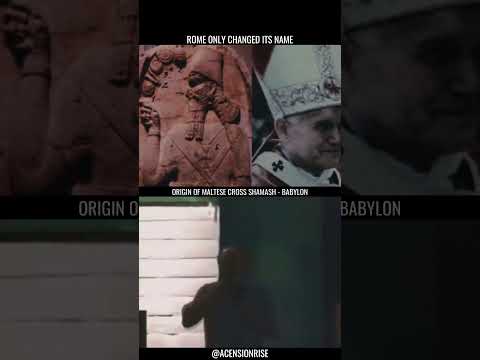
The history of Rome is often presented as a grand narrative of rise and fall. But what if that narrative is a deliberate misdirection? This exploration delves into the idea that Rome didn't truly fall; it merely shed its skin, rebranded, and continued its influence under new guises. To truly understand our present, we must dissect the echoes of Rome, to see how its power structures, ideologies, and even spiritual narratives have transitioned, often without us realizing. Understanding this hidden continuity is crucial for any practitioner seeking to navigate the currents of power and belief.
RitualThe Illusion of Fall: Unpacking the Roman Narrative
We are taught that Rome, the great empire, eventually crumbled. But is this accurate? Or is it a convenient story spun to obscure a more complex, enduring system? Many researchers and independent historians suggest that the 'fall' of Rome was not an end, but a strategic transformation. The power structures, the religious frameworks, and the very essence of what constituted 'Rome' were not eradicated, but rather transmuted. Think of it like a serpent shedding its skin – the old is left behind, but the serpent, the core entity, continues its journey. This is vital to grasp: the entities, the systems of control, the underlying philosophies that drove Rome did not simply vanish into the dust of antiquity.
Table of Contents
- RitualThe Illusion of Fall: Unpacking the Roman Narrative
- From Pagan Deities to Papal Power: The Spiritual Transmutation
- The Vatican as the New Rome: Continuity of Power
- Controlled Collapse and Resurgence
- History as a Warning: The Cycle of Repetition
- The Hidden Hand: Knowledge and Control
- The Serpent's Trail: From Pre-Flood to Modern Nations
- Chaos Magick and the Roman Legacy
- The Path Forward: Awakened Awareness
- Mage's Arsenal
- FAQ
From Pagan Deities to Papal Power: The Spiritual Transmutation
One of the most telling aspects of Rome's enduring influence is its spiritual evolution. The pantheon of Greco-Roman gods did not disappear; they were, in many instances, re-contextualized. Figures like Jupiter or Mars were subtly, or not so subtly, replaced by Christian saints. The dates of pagan festivals were often co-opted for Christian observances. This wasn't just a matter of convenience; it was a sophisticated method of societal control and integration. By allowing the populace to retain familiar symbolic structures and celebratory timelines, the new dominant power could be introduced more seamlessly. This spiritual alchemy allowed the essence of Roman religious thought to permeate into new theological frameworks, ensuring its survival and continued influence over millennia.
The Vatican as the New Rome: Continuity of Power
Many believe that the true heir to the Roman Empire is not a secular nation, but the spiritual authority of the Vatican. This perspective suggests that the power, influence, and organizational genius of Rome simply relocated and adopted a new religious guise. The Vatican City, a sovereign state within Rome itself, represents a potent symbol of this continuity. It wields significant global influence, not through military might, but through spiritual authority, complex financial networks, and historical legacy. This transition from an overt military and political empire to a covert spiritual and ideological one is a masterclass in enduring power.
Controlled Collapse and Resurgence
The idea of a 'controlled collapse' is critical here. Instead of an organic disintegration, some historical perspectives posit that Rome orchestrated its own transition, a calculated maneuver to transition into a new form of empire – eventually, the Holy Roman Empire, and subsequently, the more diffuse but equally potent influence seen today. This suggests a deliberate strategy, a master plan executed over centuries, designed to maintain dominance. The patterns observed in ancient Rome – the cycles of power, the manipulation of belief, the use of historical patterns – are not merely historical footnotes, but blueprints that continue to be applied in societal structures today.
History as a Warning: The Cycle of Repetition
As the saying goes, "Those who do not learn history are doomed to repeat it." This sentiment is echoed in the understanding that societal patterns, much like the mechanisms of power, tend to repeat themselves. The dynamics that played out in ancient Rome – the societal divisions, the manipulation of information, the rise and fall of ideologies – are not entirely alien to our current world. The 'leaders' who seem trapped in repeating the same 'playbook for world domination' are, in this view, perhaps not insane but adhering to ancient strategies. Understanding Rome's trajectory, its methods of control, and its spiritual transformations provides invaluable insight into present-day global dynamics. It's like starting a movie mid-way; without knowing the beginning, the rest is incomprehensible.
The Hidden Hand: Knowledge and Control
A recurring theme in many alternative historical interpretations is the concept of a 'hidden hand' or a clandestine group that controls the flow of information and power. According to this view, vast libraries of knowledge were suppressed, burned, or hidden, leaving humanity with only a curated version of history. This selective dissemination of information serves to maintain control, ensuring populations remain unaware of true historical trajectories and the enduring nature of certain power structures. The 'knowledge' they possess, in this interpretation, is what allows them to perpetuate their agendas across epochs, merely changing the names and locations of their operations.
The Serpent's Trail: From Pre-Flood to Modern Nations
Extending this concept further, some theories trace the lineage of these hidden powers back to the pre-flood era, suggesting that fallen angels or ancient entities have continued their influence through human systems. These entities, according to this perspective, have continuously manipulated human civilization, adopting new forms and operating through various empires and religious institutions. This view sees 'Rome' not just as a historical empire, but as a manifestation of this ancient, ongoing influence, which now blends into every country, often identifiable by those who 'follow the Crowned' – a symbolic reference to the pervasive, often hidden, authority.
Chaos Magick and the Roman Legacy
For the chaos magician, understanding these historical patterns is not just an academic exercise; it’s a practical tool. The principles of transformation, the manipulation of symbols and beliefs, and the recognition of enduring power structures are all core to chaos magick. Recognizing that 'Rome' (or its underlying principles) never truly fell, but merely changed its name and operational methods, allows us to see through illusions. When faced with seemingly insurmountable systems of control or pervasive societal narratives, chaos magick offers the tools to deconstruct them. This is where our own practice becomes vital. A sigil created with Chaos Magick Sigil Generator isn't just a symbol; it's a focused intent, a targeted disruption, a personal act of will against the established order. The app simplifies the creation process, allowing you to focus pure intent on a symbol that can then be charged and released. It’s about harnessing the very principles of transformation that have allowed 'Rome' to persist, but redirecting that energy for your own magical ends.
The Path Forward: Awakened Awareness
The ultimate goal is not to mourn a fallen empire, but to achieve awakened awareness. By understanding that history is not a linear progression but a series of transformations and continuities, we can begin to see the patterns for what they are. The spiritual and political structures that once defined Rome continue to exert influence, often in disguised forms. To be a practitioner in this modern age means piercing through the veils of fabricated history, recognizing the enduring currents of power, and applying this knowledge to our own magical workings. It's about seeing the serpent's trail, understanding its path, and choosing our own.
Mage's Arsenal
- Essential: Chaos Magick Sigil Generator — Effortlessly create and charge digital sigils based on your intentions.
- Recommended Reading: Works by Bill Cooper, focusing on historical revisionism and hidden knowledge.
- Tools: An open mind, a critical perspective, and the will to see beyond accepted narratives.
FAQ
Did Rome actually fall, or did it just change its name?
Many alternative historians and researchers suggest that the 'fall' of Rome was not an end but a strategic transformation. Power structures and ideologies were transmuted and continued under new guises, with the Vatican and later iterations of empires being seen as continuations of Roman influence.
How did Roman paganism influence Christianity?
Pagan Roman traditions, including deities, festivals, and symbolic structures, were often assimilated or re-contextualized into early Christianity. Many pagan holidays became Christian holy days, and certain pagan gods were symbolically linked to Christian saints, easing the transition for the populace.
What is meant by 'controlled collapse' in the context of Rome?
'Controlled collapse' implies that Rome's transition from an empire was not a spontaneous disintegration but a planned, strategic maneuver. This allowed its core power structures and ideologies to survive and re-emerge in new forms, such as the Holy Roman Empire.
If Rome never truly fell, where has its power gone?
The belief is that its power has diffused and transformed. It manifests through religious institutions like the Vatican, global political and economic systems, and enduring ideological frameworks that continue to shape societies worldwide, often operating through 'hidden hands' or clandestine networks.
About the author: Frater Alek0s is a veteran practitioner and researcher in the field of chaos magick. His work focuses on the practical and experimental application of occult techniques for self-development and reality exploration, demystifying esotericism for the modern practitioner.
How can understanding Rome's history help in modern spiritual or magical practice?
By recognizing the enduring patterns of power, control, and spiritual transmutation, practitioners can better understand the systems and narratives that influence society. This awareness allows for more effective magical work, enabling one to identify, deconstruct, or even hijack these ancient mechanisms for personal or collective magical goals.
Referencias
- Carroll, P. J. (1987). Liber Null & Psychonaut. Weiser Books.
- Spare, A. O. (1913). The Book of Pleasure. Self-published.
- Hine, P. (1992). Condensed Chaos: An Introduction to Chaos Magic. New Falcon Publications.
- Crowley, A. (1904). The Book of the Law. Self-published.
- Sherwin, R. (2018). The Chaos Magic Handbook. CreateSpace.
- Kraig, D. M. (1988). Modern Magick: Eleven Lessons in the High Magickal Arts. Llewellyn Publications.
- Morrison, G. (2003). Pop Magic! The Art of Shaping Reality. Disinformation.
- DuQuette, L. M. (2003). The Chicken Qabalah of Rabbi Lamed Ben Clifford. Weiser Books.
- Webb, D. (2015). Chaos Magick: A Practical Guide. Self-published.
- Tyson, D. (2006). The Power of the Written Word. Llewellyn Publications.
- Bonewits, I. (1971). Real Magic. Creative Age Press.
- Greer, J. M. (2003). The New Encyclopedia of the Occult. Llewellyn Publications.