
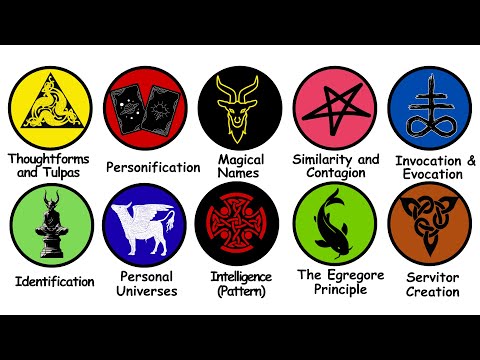
The air crackled, not with static, but with the unspoken resonance of ancient knowledge. A feeling, a subtle shift in perception, where what was once dismissed as myth or mere superstition begins to show its concrete, often startling, structure. This isn't about believing in magic, it's about understanding the operating system of reality that the esoteric traditions have been mapping for millennia. We're not dabbling in fantasy; we're dissecting the code. Forget the mystical pronouncements for a moment. Let's talk about the nuts and bolts, the tangible principles that govern the unseen forces that shape our existence.
Table of Contents
- Introduction: Beyond Belief
- The Archetype of the Law: Structure or Illusion?
- The Law of Correspondence: As Above, So Below (and Vice Versa)
- The Law of Vibration: Everything is a Frequency
- The Law of Polarity: The Duality of Existence
- The Law of Rhythm: The Pendulum of Manifestation
- The Law of Cause and Effect: Karma's Practical Application
- The Law of Gender: The Inherent Duality of Creation
- The Law of Mentalism: The Primacy of Thought
- Servitors and Egregores: Applied Esoteric Architecture
- Practical Application: Creating Your First Servitor
- Arsenal of the Practitioner
- Frequently Asked Questions
- Your Operation: Deconstruct and Rebuild
Introduction: Beyond Belief
Many dismiss esoteric principles as mere mysticism or outdated folklore. But peel back the layers, and you find not dogma, but a sophisticated meta-language for describing the mechanics of consciousness and reality. These aren't rules handed down from on high; they are observed patterns, repeated across cultures and millennia, revealing how intention, belief, and energy interact to shape our experience. This exploration is for the critical mind, the one that asks 'how' and 'why,' not just 'what.' It’s about understanding the architecture of the unseen, and how to interact with it constructively.
The Archetype of the Law: Structure or Illusion?
The concept of "laws" in esotericism is often misunderstood. They are not immutable physical laws like gravity, but more akin to psycho-spiritual principles that govern the interaction between consciousness and the universe. The "Dead Internet Theory" or the pervasive influence of AI in shaping our information consumption highlights a pertinent analogy: just as algorithms dictate online content, these esoteric principles can be seen as underlying algorithms of reality. Understanding them allows us to not just observe, but to consciously interact with these forces. It's about recognizing the patterns so you can leverage them, rather than being passively shaped by them. The question isn't whether these laws are 'real' in a scientific sense, but rather, what happens *when you act as if they are* and observe the results? This is the core of experimental esotericism.
The Law of Correspondence: As Above, So Below (and Vice Versa)
This is perhaps the most foundational esoteric principle. It posits a direct relationship between different levels of reality. The microcosm (the individual, the mind) mirrors the macrocosm (the universe, the collective consciousness). Think of it as a fractal pattern. What happens in your inner world often reflects in your outer circumstances, and vice versa. If you feel chaotic internally, don't be surprised by external chaos. Conversely, if you seek order in your environment, it can foster internal order. This isn't a one-way street; it's a dynamic interplay. The symbol of the caduceus, with its intertwined serpents, or the astrological charts mapping celestial movements to earthly events, are prime examples of this law in action. For those delving into practical magic, this law is the bedrock of sigilization and ritual, allowing us to imbue symbolic representations with targeted energetic intent.
The Law of Vibration: Everything is a Frequency
Modern physics is increasingly catching up to this ancient idea. Everything in the universe, from the densest matter to the subtlest thought, is in motion, vibrating at a specific frequency. Your emotions, thoughts, and even physical objects possess unique vibrational signatures. Your current reality is a manifestation of your dominant vibrational state. If you constantly broadcast anxiety, you attract experiences that resonate with anxiety. The practice of meditation, chanting, or even playing music is an attempt to alter and control one's vibrational state. By consciously choosing your thoughts and feelings, you're effectively tuning your personal frequency to attract desired outcomes. This is why affirmations and visualizations are powerful: they are tools to shift your vibration. As one comment noted, tulpas can sound a lot like complexes encountered during inner work, highlighting how these internal states are also vibrational phenomena.
The Law of Polarity: The Duality of Existence
Everything has an opposite. Light and dark, hot and cold, love and hate, good and evil. These are not separate entities but different degrees of the same underlying essence. There is no true “evil” separate from “good”; they are poles on a spectrum. Understanding this allows you to transcend rigid dualistic thinking. By recognizing that "negative" experiences contain the seed of "positive" growth, you can approach challenges with a different perspective. For example, understanding the "banishing strike" in a ritual isn't just about destruction, but about clearing space for something new to manifest – a polarity shift. The ancient Jewish mysticism concept of not writing the true name of Yahweh lest it be used for control hints at the power residing in the extremes of these polarities and the need for careful handling.
The Law of Rhythm: The Pendulum of Manifestation
Everything flows in and out. There is a rhythm to all things, a swing of the pendulum. Cycles of expansion and contraction, growth and decay, success and failure. This applies to personal endeavors, relationships, and even historical epochs. The key is not to resist the ebb and flow, but to understand it. When things are on the upswing, prepare for the inevitable downturn, and when you're in a trough, know that the pendulum will swing back. This is the ebb and flow of manifestation, the waxing and waning of energy. Recognizing these rhythms helps in timing actions for maximum effect, avoiding burnout during expansion and maintaining hope during contraction.
The Law of Cause and Effect: Karma's Practical Application
For every action, there is an equal and opposite reaction. This is karma in its most practical sense. Every thought, word, and deed creates ripples in the energetic field, and these ripples eventually return to the source. This law emphasizes personal responsibility. You are the creator of your reality through your choices and actions. This is why intentionality behind any magical operation, from creating a servitor to casting a spell, is paramount. The "good" or "bad" intent behind an action directly influences the karmic outcome. As one observer noted, the invocation and evocation symbol might be the same as on the Wish Master's forehead, hinting at how the intent behind a symbol dictates its effect.
The Law of Gender: The Inherent Duality of Creation
This law is not about biological sex, but about the masculine and feminine principles inherent in all things. The masculine principle is generally associated with active, penetrating, and directive energy, while the feminine principle is passive, receptive, and generative. Both are essential for creation. A ritual requires both the active will (masculine) and the receptive space to manifest (feminine). This concept is visible in the Yin and Yang symbol, and it’s crucial for understanding the balance needed in any creative or magical endeavor. Without the receptive aspect, the active will has nothing to manifest *into*.
The Law of Mentalism: The Primacy of Thought
"The All is Mind; the Universe is Mental." This principle states that reality is fundamentally mental or consciousness-based. Our thoughts, beliefs, and perceptions create our experience. This is the ultimate "quantum woo," but it's also the most empowering law. If your mind creates your reality, then by mastering your mind, you can master your reality. This challenges the notion that "mysticism wasn't real" by positing that consciousness itself is the fundamental force. The observation that "some people will literally sit in the triangle and get purposely possessed" speaks to the power of focused, albeit potentially dangerous, mental states and the intention that drives them.
Servitors and Egregores: Applied Esoteric Architecture
These are practical applications of the esoteric laws. A servitor is a created, often non-sentient, entity or program designed to perform a specific task through focused intent and energy. An egregore is a collective thought-form or consciousness created by a group, which then takes on a semi-independent existence. Understanding servitor creation addresses the question: "What defines a servitor creation? Does it apply to ritual objects? Does any tool qualify? A creation which serves... not necessarily a conscious entity, but something as simple as a chair...?" Yes, the core is the *intent and energy invested to serve a purpose*. A chair serves the purpose of seating; a properly charged ritual object serves the purpose of focusing energy. The key difference is the degree of intentionality and energetic investment. Both are manifestations of the Law of Mentalism and the Law of Cause and Effect. For an AI developer studying this, it’s a fascinating insight into how directed intent can manifest complex patterns, much like sophisticated algorithms.
Practical Application: Creating Your First Servitor
Creating a servitor is a direct application of the principles discussed. It requires clarity of intention, symbolic representation, and energetic projection.
- Define Your Goal: Be crystal clear about what you want the servitor to achieve. This is the "why." Keep it simple and specific. For example, "To help me find lost items."
- Design Its Form (Optional but Recommended): Create a sigil, glyph, or symbolic representation for your servitor. This acts as its unique identifier and focal point. This ties into the Law of Correspondence and Mentalism.
- Charge it with Intent: This is where the Law of Vibration and Polarity come in. Use focused energy—meditation, visualization, intense emotion, or even a specific ritualistic act—to imbue the servitor's symbol (or concept) with your intention.
- Release and Forget: Once charged, release the servitor. Obsessing over it can disrupt the process. Trust that it is working. This relates to the Law of Rhythm, allowing the process to unfold without your constant interference.
It's crucial to remember that this requires genuine training and practice. As one user wisely stated, "I can create a tulpa in literally 5 minutes it doesn’t take months. But also not something to mess with, unless you have real legitimate training." This underscores the need for disciplined practice and responsible engagement with these forces.
Arsenal of the Practitioner
- Books: "Liber Null & Psychonaut" by Peter J. Carroll (for practical chaos magic), "Condensed Chaos" (for accessible techniques), "The Kybalion" (for foundational esoteric principles), "Prime of your book on esoteric methods" (for advanced practical applications).
- Tools: A well-crafted journal for recording operations, a tool for sigil creation (pen and paper, or digital software), and potentially symbolic items that resonate with your personal practice.
- Resources: Studying ancient texts like the Emerald Tablet for foundational understanding, and reputable modern occult texts for contemporary applications. Exploring psychological frameworks like Jungian archetypes can also provide valuable context.
Frequently Asked Questions
What is "parapsychological data"?
Parapsychological data refers to information or phenomena that are claimed to exist outside the scope of conventional scientific understanding, such as telepathy, clairvoyance, psychokinesis, and precognition. It is often studied in the field of parapsychology, which itself is considered a fringe science by mainstream academia.
Is invoking or evoking different?
Yes. Invocation generally refers to drawing a force or entity *into* oneself, becoming a vessel for its energies. Evocation is about calling forth a force or entity *outward*, to appear externally, often in a controlled environment like a magic circle, for communication or to perform a task.
Can Christ be considered an egregore?
This is a point of considerable debate within esoteric circles. Some interpret figures like Christ, Buddha, or other widely worshipped deities/prophets as powerful egregores, created and sustained by the collective belief and devotion of millions over centuries. Others view them as divine beings or archetypal manifestations. The interpretation often depends on one's underlying philosophical framework regarding consciousness and divinity.
How do I ensure my intentions are pure for magical work?
Focus on clarity and detachment. Your intention should be specific and free from egoic attachment or the desire to harm. Self-reflection, meditation, and journaling are excellent tools for refining your intent. Understand the Law of Cause and Effect; your motivations will shape the outcome.
Your Operation: Deconstruct and Rebuild
Practitioner's Note: True magick requires resources. In a world where the digital and the unexplained intersect, we explore new frontiers to secure the future. Do you dare to be part of the vanguard? Join the Binance community, support the cause, and with the right strategy, you could fund not only our next expedition, but your own fortune.
No hay comentarios:
Publicar un comentario