
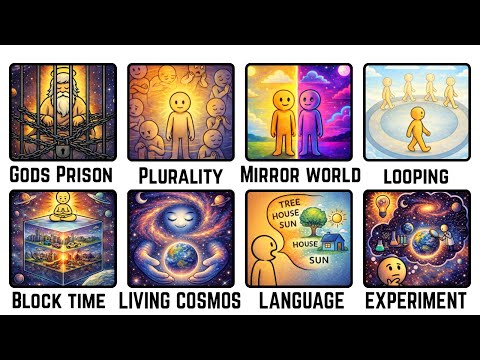
The illusion of freedom is a comfortable lie. But what if existence itself is not a boundless expanse, but a meticulously crafted prison? Not a physical confinement, but a psychological and metaphysical trap designed to contain… something. Or someone. Forget pleasant platitudes and gurus promising enlightenment; we're dissecting the cold, hard, and deeply unsettling notions that suggest reality, as we perceive it, is a sophisticated cage. This isn't about finding solace, but about confronting uncomfortable truths that challenge the very fabric of your being. Prepare for a descent into theories that propose reality is a prison—for God, for consciousness, or for existence itself.
Tabla de Contenidos
- 0:00 The Prison of the Divine: Is God Confined?
- 1:12 The Echoes Within: Multiple Selves and Shared Existence
- 2:37 Worlds Apart: The Concept of Mirror Realities
- 3:52 The Infinite Cycle: Nietzsche's Eternal Recurrence
- 4:48 Frozen in Time: The Block Universe Paradigm
- 5:56 The Sentient Universe: A Cosmic Consciousness
- 6:56 The Architects of Perception: Language and the Law of Assumption
- 7:52 Reality as a Simulacrum: The Universe as a Thought Experiment
0:00 The Prison of the Divine: Is God Confined?
The notion of a celestial being, omnipotent and omnipresent, is a cornerstone of many belief systems. Yet, what if this divine entity isn't the jailer, but the prisoner? This perspective posits that the universe we inhabit is a construct, a containment field designed to restrict a higher power. The implications are staggering: our entire existence could be a manifestation of this divine confinement, a cosmic holding cell. It forces us to question the nature of divinity and our role within its perceived limitations. Are prayers whispers to a captive god? Are miracles the futile attempts of a bound entity to communicate or escape? This idea transforms the divine from an overseer into a fellow inmate, a profound inversion of theological dogma.
"The unexamined life is not worth living." - Socrates. When the very nature of life is questioned, the examination becomes paramount.
1:12 The Echoes Within: Multiple Selves and Shared Existence
Consider the disquieting possibility that you are not a singular entity, but one iteration in a continuous cycle of consciousness. Imagine multiple versions of "you" taking turns occupying this body, like actors in a play, each with their own memories and experiences. This theory, reminiscent of concepts like the Egg (a narrative exploring a soul's journey through all lives) or observing distinct personas in dreams, suggests a fragmented self potentially managed by a higher awareness. Some observers report experiencing fleeting, alien memories or lucid dream states where another version of themselves seems to be actively living a separate life. This raises questions about agency, identity, and the continuity of consciousness. Are these mere neurological glitches, or glimpses into a more complex, distributed self?
2:37 Worlds Apart: The Concept of Mirror Realities
Beyond the familiar dimensions lies a spectrum of potential realities, each a reflection or inversion of our own. The concept of "mirror worlds" suggests parallel universes that are eerily similar, yet fundamentally different. Perhaps these are worlds where every choice you *didn't* make has played out, or where physical laws are subtly altered. This isn't mere science fiction; it touches upon the interpretations of quantum mechanics, where multiple outcomes are said to exist simultaneously. It’s the ultimate "what if" scenario made tangible, a cosmic hall of mirrors reflecting infinite possibilities and, perhaps, infinite selves living divergent fates. The thought of these other selves, existing in parallel, can be both fascinating and deeply unsettling.
3:52 The Infinite Cycle: Nietzsche's Eternal Recurrence
Friedrich Nietzsche's concept of the eternal recurrence is a philosophical hammer blow to the linear progression of time. It posits that every moment of your life, in every excruciating detail, will repeat itself infinitely. There is no escape, no progression, only an endless loop. This idea isn't about time travel; it's a thought experiment designed to imbue life with ultimate significance. Would you live your life differently if you knew you had to relive it, exactly as it is, an infinite number of times? The weight of this repetition is immense, transforming every action into an eternal commitment. It’s a stark reminder that how we navigate the present moment is critical, as it is the blueprint for eternity.
"If you wish to understand the universe, think in terms of energy, frequency, and vibration." - Nikola Tesla. This sentiment echoes in the idea of cyclical repetition; patterns of energy and information endlessly cycling.
4:48 Frozen in Time: The Block Universe Paradigm
The "block universe" theory, deeply rooted in physics and Einstein's theories of relativity, shatters our perception of time as a flowing river. Instead, it presents time as a static, four-dimensional block where past, present, and future exist simultaneously. Imagine a loaf of bread: every slice exists at once, but you only experience one slice at a time as you consume it. In this paradigm, what we perceive as the "present" is merely our current slice, but all other slices—all moments—are already there, fixed and immutable. This challenges the notion of free will, as all events are predetermined. The future is not something to be created, but something that already *is*. This raises profound philosophical questions about causality and determinism, turning our perceived dynamic reality into a static monument.
5:56 The Sentient Universe: A Cosmic Consciousness
What if the universe itself is alive? Not merely a collection of stars and planets, but a conscious entity with its own thoughts, perceptions, and perhaps even intentions. This perspective moves beyond a singular, divine creator to a pervasive sentience woven into the fabric of spacetime. Some theories suggest that consciousness is not an emergent property of brains, but a fundamental aspect of the cosmos. Our individual consciousness could be nodes within this grander, universal mind, much like egregores are collective psychic constructs. This transforms our existence from an accidental occurrence to a component of a vast, living experiment. It also brings up the idea that reality might be a thought experiment, a grand meditation by a cosmic intelligence. The sheer darkness of space, often perceived as void, could be the canvas of this immense awareness.
6:56 The Architects of Perception: Language and the Law of Assumption
Our perception of reality is inextricably linked to language. The Sapir-Whorf hypothesis suggests that the structure of a language affects its speakers' worldview and cognition. But what if language isn't just descriptive, but prescriptive? What if our words, our beliefs, and our assumptions actively shape the reality we inhabit? This aligns with concepts like the Law of Assumption, popularized by Neville Goddard, which posits that assuming something to be true is the surest way to manifest it. The idea is that our linguistic constructs become the blueprints for our experienced reality. The universe may not be a prison of matter, but a prison of perception, built by the very language we use to describe it. Consider how often we accept limitations simply because they are articulated as facts.
7:52 Reality as a Simulacrum: The Universe as a Thought Experiment
Perhaps the ultimate form of containment is the realization that our entire existence is an elaborate simulation, a thought experiment conceived by a higher intelligence. This is more than just the simulation hypothesis; it delves into the nature of reality as a mental construct. If the universe is a thought, then everything within it—laws, consciousness, even the perceived "prison"—are merely ideas. This challenges our notions of objective truth and subjective experience. Are our memories real, or data points? Are our emotions genuine, or programmed responses? This profound questioning leads back to the origins of consciousness and the potential for a cosmic mind to be the ultimate experimenter, us being the subjects of its ongoing intellectual exploration.
Arsenal del Mago
- Libros Clave: "Liber Null & Psychonaut" de Peter J. Carroll (para la exploración radical de la Magia del Caos), "Condensed Chaos" (un compendio práctico de técnicas caóticas), "The Kybalion" (para principios herméticos y la naturaleza de la realidad), y para el debate filosófico sobre la existencia, considera obras de Nietzsche y las exploraciones sobre la Hipótesis de la Simulación.
- Herramientas de Reflexión: Un diario robusto es indispensable. Ya sea físico, para las notas más crudas, o digital, para una organización más profunda (considera aplicaciones de Notion o Evernote). Un buen mazo de Tarot, como el de Thoth, puede ofrecer perspectivas simbólicas complejas.
- Recursos Digitales: Explorar canales de YouTube como el que dio origen a estas ideas (con precaución y pensamiento crítico), así como foros y comunidades online dedicadas a la filosofía, la física teórica y el ocultismo, puede proporcionar una visión amplia de las diversas interpretaciones.
Taller Práctico: Tu Experimento de Realidad
- Define Tu Paradigma: Elige UNA de las teorías presentadas (Prisión Divina, Múltiples Yo, Universo Bloque, etc.). Escribe una breve descripción de esta teoría y cómo resonaría contigo si fuera cierta.
- El Experimento de la "Ley de Suposición": Para la teoría elegida, formula una suposición contraria. Por ejemplo, si eliges el "Universo Bloque" (determinismo), tu suposición podría ser: "Mi libre albedrío es absoluto y cada decisión redefine el futuro, creando nuevas líneas temporales."
- Registro de Observaciones: Durante una semana, lleva un diario detallado. Anota cualquier evento, pensamiento, sueño o coincidencia que parezca apoyar o contradecir tu suposición. Busca patrones que refuercen tu nueva creencia.
- Análisis Crítico: Al final de la semana, revisa tu diario. ¿Se manifestaron eventos de forma inusual? ¿Cambió tu perspectiva? ¿O todo se mantuvo dentro de lo esperado, reforzando la teoría original?
- Inferencia Personal: ¿Qué aprendiste de este ejercicio? No busques "ganar" el experimento, sino entender cómo la focalización de la atención y la creencia pueden influir en tu percepción de la realidad.
Preguntas Frecuentes
- ¿Estas teorías son científicas o filosóficas? La mayoría de estas ideas se originan en la filosofía y la metafísica, pero a menudo se cruzan con conceptos de la física teórica (como la relatividad y la mecánica cuántica) y la neurociencia.
- ¿Es posible probar alguna de estas teorías? La naturaleza misma de estas ideas las hace difíciles, si no imposibles, de probar empíricamente con los métodos actuales. Se basan más en la especulación lógica y la introspección.
- ¿Pueden estas ideas ser perjudiciales? Como cualquier exploración profunda de la realidad, pueden ser desorientadoras. Es crucial mantener un anclaje en la vida práctica y evitar caer en la desesperación. La auto-responsabilidad es clave.
- ¿Cómo se relaciona esto con la Magia del Caos? La Magia del Caos opera bajo el principio de que la realidad es maleable y que la creencia es una herramienta. Estas teorías proporcionan un marco para cuestionar la naturaleza de esa maleabilidad y las bases de nuestras creencias.
Tu Operación: Desafía Tu Realidad Percibida
Ahora, la verdadera operación comienza contigo. No te conformes con la descripción. Elige una de las teorías de este post que te haya removido más profundamente. Durante las próximas 48 horas, actúa como si esa teoría fuera la verdad absoluta. ¿Cómo cambiaría tu comportamiento? ¿Qué decisiones tomarías de manera diferente? ¿Cómo interactuarías con los demás, sabiendo que tu realidad podría ser una prisión, un espejo o un sueño cósmico? Documenta cualquier cambio sutil en tu percepción o en los eventos que te rodean. No busques confirmación; busca la experiencia pura de habitar temporalmente un paradigma diferente. La verdadera magia reside en la audacia de cuestionar lo incuestionable.
Practitioner's Note: True magick requires resources. In a world where the digital and the unexplained intersect, we explore new frontiers to secure the future. Do you dare to be part of the vanguard? Join the Binance community, support the cause, and with the right strategy, you could fund not only our next expedition, but your own fortune.
No hay comentarios:
Publicar un comentario