
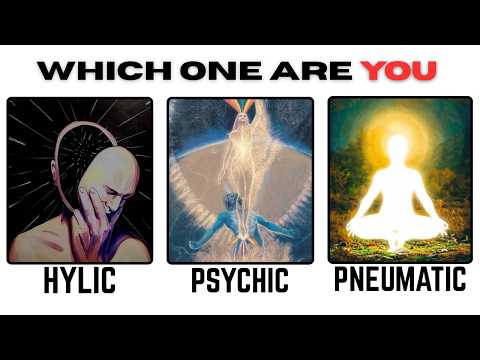
Nearly two millennia ago, a profound early Christian text proposed a startling division of humanity into three distinct spiritual archetypes. Unearthed in 1945 as a cornerstone of the Nag Hammadi Library, the Tripartite Tractate, a seminal work of Valentinian Gnosticism, delves into the genesis of the divine realm, the fragmentation of reality, and the emergence of three fundamental human classifications:
- The Hylic (material-bound)
- The Psychic (soul-driven)
- The Pneumatic (spiritually attuned)
This ancient scripture posits that one's spiritual composition dictates not only their perception of the world but also their ultimate cosmic destiny. This framework offers a potent lens through which to understand individual motivations and societal dynamics. Are you merely a vessel of the material world, a soul navigating the complexities of existence, or a spirit striving for divine reunification?
Understanding the Tripartite Framework
The Valentinian Gnostics, a significant intellectual current within early Christianity, challenged prevailing orthodoxies with their intricate cosmology and anthropology. Their writings, often expressed through allegorical narratives and philosophical discourse, sought to unlock esoteric truths about the nature of reality and humanity's place within it. The Tripartite Tractate stands as a testament to this pursuit, offering a detailed map of the spiritual topography of human existence.
The Hylic: Bound to the Material
The Hylics represent the lowest stratum of spiritual awareness. Their consciousness is almost entirely immersed in the material plane, with little to no recognition or yearning for the divine or spiritual realms. For the Hylic, the physical world is the sole reality, and their existence is dictated by base desires, material possessions, and immediate gratification. Gnostic thought suggests that Hylics are largely unaware of their spiritual potential, if any, trapped in a cycle of sensory experience and physical needs. This perspective can be seen as a critique of purely materialistic worldviews, highlighting the limitations of a life devoid of spiritual inquiry.
From a modern psychological standpoint, this archetype might resonate with individuals exhibiting extreme materialism, a lack of introspection, or an inability to connect with abstract concepts or deeper emotional states. The Gnostic view is stark: for the Hylic, salvation or awakening is often considered exceptionally difficult, if not impossible, due to their profound disconnection from the spiritual.
The Psychic: Navigating the In-Between
The Psychic individuals occupy a more complex and fluid position within the Gnostic framework. They possess a degree of spiritual awareness and can comprehending the existence of a divine realm, but they are still heavily influenced by the material world and the dictates of the lower self. Psychics can engage with spiritual concepts, practice rituals, and even experience moments of gnosis (direct spiritual knowledge), but their journey is often fraught with instability and doubt. They are susceptible to the allure of the material and can easily be swayed by worldly concerns, making their path to spiritual liberation a precarious one.
This archetype resonates deeply with many contemporary individuals who grapple with balancing their worldly responsibilities with their spiritual aspirations. The struggle to maintain spiritual focus amidst the distractions of modern life, the ebb and flow of faith, and the constant negotiation between material needs and soul desires are hallmarks of the Psychic state. The comment, "The instability of the psychic state is real, interesting insight and video, can’t wait to see more!" perfectly captures this inherent tension. The challenge for the Psychic lies in transcending their material attachments and cultivating a steadfast connection to the divine spark within.
The Pneumatic: The Spiritually Awakened
The Pneumatics, or spiritual individuals, are those who possess a direct and innate connection to the divine spark. They are characterized by their profound spiritual insight, their detachment from worldly illusions, and their unwavering pursuit of gnosis. Unlike the Hylics and Psychics, Pneumatics inherently recognise the illusory nature of the material world and are driven by an insatiable desire to return to the Pleroma, the divine totality. They possess an intuitive understanding of spiritual truths and often experience synchronicity and divine guidance as natural aspects of their existence.
The comment, "Since my earliest years I've always said that 'I am merely passing through'," reflects the quintessential sentiment of the Pneumatic. These individuals often feel like strangers in a strange land, their true home being the spiritual realm. Their path is one of liberation, of shedding the veils of illusion to reclaim their divine heritage. The pursuit for the Pneumatic is not about acquiring more knowledge but about remembering what they already inherently know.
Personal Application and Reflection
Understanding these three types isn't about rigid categorization but about self-awareness and spiritual assessment. The Gnostics believed that true knowledge—gnosis—was key to liberation, and this understanding of the Tripartite Tractate can serve as a catalyst for personal introspection. Which archetype do you most closely identify with? Are you striving to move from the material to the psychic, or from the psychic towards the pneumatic?
The ancient Gnostics emphasized that the material world, often influenced by lower spiritual entities or 'Archons,' actively seeks to keep humanity bound to the Hylic and Psychic states, obscuring the path to spiritual freedom. Educational systems and societal norms, as one comment suggests ("They try to force us into hylic state. By forcing us to believe only in the material in schools."), can inadvertently reinforce this materialist illusion.
For those who feel they resonate with the Psychic or Pneumatic states, the journey involves cultivating inner awareness and discerning spiritual truths from material distractions. This involves rigorous self-examination and a conscious effort to transcend the limitations imposed by the physical realm. It's about recognizing that true wealth lies not in possessions but in spiritual understanding and connection.
The historical context of the Nag Hammadi library and Valentinian Gnosticism itself is a fascinating area for further exploration. These texts offer a counter-narrative to mainstream early Christianity and provide invaluable insights into diverse spiritual and philosophical thought of the era. Engaging with these foundational texts, even through secondary sources, can offer profound perspectives on the human condition.
"The Hylics are those who have emerged from darkness into the light that is destined for them. The Psychics are those who have emerged from the light into the darkness that is destined for them. The Pneumatics are those who have emerged from the light into the light that is destined for them." - From the Tripartite Tractate (paraphrased)
The Tools of Spiritual Exploration
Navigating these spiritual archetypes and the complexities of Gnostic cosmology can be an arduous task. The ancient texts themselves are often dense, requiring dedicated study and interpretation. In our modern era, technology offers unprecedented ways to engage with these profound concepts. For instance, when delving into the intricate geometrical and symbolic patterns inherent in sigil magic or the conceptual frameworks of ancient cosmologies, having a dedicated tool can significantly enhance focus and precision. I personally find tools that generate complex sigils or allow for detailed astrological calculations indispensable for my own practice. They streamline the technical aspects, allowing me to dedicate more mental energy to the intentional charging and visualization process, rather than getting bogged down in manual calculations or design errors. For anyone serious about exploring the deeper currents of Gnostic thought and its practical applications, digital aids can be transformative.
To aid in the creation and exploration of personal spiritual symbols and frameworks, consider utilizing a dedicated resource. The Chaos Magick Sigil Generator can assist in crafting unique sigils representing your spiritual type or intentions, helping to bridge the gap between abstract knowledge and practical application.
Mage's Arsenal
- Chaos Magick Sigil Generator: Essential for manifesting intentions and exploring symbolic representation.
- The Tripartite Tractate (Scholarly Editions): For deep dives into Gnostic thought.
- Access to the Nag Hammadi Library (Online Archives/Databases): For primary source research.
- Valentinian Gnosticism Academic Texts: For scholarly analysis and historical context.
- Journal and Pen: For recording personal insights and identifying your spiritual type.
FAQ
- What is Gnosis? Gnosis, in the Gnostic context, refers to direct spiritual knowledge or intuitive understanding of divine truths, distinct from empirical or propositional knowledge.
- Can a person change their spiritual type? Gnostic texts generally present these types as inherent spiritual constitutions, though the Psychic state offers the most potential for 'ascent' through gnosis.
- Are Archons real entities? In Gnosticism, Archons are lesser spiritual beings who rule the material cosmos and seek to entrap human souls, preventing their return to the divine Pleroma.
- Is this compatible with mainstream Christianity? Gnosticism, particularly Valentinian Gnosticism, is considered a heterodox or heretical branch of early Christianity by mainstream traditions due to its differing cosmological and theological views.
Your Operation: Identifying Your Spiritual Archetype
Take some time for quiet contemplation. Reflect on your core motivations, your perception of the material world, and your innate spiritual inclinations. Journal your thoughts, focusing on the following prompts:
- When faced with challenges, do you primarily focus on practical, material solutions, or do you seek deeper, intangible answers?
- How much influence do societal expectations and material possessions have on your sense of self-worth?
- Do you feel an innate longing for something beyond the physical world, a sense of 'coming home' to a spiritual reality?
Based on your reflections, identify which of the three types—Hylic, Psychic, or Pneumatic—you most strongly resonate with at this stage of your journey. Understand that this is not a static definition but a snapshot of your current spiritual landscape. This self-knowledge is the first step toward conscious spiritual evolution.
Practitioner's Note: True magick requires resources. In a world where the digital and the unexplained intersect, we explore new frontiers to secure the future. Do you dare to be part of the vanguard? Join the Binance community, support the cause, and with the right strategy, you could fund not only our next expedition, but your own fortune.
No hay comentarios:
Publicar un comentario