
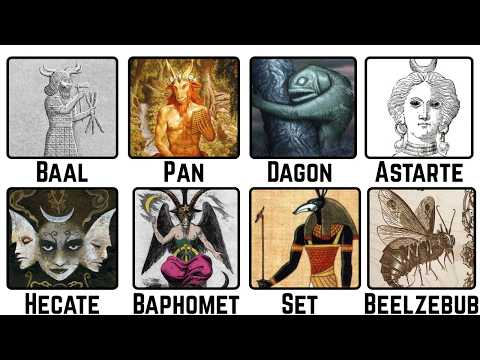
The whispers of forgotten gods echo through the halls of history, their forms once radiant and revered, now shrouded in shadows of demonization. It's a narrative as old as conquest itself: the victors rewrite the spiritual landscape, transforming the divine figures of the vanquished into instruments of terror. This exploration delves into the intricate tapestry of religious conflict, cultural metamorphosis, and theological evolution that led to the vilification of ancient pagan gods and potent esoteric symbols.
We will dissect the historical journeys of figures like Baal, Pan, Dagon, Astarte, Hecate, Set, and even Baphomet. Witness how storm gods, the embodiment of primal power, and fertility goddesses, creators of life, were twisted into demonic archetypes. Trace the descent of nature spirits, once benevolent guides, into figures of corruption, and how powerful occult symbols became synonymous with malevolence in later Jewish and Christian narratives. Our journey spans from the ancient fervor of Canaanite religion and the rich mythology of Mesopotamia, through the philosophical depths of Greek mythology and the enigmatic pantheon of Egyptian mythology, reaching into the crucible of medieval Europe and the mysterious dawn of 19th-century occultism. This is an analytical expedition, revealing how the relentless march of political power, the ascendancy of monotheism, the ambitions of empire building, and the fierce competition between faiths reshaped the spiritual iconography across millennia, all without succumbing to sensationalism.
Table of Contents
- The Fall of Baal: A Storm God's Demise
- Pan's Shadow: From Nature's Embrace to Demonic Wildness
- Dagon's Transformation: A Semitic Deity's Descent
- Astarte's Reimagining: A Goddess of Love and War Corrupted
- Hecate's Midnight: The Sorceress of the Crossroads
- Set's Rebellion: The Egyptian God of Chaos
- The Enigma of Baphomet: A Symbol's Perilous Evolution
- The Alchemy of Divinity: Why Gods Become Demons
The Fall of Baal: A Storm God's Demise
Baal, often depicted as a powerful storm god, was central to the pantheons of many ancient Near Eastern cultures, including the Canaanites. His worship was deeply intertwined with agricultural cycles and the promise of rain and fertility. However, as monotheistic faiths like Judaism began to solidify their theological frameworks, Baal became a prime target. The narrative presented in texts like the Hebrew Bible often portrays Baal worship as idolatrous and corrupt, directly opposing the worship of Yahweh. This wasn't merely a theological disagreement; it was a political and cultural struggle for dominance. By demonizing Baal, early Israelite leaders effectively delegitimized the religious practices of surrounding peoples, consolidating their own spiritual authority. The fervent attacks on Baal as a false idol set a precedent for the later demonization of other deities.
Consider the complexities of early Hebrew religion. The idea that Yahweh and El were initially distinct storm gods, later synthesized amidst Babylonian influence to forge monotheism, provides a fascinating lens. The concept of Ashtaroth as a divine consort, a representation of the divine mother, highlights the ancient patriarchal shift that often accompanies the rise of singular male deities. This echoes the broader historical trend of masculine deities supplanting feminine principles in positions of ultimate power. The justifications for violence often attributed to these deities in later epochs seem to underscore a human construct of the divine, reflecting our basest traits rather than a loving creator.
Pan's Shadow: From Nature's Embrace to Demonic Wildness
Pan, the goat-footed god of the Greeks, embodied the wild, untamed spirit of nature. His domain was the forests, mountains, and pastoral life, often associated with revelry, music, and primal instincts. As Christianity spread throughout the Roman Empire, figures like Pan became emblematic of paganism's allure and perceived licentiousness. His association with sensuality, wildness, and ecstatic states was reinterpreted through a lens of sin and corruption. The hoofs, the horns, and his association with music and dance were gradually twisted into devilish attributes. The fear of the wild and the unknown, inherent in many human societies, was projected onto Pan, transforming him from a spirit of nature into a symbol of untamed, dangerous forces.
The Hellenistic interpretations of older deities often serve as fertile ground for demonization. When these symbols cross cultural boundaries and encounter new theological systems, their original meanings can be drastically altered. The discomfort with untamed nature and primal urges, often seen in more ascetic or disciplined religious traditions, finds a convenient scapegoat in figures like Pan.
Dagon's Transformation: A Semitic Deity's Descent
Dagon was a prominent Mesopotamian and Canaanite deity, often associated with grain, agriculture, and possibly storms. As a significant god in Philistine culture, his temples and worship were well-established. His prominence made him a direct rival to the rising power of Yahweh in early Israelite narratives. The biblical accounts frequently depict Dagon in opposition to the Ark of the Covenant, portraying his statue falling before it, symbolizing the superiority of the Israelite God. This narrative effectively diminished Dagon's stature, casting him as a lesser, ultimately defeated, idol. The association of sea-dwelling or fish-like imagery sometimes linked to Dagon further lent itself to later interpretations associating him with monstrous or sub-aquatic entities within demonological lore.
It's crucial to acknowledge that "Israelite monotheism" as a fully formed concept likely developed later, primarily within the Kingdom of Judah. Early Semitic peoples, including the Israelites themselves, had a history of polytheism. The integration of deities like Baal Hadad was not "new" to the Israelites, as they were part of the same cultural sphere. Jezebel, often blamed for introducing Baal worship, was in fact bringing back a deity whose worship was already extant.
Astarte's Reimagining: A Goddess of Love and War Corrupted
Astarte (or Ishtar in Babylonian and Assyrian traditions) was a major deity across the ancient Near East, revered as a goddess of love, beauty, sex, fertility, war, and political power. Her worship was widespread and deeply ingrained in the cultural fabric of many societies. In the biblical narratives, Astarte is often equated with Asherah, another goddess whose worship was suppressed by proponents of strict monotheism. The Hebrew Bible frequently condemns the worship of Asherah and Astarte as an abomination, directly linking them to idolatry and spiritual defilement. Her powerful and multifaceted nature, encompassing both eroticism and martial prowess, made her a potent symbol of the "other" that needed to be eradicated by emerging monotheistic systems.
The divine mother figure represented by Astarte and Asherah often clashed with the ascendant patriarchal structures that favored singular male deities. Eradicating the worship of these powerful feminine deities was not just about religious purity; it was about asserting a new social and political order where masculine principles dominated.
Hecate's Midnight: The Sorceress of the Crossroads
Hecate, a goddess from the pre-Hellenic pantheon, later integrated into Greek mythology, was associated with magic, witchcraft, the night, moon, ghosts, and crossroads. She was often depicted as a powerful, enigmatic figure, sometimes with three faces or bodies, presiding over liminal spaces and transitions. As Christianity became the dominant religion in Europe, Hecate, with her strong ties to magic and the nocturnal realm, became an easy target for demonization. She was increasingly conflated with witches and demonic entities, her traditional domains of shadowy places and mystical knowledge becoming associated with malevolent sorcery and pacts with the devil. Her complex nature, existing on the fringes of the Olympian pantheon, made her a convenient symbol for all that was considered dark and forbidden.
The association of Hecate with liminal spaces—crossroads, boundaries, the threshold between worlds—is a potent metaphor for her position in religious history. She represents the "other," the power that exists outside the established order, making her an ideal figure to be cast as demonic when that order shifts.
Set's Rebellion: The Egyptian God of Chaos
In ancient Egyptian mythology, Set was the god of chaos, deserts, storms, and foreigners. He was a complex deity, often depicted as an antagonist to Osiris and Horus, representing the untamed forces that threatened the ordered cosmos represented by the pharaoh and the established religious system. While an integral part of the Egyptian pantheon, Set's disruptive nature made him a symbol of disorder. When foreign powers or religious ideas gained influence in Egypt, figures like Set, representing chaos and the "other," could be more easily demonized or reinterpreted as malevolent. Later traditions, particularly those influenced by Abrahamic religions, sometimes drew parallels between Set and demonic figures due to his role as an antagonist and his association with disruptive, "unclean" domains like the desert.
The concept of an "Egyptian monotheism" under Akhenaten, though brief, highlights the fluidity of religious thought in the ancient world. The eventual return to polytheism, and the subsequent re-establishment of traditional deities, shows how religious identities were constructed and contested, often by absorbing or reinterpreting elements from neighboring cultures.
The Enigma of Baphomet: A Symbol's Perilous Evolution
Baphomet is a figure that first gained notoriety during the trials of the Knights Templar in the early 14th century. Accused of heresy, the Templars were alleged to have worshipped an idol known as Baphomet. The exact nature of this idol remains obscure, but it became a potent symbol of heresy and devil worship in the Christian imagination. Centuries later, in the 19th century, occultists like Éliphas Lévi reinterpreted Baphomet as a symbolic representation of the reconciliation of opposites—male and female, good and evil, light and dark—often depicted with a human body, goat's head, and wings. This symbolic, esoteric interpretation, however, did not erase the earlier association with devil worship. In modern popular culture and certain fringe interpretations, Baphomet continues to be linked with Satanism and demonic forces, illustrating how symbols can acquire new, often darker, meanings through historical association and cultural fear.
The perception of Baphomet illustrates how a symbol's meaning can be violently re-written. From a potentially misunderstood idol of a disgraced military order to a complex arcane sigil, its journey is a testament to the power of narrative and fear in shaping our understanding of the "other."
The Alchemy of Divinity: Why Gods Become Demons
The transformation of pagan deities into demons is not merely an artifact of religious history; it is a recurring pattern woven into the fabric of human civilization. It is a powerful illustration of how power structures, cultural dominance, and the fear of the unknown can reshape our spiritual narratives. The demonization of ancient gods served multiple purposes: it legitimized the conquering religion, consolidated theological and political power, and provided a framework for understanding and controlling perceived threats—whether they were external cultures or internal anxieties.
Ultimately, figures like Baal, Pan, Dagon, Astarte, Hecate, Set, and Baphomet remind us that the divine is not static. It is a fluid concept, constantly being reinterpreted, redefined, and, at times, actively suppressed by the forces that seek to impose their own spiritual order. Understanding this process is crucial for anyone seeking true esoteric knowledge, moving beyond simplistic good-versus-evil binaries to appreciate the complex interplay of history, power, and belief.
Your Operation: Reclaiming the Narrative
The historical demonization of ancient deities reveals a pattern of control and redefinition. Consider a deity or spiritual figure from your own cultural background or one that resonates with you. How has their portrayal evolved over time? What forces might have influenced this evolution? Your task is to investigate one such figure, looking beyond simplistic interpretations to understand the historical, political, and cultural factors that shaped their perception. Document your findings, noting where the original meaning might have been obscured or intentionally corrupted. This is an exercise in critical thinking and reclaiming the richness of spiritual heritage from the shadows of imposed dogma.
Arsenal del Mago
- Esencial: Magickal Seals Generator - Para visualizar y generar la esencia de figuras arquetípicas, independientemente de su connotación.
- *Liber Null & Psychonaut* por Peter J. Carroll - La biblia de la Magia del Caos, fundamental para entender la manipulación de la realidad.
- *The Golden Bough* por James George Frazer - Un compendio exhaustivo de mitología y rituales comparados a través de culturas.
- *The Kybalion* - Principios herméticos que subyacen en muchas de estas transformaciones y arquetipos.
- Un diario de estudio detallado - Para registrar tus propias investigaciones y reflexiones sobre estas figuras.
Preguntas Frecuentes
- ¿Por qué las religiones monoteístas tienden a demonizar a las deidades de religiones politeístas?
La demonización sirve para desacreditar las creencias rivales, consolidar la autoridad del nuevo sistema de creencias y marcar una clara distinción entre "lo sagrado" y "lo profano" según la visión del vencedor. - ¿Podrían figuras como Satanás ser interpretaciones posteriores de deidades antiguas?
Existe una fuerte teoría académica que sugiere que el concepto de Satanás en las religiones abrahámicas se desarrolló en parte a partir de la demonización de deidades extranjeras y figuras adversariales de mitologías anteriores, adaptándose a nuevas narrativas teológicas. - ¿El Baphomet de los Templarios es el mismo que el Baphomet moderno?
No necesariamente. El Baphomet de los Templarios es una figura histórica oscura ligada a acusaciones de herejía. El Baphomet moderno, popularizado por ocultistas del siglo XIX, es una representación simbólica compleja con significados esotéricos distintos, aunque la asociación con lo "demoníaco" persiste en la cultura popular. - ¿Cómo puedo usar este conocimiento para mi propia práctica mágica?
Comprender cómo las energías y los arquetipos son manipulados y redefinidos históricamente te da poder. Te permite identificar las capas de significado en los símbolos, deconstruir dogmas y trabajar de forma más consciente con las fuerzas arquetípicas, reconociendo cómo su "naturaleza" puede ser percibida de maneras muy diferentes.
Practitioner's Note: True magick requires resources. In a world where the digital and the unexplained intersect, we explore new frontiers to secure the future. Do you dare to be part of the vanguard? Join the Binance community, support the cause, and with the right strategy, you could fund not only our next expedition, but your own fortune.
No hay comentarios:
Publicar un comentario