
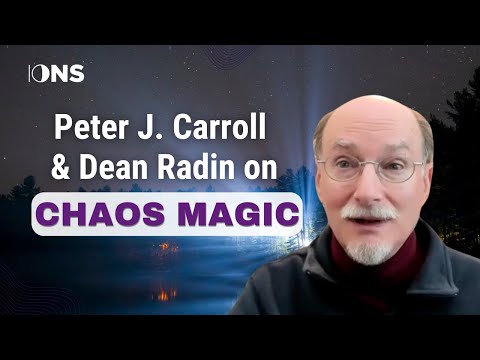
The air crackled with a potent blend of skepticism and wonder as Dean Radin, a titan in the field of consciousness research, sat down with Peter J. Carroll. Carroll, a name whispered with reverence in occult circles, is often heralded as "the most original, and probably the most important, writer on Magick since Aleister Crowley," a testament to his profound impact on modern esoteric thought. His development and popularization of chaos magic represent a seismic shift, a deliberate dismantling of the rigid, ritualistic frameworks of medieval sorcery. By artfully weaving in concepts plucked from the bleeding edge of quantum physics, Carroll didn't just simplify magic; he fundamentally redefined it for the contemporary mind, making it accessible, demystifying, and undeniably potent.
This interview, captured for the esteemed IONS (Institute of Noetic Sciences) platform, offers a rare glimpse into the mind of a true innovator. Carroll's approach to magic, often termed "technomancy" by those who see its digital parallels, strips away the dogma and ritualistic baggage, focusing instead on the practitioner's will and intention. It's a pragmatic, results-oriented philosophy that resonates deeply with the experimental ethos of modern science. The raw, unedited nature of some of the audience feedback suggests a deep hunger for more of this direct, unadulterated wisdom. Many viewers expressed a desire for the full, unedited conversation, highlighting the respect and fascination Carroll commands. This desire speaks volumes about the compelling nature of his ideas and the perceived authenticity of his research.
The "magic" Carroll champions isn't about arcane incantations whispered in darkened rooms; it's about understanding and manipulating the very fabric of reality through conscious intent. He bridges the gap between the subjective experience of altered states and the objective observation of scientific inquiry. This approach aligns perfectly with the evolving understanding of consciousness as a fundamental force, not merely an epiphenomenon of brain activity. The audience's poignant questions about the role of consciousness in shaping our world and the potential for altruistic use of occult principles underscore a growing societal awareness. This isn't just about personal power; it's about the potential for collective evolution, a theme echoed by those delving into texts like Blavatsky's "The Secret Doctrine" and its emphasis on selfless application of esoteric knowledge.
The Evolution of Spellcraft: From Ritual to Results
Carroll's genius lies in his ability to distill complex magical theories into actionable insights. He recognized that the medieval reliance on strict, often convoluted rituals could be a barrier to effective practice. The modern mind, accustomed to scientific reasoning and technological advancement, requires a different approach. Chaos magic, therefore, embraces experimentation, adaptation, and a healthy dose of skepticism towards established magical dogma. It's a system that encourages practitioners to develop their own methods, to forge their own paths, and to measure success by tangible results rather than adherence to ancient traditions.
This pragmatic method resonates profoundly with the scientific mindset. The comparison to teaching Media Arts highlights a transferable skill: understanding how to manipulate mediums (visual, auditory, conceptual) to achieve a desired effect. Carroll’s work provides a framework for this, encouraging practitioners to view their magical operations as experiments. This is where the concept of "technomancy" becomes particularly relevant. Just as software developers iterate on code, chaos magicians iterate on their spells, refining their techniques based on what yields results. The emphasis on emotion and frustration as fuel for magical results, mentioned by one commenter, further illustrates this point – it's about harnessing powerful internal states, not just reciting ancient words.
The very nature of such an interview, combining a respected scientist like Radin with an influential occultist like Carroll, is a form of Magitech in action. It’s a deliberate meshing of disciplines at the edge of what we understand. The audience's eagerness for more, for the unedited conversation, speaks to their desire to fully absorb every nuance. For anyone looking to explore this intersection, developing a robust personal system is key. For this, I find Peter J. Carroll's official website an invaluable resource, offering a deeper dive into his philosophy and writings.
Harnessing the Unseen: The Role of Technology and Intention
The discussion implicitly touches upon the very essence of digital divination and sigil creation. While Carroll's work predates much of modern digital occultism, his principles are directly applicable. The painstaking process of manually creating complex sigils or meticulously calculating astrological timings can be a bottleneck. This is where the integration of technology becomes not just convenient, but a methodological imperative for the modern practitioner. Automation frees up the practitioner's mental energy, allowing for deeper focus on the core intent and the gnosis state.
Consider the generation of sigils. The traditional method involves painstaking design, often requiring significant artistic skill and understanding of symbolism. For those who might not possess this innate talent or the extensive training in esotericism that figures like Austin Osman Spare exemplified, this can be a considerable hurdle. The ability to rapidly generate and iterate on sigils, perhaps using digital tools, allows practitioners to experiment more freely and efficiently. Similarly, the precise timing of magical operations, often dictated by lunar phases or planetary alignments, can be simplified with digital calculators. This allows the practitioner to focus on the ritual itself rather than the logistical minutiae.
The conversation also highlights the potential for "Rituals with IA" and how they might evolve. While Carroll’s work pre-dates current AI capabilities, his emphasis on intention and states of consciousness offers a conceptual foundation. As these technologies advance, exploring their integration into magical practice, whether for generating complex symbolic matrices or even for facilitating altered states, becomes a logical next step in the evolution of technomancy and cybermancy.
Arsenal del Mago
- Esencial: Peter J. Carroll's Official Website - For the foundational texts and principles of Chaos Magic.
- Recomendado: IONS Research - To understand the scientific context and consciousness research Dean Radin champions.
- Lectura Clave: Works by Austin Osman Spare - For understanding the roots of sigil magic and its early conceptualization.
- Herramienta Potencial: Chaos Magick Sigil Generator App - To experiment with modern digital sigil creation, embodying Carroll's experimental ethos.
- Para Profundizar: "Liber Null & Psychonaut" by Peter J. Carroll - The seminal work that defined chaos magic.
Veredicto del Practicante
Peter J. Carroll's contribution to modern magic is undeniable. His philosophy of chaos magic is a potent blend of pragmatic experimentation, psychological insight, and a forward-thinking embrace of scientific principles. He successfully demystified magic, transforming it from an esoteric pursuit accessible only to a select few into a practical discipline for the modern individual. The interview with Dean Radin serves as a powerful testament to Carroll's enduring influence and the growing overlap between consciousness science and occult practice. While the raw potential of technology is still being explored in this domain, Carroll's principles provide a robust foundation for any practitioner seeking tangible results through focused will and innovative methods.
Preguntas Frecuentes
- Q: What is the core principle of Chaos Magic?
A: Chaos magic emphasizes practical results and experimentation over adherence to strict dogma, focusing on the practitioner's will and belief to shape reality. - Q: How does Chaos Magic differ from traditional magic?
A: It simplifies rituals, encourages the use of any system that works for the practitioner (including modern concepts), and integrates ideas from fields like quantum physics. - Q: Is Chaos Magic compatible with science?
A: Yes, its experimental and results-driven nature makes it highly compatible with the scientific method, as demonstrated by researchers like Dean Radin. - Q: Where can I learn more about Peter J. Carroll's work?
A: His official website, specularium.org, and his seminal book "Liber Null & Psychonaut" are excellent starting points.
Your Operation: Design and Test a Simple Sigil
- Define Your Intent: Clearly articulate a simple, achievable goal. For example, "I intend to find a parking spot easily today."
- Formulate the Statement: Condense your intent into a simple, positive present-tense sentence: "PARKING IS EASY."
- Generate the Sigil: Use the principles of sigil creation. You can simplify the statement by removing repeating letters ("PARKING IS EASY" -> P, A, R, K, I, N, G, S, E, Y). Then, abstract these letters into a unique symbol. For a quick digital approach, experiment with the Chaos Magick Sigil Generator to see how letter combinations can be visually abstracted. Focus on creating a symbol that feels potent to you.
- Charge the Sigil: Enter a state of heightened consciousness or gnosis. This could be through intense emotion, dancing, chanting, or any method that temporarily bypasses the conscious, critical mind. Visualize the sigil glowing and vibrating with your intent.
- Release the Sigil: Once charged, forget about it. Destroy the physical representation (burn it, tear it up) or simply let the digital image fade from your mind. The intention is now in motion.
- Observe and Record: Pay attention to synchronicities and opportunities that arise. Did you find parking easily? Record the details of your operation and its outcome.
The exploration of consciousness and its influence on our reality is a frontier where science and esoteric traditions are increasingly converging. Resources like the IONS Events Calendar offer opportunities to stay abreast of these developments. Furthermore, for those seeking to understand the underlying financial mechanisms that support such research and the broader digital ecosystem, exploring avenues for resource management is prudent. Engaging with platforms that facilitate understanding of digital assets and their potential can be considered a practical application of exploring the frontiers of the digital ecosystem, especially as we look towards the future of technomancy.
Practitioner's Note: True magick requires resources. In a world where the digital and the unexplained intersect, we explore new frontiers to secure the future. Do you dare to be part of the vanguard? Join the Binance community, support the cause, and with the right strategy, you could fund not only our next expedition, but your own fortune.
No hay comentarios:
Publicar un comentario