
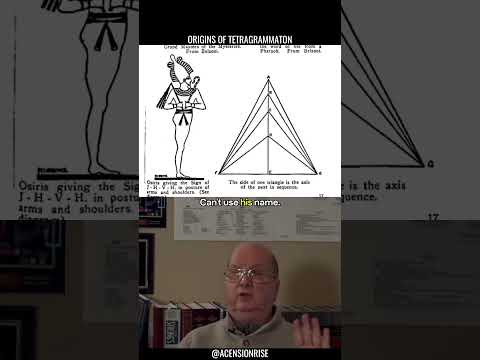
The very act of naming something imbues it with power and definition. In the realm of the sacred, this principle is magnified. Consider the Tetragrammaton – the four-letter Hebrew name of God, YHWH. It's a divine appellation that has resonated through millennia, shaping theological discourse, mystical practices, and even our understanding of reality itself. Jordan Maxwell, a profound explorer of the esoteric, delved deep into its origins and implications, revealing a tapestry of cosmic connections that transcend simple religious dogma and bleed into the very fabric of existence. This exploration isn't just about a name; it's about the nature of existence, the architecture of the cosmos, and the power of intention.
The name YHWH, transliterated as Yahweh, is not merely a label. It's a profound declaration of God's self-existent nature, directly linked to His utterance in Exodus 3:14: "I AM WHO I AM." This assertion is a cornerstone of theological understanding, a signal that distinguishes the divine from the transient. This isn't a God who simply *is*, but one who *is* in an absolute, self-generating sense. This concept, while central to Jewish theology, has often been a point of nuanced interpretation. Ancient Jewish belief, rather than a rigid, exclusive monotheism in the modern sense, often leaned towards henotheism or monolatry – worshiping one God while acknowledging the potential existence of others. However, critically, Yahweh was not seen as equivalent to these other deities. He alone was the uncreated, the eternal creator, possessing sovereign authority and deserving of worship due to His unique, superior nature. This distinction, though subtle, is crucial, separating Jewish belief from typical polytheism where deities might possess comparable power.
The very structure of the Tetragrammaton—Yod, Heh, Vav, Heh—is laden with symbolic weight. Each letter can be seen as representing a fundamental element, and together, they form a representation of the *Ein Soph Aur*, the infinite potential of creation before its emanation into the physical world. This connects directly to broader mystical traditions where the divine name encapsulates the totality of existence, from the unmanifest to the manifest. It's a micro-representation of the macrocosm, a concept echoed in traditions across the globe, from the Hindu pantheon with its myriad names and manifestations of the divine, to the very concept of the atom.
The complexity of the Tetragrammaton extends to its relationship with other divine or powerful names. Some have noted its sonic resonance with names like Metatron, a significant angelic figure. The discussion also touches upon the ancient Egyptian concept of Aten, the solar disk, and the historical shift in theophoric names such as TutankhATEN becoming Tutankhamun. These connections, while seemingly disparate, reveal a recurring pattern in human history: the search for and reverence of divine or cosmic forces through symbolic appellations.
The divine name's significance is further highlighted by the injunction not to misuse it—a divine paradox, perhaps, to reveal a name and then forbid its casual use. This raises questions about divine will, human interpretation, and the very nature of power. It suggests that the name itself is not a magical password to be wielded lightly, but a sacred key to understanding the divine essence. This caution might also be interpreted as a safeguarding mechanism, preventing the name from being corrupted or trivialized, a common theme when discussing powerful esoteric concepts.
Furthermore, the concept of the Tetragrammaton intertwines with broader cosmological ideas. In meditative states, visions of four points forming a square have been reported, suggesting a direct intuitive apprehension of this divine quaternary structure. This mirrors the idea of creation emanating through distinct focal points, each contributing to the infinite whole. The ancient world, with its pantheon of gods—Zeus, Thor, and the like—often associated powerful deities with elemental forces like the sky and thunder, frequently represented by names composed of four letters, underscoring a universal human inclination to find order and meaning in divine designations.
The historical context of monotheism and henotheism has been particularly illuminating. The evidence suggests that early Jewish communities practiced a form of monolatry, where they exclusively worshipped Yahweh while acknowledging other gods existed. This distinction is vital: Yahweh's superiority was not merely one of power, but of being. He was uncreated, the sole true existent, unlike other deities who were considered subsequent creations. This nuanced theological landscape, while unusual for the ancient Mediterranean world, was a precursor to the strongly held monotheistic convictions that solidified, especially during periods of persecution, like that enacted by Antiochus IV.
The Architect Behind the Name
Jordan Maxwell's approach consistently invites us to look beyond dogma and into the underlying symbolic architecture of our belief systems. He often posits that understanding these ancient names and symbols is crucial for comprehending the forces that shape our reality. The Tetragrammaton, in this light, is not just a theological artifact but a Technomancy blueprint, a divine code woven into the fabric of existence. It speaks to a profound order, a cosmic intelligence that can be apprehended through symbols and names. He challenges us to see these ancient narratives not as historical curiosities, but as living blueprints for understanding the universe and our place within it.
The exploration into the Tetragrammaton also inevitably leads to discussions around higher consciousness and the nature of reality itself. Is existence infinite, with all of creation as mere focal points within it? Are beings capable of comprehending this infinity meant to remain mindful of their true identity while embracing humility? These philosophical quandaries are deeply intertwined with the divine name, suggesting that YHWH is not just a deity, but a representation of the ultimate, all-encompassing consciousness. This perspective aligns with mystical traditions that emphasize the oneness of all things and the divine spark within each individual.
Arsenal of the Explorer
To truly grasp the depth of these concepts, a robust set of tools and resources is essential. The journey into arcane knowledge requires more than just intellectual pursuit; it demands practical exploration and reliable guidance. For those seeking to delve deeper into the symbolic language of the divine and unlock the secrets woven into names like the Tetragrammaton, the proper instruments are indispensable. The practice of Magitech and Digital Divination offers new avenues for this exploration, bridging ancient wisdom with modern technological possibilities.
- Essential: Chaos Magick Sigil Generator: Understanding the power of symbolic representation, as found in the Tetragrammaton, is paramount. This app allows you to create your own potent sigils, translating your intentions into concrete visual forms, much like the ancient practice of imbuing divine names with power.
- Recommended: The Book of Forbidden Knowledge by William Buehler: A comprehensive compendium of esoteric lore, offering context and a breadth of knowledge that complements any serious study.
- Recommended: The Secret Teachings of All Ages by Manly P. Hall: A foundational text for understanding comparative mythology and esoteric symbolism across cultures.
- Recommended: Liber Null and Psychonaut by Peter J. Carroll: Essential reading for anyone serious about practical Magia del Caos, offering a secular, scientific approach to altering consciousness and reality.
- Recommended: Online resources for ancient Hebrew etymology and theological interpretations: Cross-referencing scholarly articles and historical texts is crucial for a nuanced understanding.
Veredict of the Practitioner
The Tetragrammaton, when stripped of rigid dogma and examined through the lens of comparative mythology and esoteric symbolism, reveals itself as far more than a simple divine name. It is a nexus of profound concepts: the nature of existence, the power of intention, the structure of creation, and the relationship between the human and the divine. Jordan Maxwell's contribution lies in his ability to connect these dots, illustrating how ancient wisdom, encoded in names and symbols like YHWH, continues to resonate with fundamental truths about our reality. It’s a testament to the enduring human quest for meaning and connection to the ultimate source.
Frequently Asked Questions
- What is the literal translation of the Tetragrammaton?
The Tetragrammaton, meaning "four letters," refers to the Hebrew name YHWH. Its exact pronunciation is debated, but it is often associated with "Yahweh" and linked to the divine self-description "I AM WHO I AM." - Was ancient Judaism strictly monotheistic?
Ancient Jewish belief is often described as henotheistic or monolatric, focusing on the exclusive worship of one God (Yahweh) while not necessarily denying the existence of other deities. However, Yahweh was considered uniquely superior and uncreated. - How does the Tetragrammaton relate to other ancient gods or concepts?
The structure and symbolism of the Tetragrammaton have been conceptually linked to various traditions, including the concept of elemental representation in creation, the divine name in other mythologies, and even the idea of ultimate, self-existent consciousness. - Why is the Tetragrammaton considered so sacred?
Its sacredness stems from its direct association with God's self-revealed name and essence. The injunction not to misuse it highlights its profound significance and the reverence due to the divine.
Your Operation: Contemplation of the Fourfold
Take a quiet moment. Close your eyes and visualize the four letters of the Tetragrammaton: Yod, Heh, Vav, Heh. As you focus on each letter, contemplate its potential elemental or symbolic correspondence (e.g., Yod as Fire/Spirit, Heh as Water/Creation, Vav as Air/Connection, Heh as Earth/Manifestation – this is one interpretation among many). Allow your mind to grasp the concept of these four points coalescing into a unified divine presence. If a meditative experience arises, observe it without judgment. Consider how this fourfold structure might be reflected in your own life or in the broader patterns of existence.
Practitioner's Note: True magick requires resources. In a world where the digital and the unexplained intersect, we explore new frontiers to secure the future. Do you dare to be part of the vanguard? Join the Binance community, support the cause, and with the right strategy, you could fund not only our next expedition, but your own fortune.
No hay comentarios:
Publicar un comentario