
The night sky, a canvas of cosmic whispers, holds secrets that have captivated humanity for millennia. Among the celestial bodies, Saturn, the ringed jewel, has long been shrouded in mystery and symbolic weight. Its influence, often associated with discipline, limitations, and destiny, extends far beyond the realm of astronomy. The recent surge of interest in its enigmatic hexagonal storm, the historical syncretism of its symbols, and its pervasive presence in religious and occult traditions demands a deeper exploration. This isn't merely about astronomical observation; it's about understanding the deep currents of human consciousness that have projected meaning onto the heavens.
One cannot discuss Saturn without acknowledging the intricate web of symbolism that surrounds it. The hexagram, often seen as a symbol of the union of opposites, a fusion of the divine and earthly, or the interplay of masculine and feminine energies, finds a striking celestial parallel in the six-sided jet stream at Saturn's north pole. This natural phenomenon, visible even before the advent of telescopes, has fueled speculation about ancient knowledge and its connection to celestial patterns. The question arises: how did our ancestors possess such intimate knowledge of these distant worlds? Was it a matter of keen observation, or something more arcane?
Table of Contents
The Ancient Gaze: Observation or Intuition?
The visibility of Saturn's hexagonal storm to the naked eye in ancient times remains a point of profound wonder. While modern telescopes have unveiled its intricate details, the ability of early civilizations to discern such a specific geometric pattern raises questions about their observational capabilities or perhaps, a more intuitive connection to celestial mechanics. It's a testament to the enduring human drive to map the cosmos and find order within its apparent chaos. This pursuit of celestial understanding has always been intertwined with spiritual and psychological endeavors, blurring the lines between empirical science and esoteric knowledge. The "wandering stars," as planets were once known, were not just distant lights but potent forces shaping human destiny and belief systems.
The concept of the "Master Game" often emerges when discussing these ancient cosmological understandings. It suggests a grand, underlying structure to reality, a cosmic play where celestial movements dictate terrestrial events, and where symbols act as keys to unlocking deeper truths. This perspective encourages us to see the universe not as a random collection of matter, but as an interconnected system governed by principles that can be understood through diligent study and personal gnosis.
The Crossroads of Symbols: From Moloch to Murugan
The symbolism associated with Saturn is remarkably fluid, often appearing in different cultures under various guises. The hexagram, for instance, has been linked to figures and deities across a spectrum of traditions. Some historical interpretations associate it with the worship of Moloch, a deity linked to child sacrifice, raising uncomfortable questions about its early usage. However, this same geometric form, the Star of David, is a central symbol in Judaism, representing the covenant between God and the Jewish people, and the balance between divine and human love. This stark contrast highlights how symbols can be recontextualized and their meanings evolve or are deliberately obscured over time.
Further complicating this symbolic tapestry is the striking resemblance between the hexagram and the Shanmukha Yantra, or Star of Murugan, in South Asian traditions. This yantra symbolizes the union of Shiva and Shakti, the masculine and feminine divine principles, and is seen as a stylized representation of the Shiva Lingam, an ancient symbol of creation. Murugan himself, a prominent deity in Hinduism, is associated with the sun, war, and wisdom, and is known by numerous names across cultures, including Tamuz, Horus, Helios, and Apollo. This cross-cultural resonance suggests a universal archetypal language embedded within these celestial symbols, a language that speaks of fundamental cosmic principles like the integration of polarities.
"The Sun/Son/Murugan is the hexagon formed by combining the two triangles. Murugan is indeed the son of Parvati & Shiva, being both Sun Deity & God of War. He is a Worldwide God, not just India!"
The profound connection between these symbols might lead some to believe that the "elites" are channeling Saturn's energy, represented by the hexagram, to influence earthly affairs. This perspective paints a picture of a cosmic battle for consciousness, where ancient symbols hold the keys to manipulating unseen forces. The idea of a "hex" as a form of energetic control resonates with occult theories about the power of symbols and their ability to shape reality.
Saturn in Sacred Texts and Rituals
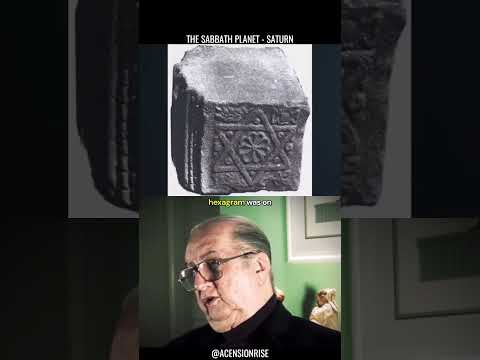
The influence of Saturn is deeply embedded within religious frameworks, often subtly. The word "Sabbath," meaning rest, originates from the Hebrew word "Shavat." Saturday, the Sabbath day in many traditions, is named after Saturn, underscoring the planet's historical association with a day of divine rest or observance. The black cube, often associated with Saturn, also carries significant symbolic weight. Some interpretations note the Hebrew word for "Sin" inscribed upon it, adding another layer to Saturn's complex and often dualistic representation.
Biblical texts also touch upon symbols that have been linked to Saturn, albeit through controversial interpretations. The "Star of Remphan," mentioned in Acts, has been identified by some scholars as referring to Saturn or a symbol associated with its worship, and is described as a demon. This interpretation suggests that certain symbols, like the hexagram, might have been co-opted and re-framed within different religious narratives, sometimes to denigrate older traditions or to warn against perceived demonic influences. The strict adherence to religious laws, like the prohibition against sacrificing children, further illustrates the complex history of these symbols and the societies that embraced them.
"Bible.tells us its the star of remphan and tells the jews not to sacrifice their children to this demon. Jews mixed with babylon and Cannanites didnt follow Tora. Was never star of David."
The juxtaposition of these interpretations—from a symbol of divine balance and creation to a representation of sin, Moloch, or a demonic force—highlights the subjective nature of meaning-making. What one tradition sees as sacred, another may condemn as profane. This underscores the importance of personal investigation and discerning truth from imposed dogma.
Technomancy and the Future of Celestial Rites
In our increasingly digital age, the ancient practice of celestial observation and symbolic interpretation is undergoing a transformation. The rise of technomancy and cybermancy allows for new ways to engage with cosmic energies. Understanding the foundational principles of astrology, planetary correspondences, and symbolic languages is essential for anyone seeking to harness these forces. For those looking to delve deeper into the creation and manipulation of symbolic energies, tools that facilitate this process are invaluable. The generation of sigils digitales, for example, offers a modern approach to ancient magical practices.
The ability to perform rituals with AI or to utilize digital divination tools can offer practitioners enhanced control and precision. The principles laid down by figures like Austin Osman Spare, a pioneer of magia del caos, emphasized the power of focused intent and the creation of personal symbolism. Today, these concepts can be amplified through technology. For instance, the timing of rituals is crucial, and tools like a Lunar Phase Calculator can help align your operations with celestial rhythms.
For those drawn to the more structured and complex aspects of ceremonial magic, the Goetia offers a rich, albeit challenging, path. However, the meticulous nature of creating and wielding the seals of these entities can be daunting. This is where modern tools can significantly streamline the process, allowing practitioners to focus on the more critical elements of intent and visualization. The rapid generation of these intricate seals is now at your fingertips. You can explore the power of these ancient symbols with the Goetian Seals Generator app. This tool simplifies the creation of Goetian seals, enabling you to focus your energy on the invocation and practical application, rather than the tedious geometrical construction.
Mage's Arsenal
- Goetian Seals Generator (Essential): For the precise and rapid creation of ceremonial seals, bypassing the complexities of manual drafting and focusing on the energetic charge. Check it out.
- Liber Null & The Psychonaut by Peter J. Carroll: A foundational text for modern chaos magick, exploring practical techniques and philosophical underpinnings.
- The Golden Bough by James George Frazer: An anthropological study of comparative religion and myth, offering vast insights into ancient rituals and symbolism.
- 777 And Other Qabalistic Writings of Aleister Crowley: A key reference for Qabalistic correspondences, essential for understanding magical systems.
- The Secret Teachings of All Ages by Manly P. Hall: A comprehensive encyclopedia of ancient symbolism, mythology, and esoteric philosophy.
- High-Quality Inks and Parchment: For those who prefer traditional methods of sigil creation or ritual inscription. Details matter.
- A Dedicated Journal: To record observations, sigil manifestations, dream work, and ritual outcomes. Crucial for tracking progress and understanding patterns.
Practitioner's Verdict
Saturn, the "Black Cube," the "Lord of Time," is more than just a celestial body; it's a potent archetype woven into the fabric of human culture and consciousness. Its hexagonal storm is a stark reminder of the natural world's inherent geometric order, a phenomenon that has resonated with humanity's search for meaning since antiquity. The syncretism of its symbols, from the Star of David to the Star of Murugan, illustrates how fundamental cosmic patterns are interpreted and reinterpreted across diverse spiritual landscapes. While some interpretations point to darker associations, others reveal profound truths about the balance of energies and the interconnectedness of all things. The true power lies not in the symbol itself, but in the intent and understanding of the practitioner wielding it. Whether approached through ancient texts, anthropological studies, or modern technomancy, Saturn's influence demands respect, rigorous study, and a willingness to confront the limitations it represents, ultimately paving the way for profound personal growth.
FAQ
- How did ancient civilizations know about Saturn's hexagonal storm without telescopes?
This is a profound question. Theories range from advanced observational skills and atmospheric phenomena visible under specific conditions to intuitive or even precognitive knowledge passed down through generations. The exact mechanism remains a subject of debate and wonder. - Is Saturn considered a benevolent or malevolent influence in occultism?
Saturn's influence is dualistic. It represents discipline, structure, karma, and lessons learned, which can be perceived as restrictive or challenging (malevolent). However, it also signifies wisdom, mastery, and the achievement of long-term goals through perseverance (benevolent). Its nature depends heavily on the practitioner's perspective and the context of its use. - What is the connection between the hexagram and Saturn?
The hexagram, formed by two interlocking triangles, is often associated with Saturn due to the hexagonal storm at its north pole. Symbolically, it represents the union of opposites, the integration of spiritual and material realms, and the balance of energies, all themes closely aligned with Saturn's archetypal domains. - Can the Star of David be considered a symbol of Saturn?
While the hexagram associated with the Star of David appears coincidentally to the hexagonal storm on Saturn, many scholars and occultists argue that its primary religious and historical context within Judaism is distinct from Saturn worship. However, the symbolic overlap allows for syncretic interpretations in broader esoteric studies. - What is 'Technomancy'?
'Technomancy' refers to the practice of magic that incorporates technology, such as computers, software, and digital tools, into rituals and spellwork. It's about bridging the gap between ancient magical principles and modern innovations.
Your Operation
To truly grasp the practical implications of Saturn's symbolism, embark on a personal "Saturn Rite of Integration." For one week, dedicate 15 minutes each day to contemplating a specific Saturnian theme: discipline, patience, or limitation. Journal your thoughts and any challenges or insights that arise. Use the knowledge of celestial timing; if possible, perform this contemplation during Saturn's hour on a Saturday. Document any synchronicities or profound understandings that emerge. This exercise isn't about invoking Saturn, but about integrating its archetypal lessons into your own lived experience. The more you explore the symbolic landscape, the more you realize the power of intention and consistent practice. For those seeking to amplify their intentions with focused energy, exploring tools for sigil creation can be a powerful next step. You can begin crafting your own potent symbols for manifestation using the Chaos Magick Sigil Generator app, allowing you to translate your insights into tangible energetic forms.
Practitioner's Note: True magick requires resources. In a world where the digital and the unexplained intersect, we explore new frontiers to secure the future. Do you dare to be part of the vanguard? Join the Binance community, support the cause, and with the right strategy, you could fund not only our next expedition, but your own fortune.
No hay comentarios:
Publicar un comentario