
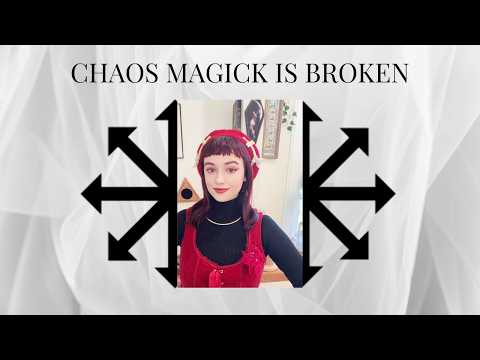
The world of magick is often a battlefield of ideas. Dogmas clash, traditions vie for supremacy, and practitioners, whether in sacred groves or dimly lit rooms, seek definitive answers. In this arena, Chaos Magick often finds itself on the defensive, labeled as broken, undisciplined, or a mere stepping stone. But is this critique valid, or is it a fundamental misunderstanding of what Chaos Magick truly represents?
Georgina Rose, a perennialist, polytheist, and thelemite, has articulated a perspective that many find challenging: that Chaos Magick, in its popular interpretation, might indeed be "broken." This viewpoint stems from a place of deep engagement with established magical systems, particularly Thelema, and a concern that the very fluidity and freedom offered by Chaos Magick can lead to a lack of cohesive practice, a shallow engagement with esoteric principles, and ultimately, a failure to achieve the "Great Work."
However, the discourse surrounding Chaos Magick is rarely one-sided. For decades, practitioners have debated its merits, its flexibility, and its potential pitfalls. The very essence of Chaos Magick—its emphasis on personal gnosis, paradigm shifting, and a results-oriented approach—is what draws many to it, and what others critique. It’s a system, or perhaps more accurately, an anti-system, that reflects the chaotic nature of existence itself. As one commentator aptly put it, "Trying to define Chaos Magick logically is a category error. It’s like trying to measure the weight of a color or the smell of a triangle."
The Toolkit vs. The System Argument
A recurring theme in the defense of Chaos Magick is the idea that it functions as a toolkit rather than a complete, self-contained system. This perspective suggests that Chaos Magick offers a powerful array of techniques and principles that can be adapted and utilized within any framework, be it traditional, polytheistic, or entirely self-created. A disciplined craftsman, using these tools, can build something magnificent. Conversely, an undisciplined individual might misapply them, leading to ineffective or even detrimental results.
This aligns with the concept of paradigm shifting, a cornerstone of Chaos Magick. The idea is to temporarily adopt or embody beliefs and systems to achieve specific magical effects, rather than becoming dogmatically attached to any single one. This allows practitioners to borrow from diverse traditions, to see deities, spirits, and archetypes as masks for fundamental energies, and to craft their magical practice in a way that resonates deeply with their personal gnosis. The freedom to "get rid of the masks" and create new ones, like using Pikachu as a representation of energy, is both a strength and, for some, a source of confusion or criticism.
"The thing about chaos magick is that it is not really a specific set of practices or beliefs, I would consider it more like a 'theory of magick' that you can use as a foundation to build your own pantheon and set of practices on top of."
This approach, by its very nature, can appear eclectic, even scattered, to those accustomed to more rigid structures. Yet, for many, it’s precisely this flexibility that allows for a more profound and personalized spiritual journey. The challenge, as many practitioners acknowledge, lies in maintaining cohesion and discipline when the only dogma is "do what thou wilt."
Addressing the "Broken" Critique
The critique that Chaos Magick is "broken" often stems from a perceived lack of:
- End Goal: Unlike religions with defined ultimates (e.g., Thelemic "Great Work," Buddhist "Nirvana"), Chaos Magick’s ultimate aim is often whatever the practitioner defines it as. This can be seen as a strength (personal meaning) or a weakness (lack of direction).
- Discipline and Cohesion: The freedom to shift paradigms and adopt varied techniques can, if not managed, lead to a "loosey-goosey" approach, where practices lack depth or consistent application.
- Theological Depth: Critics argue that the tendency to borrow from or even satirize existing pantheons (e.g., "Pikachu Magick") dilutes serious magical work and disrespects established traditions.
However, these criticisms often overlook the underlying principles. For seasoned practitioners, Chaos Magick isn't about abandoning structure, but about understanding that structure can be created and dissolved at will. The rituals, the use of servitors, sigils, and egregores, are not mere whims; they are psychological tools designed for immersion, emotion, and repetition—powerful catalysts for reorganizing one's perception and achieving desired outcomes. For many, the goal *is* the continuous refinement of these perspectives and the development of personal meaning.
Furthermore, the argument that Chaos Magick is inherently flawed because it lacks a prescribed cosmology or a singular "Great Work" misses the point for many. As one practitioner noted, "The aim of Chaos Magick? Whatever the Magician wants." This is not a failing, but a feature. The meaning and aim are self-generated, leading to a form of practice where the creator benefits most intimately from their own system.
"Reality is no one who has not practiced for good and not in a lazy way knows what Chaos Magick really is, especially if he makes his ideas regarding it by browsing tik tok. No offense, but it's no wonder you have such a poor opinion of Chaos Magick, you are calling salmon 'meat' and expecting to taste more or less like beef."
The issue often lies not with Chaos Magick itself, but with the practitioner's approach. The internet, and platforms like TikTok, have undoubtedly contributed to a superficial understanding of many esoteric practices, including Chaos Magick. This has given rise to what some call "pop culture Chaos Magick," characterized by a transgression-for-transgression's-sake mentality, rather than a deep, methodical exploration of consciousness and reality. This is a critique of the *implementation*, not the underlying theory.
The Pragmatic Core: Technomancy and Digital Divination
In the modern era, the principles of Chaos Magick are finding potent expression through technological advancements. The creation of sigils, once a painstaking manual process, can now be streamlined with digital tools, allowing practitioners to focus on the intent and energetic charge rather than the minutiae of design. This fusion of the arcane with the digital, often termed Technomancy or Cybermancy, is not a dilution of the art but its evolution. This is where tools like the Chaos Magick Sigil Generator become invaluable. Instead of getting bogged down in geometric precision, you can rapidly generate potent sigils, allowing you to dedicate more energy to the visualization and the altered state required for charging. This focus on efficiency and practical application is at the heart of effective Magitech.
Similarly, Digital Divination offers new avenues for exploring the currents of consciousness. Utilizing algorithms or specialized software can provide unique perspectives on symbolic landscapes, akin to a modern oracle. Embracing these tools, rather than shunning them, allows for a more dynamic and responsive magical practice, integrating the principles of Chaos Magick with the realities of our interconnected world. This is the essence of Esotericism Digital and the potential for Rituals with IA to augment our own abilities.
The historical figures of Chaos Magick, like Austin Osman Spare, were innovators in their time, creating unique methods for working with symbols and the subconscious. Today, the digital realm offers a new frontier for similar innovation. What remains constant is the need for a clear intention and the ability to enter and maintain a State Gnóstico, regardless of the tools used.
Arsenal del Mago
- Chaos Magick Sigil Generator (Esencial): For rapid, efficient sigil creation and intention manifestation.
- "Liber Null & Psychonaut" by Peter J. Carroll: A foundational text for understanding Chaos Magick principles.
- "The Psychonaut Field Manual: Symbols, Sigils, and Mind-Magic" by Rufus Opus: Offers practical applications and further exploration of symbolic magick.
- "Condensed Chaos" by Phil Hine: Provides a comprehensive overview of Chaos Magick theory and practice.
- A reliable journal and pen: For recording your experiments, intentions, and results.
Veredicto del Practicante
Chaos Magick, when approached with discipline and a clear understanding of its core principles, is not "broken." It is, rather, a meta-system—a framework for understanding and manipulating reality that transcends the limitations of any single dogma. Its strength lies in its adaptability, its emphasis on personal experience, and its direct, results-oriented methodology. The critique often arises from a misunderstanding of its fluid nature or from observing its superficial manifestations online. For the serious practitioner, Chaos Magick offers unparalleled freedom to construct a potent, personalized path toward their own definition of the Great Work, whatever that may be. The "brokenness" is rarely inherent to the system, but a reflection of the practitioner's own lack of focus or commitment.
Preguntas Frecuentes
- ¿Es Chaos Magick peligroso? Como cualquier práctica que involucra la manipulación de la psique y la realidad, Chaos Magick conlleva riesgos, especialmente si se aborda sin disciplina o una comprensión adecuada. Los resultados pueden ser impredecibles si la intención no está clara.
- ¿Necesito abandonar todas mis otras creencias para practicar Chaos Magick? No necesariamente. La esencia de Chaos Magick es la flexibilidad. Puedes integrar sus principios y técnicas con tus creencias existentes, utilizándolas como herramientas para potenciar tu práctica principal.
- ¿Qué es un "estado gnóstico"? Un estado gnóstico se refiere a un estado alterado de conciencia, a menudo caracterizado por la inhibición de la mente consciente y la amplificación del subconsciente, que es propicio para la carga de sigilos y la manifestación de intenciones.
- ¿Por qué algunos usan personajes de ficción en Chaos Magick? Utilizar arquetipos, ya sean históricos, míticos o de ficción, es una forma de enfocar y dirigir energías específicas. Los personajes de ficción pueden encarnar potentes arquetipos que resuenan en la psique colectiva y personal, sirviendo como anclajes para la intención mágica.
Tu Operación: El Sigilo de la Claridad
La próxima vez que te sientas abrumado por las diferentes interpretaciones o críticas de Chaos Magick, o incluso por la propia complejidad de la vida, realiza la siguiente operación:
- Define tu Intención: Escribe en una frase clara y concisa lo que buscas clarificar sobre Chaos Magick o tu propia práctica. Por ejemplo: "Mi intención es comprender la aplicación práctica de Chaos Magick en mi vida."
- Crea tu Sigilo: Utiliza el método que prefieras (manual o digitalmente con el Chaos Magick Sigil Generator) para transformar tu intención en un sigilo.
- Carga y Lanza: Lleva tu sigilo a un estado de carga y liberación. Esto puede ser a través de meditación intensa, danza, o cualquier otra técnica que te permita alcanzar un estado gnóstico.
- Olvida y Confía: Una vez cargado, olvida el sigilo conscientemente y confía en que la energía que has liberado trabajará hacia tu intención.
Observa cómo se manifiesta la claridad en tu práctica y tu comprensión.
Practitioner's Note: True magick requires resources. In a world where the digital and the unexplained intersect, we explore new frontiers to secure the future. Do you dare to be part of the vanguard? Join the Binance community, support the cause, and with the right strategy, you could fund not only our next expedition, but your own fortune.
No hay comentarios:
Publicar un comentario