
Table of Contents
- Introduction: The Spectrum of Certainty
- The Antitheist: A Rejection of Divinity
- The Strong/Gnostic Atheist: The Certainty of Non-Existence
- The Weak Atheist: The Absence of Belief
- The Agnostic Atheist: Doubt Meets Disbelief
- The Agnostic: The Unknowable Frontier
- The Agnostic Theist: Faith in the Veil
- The Deist: The Cosmic Watchmaker
- The Theist: Embracing the Divine Narrative
- The Gnostic Theist: Experiencing the Divine Within
- Practical Implications: Beyond Labels
- Mage's Arsenal
- Practitioner's Verdict
- Frequently Asked Questions
- Your Operation: Charting Your Own Course
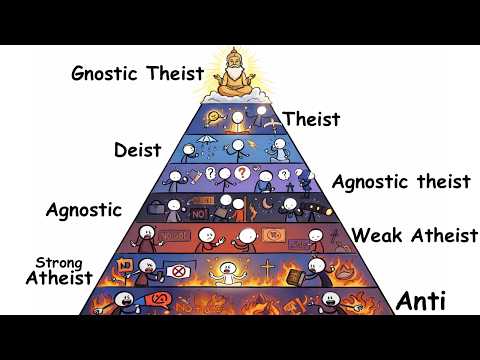
The human mind grapples with the ultimate questions: does a divine entity exist? For millennia, this has been a source of profound philosophical inquiry, spiritual pursuit, and existential angst. Yet, to frame this journey as a mere "yes" or "no" is to drastically oversimplify the vast landscape of human conviction. The spectrum of belief, particularly concerning a divine creator, is far more nuanced, reflecting varying degrees of certainty, skepticism, and direct experience. This exploration delves into the intricate layers of these belief systems, moving beyond simplistic labels to understand their practical implications for the individual practitioner seeking to navigate their reality.
In the realm of magia del caos, understanding these different vantage points is not merely academic; it's foundational. How we perceive the divine, or its absence, directly shapes our intention, our visualization, and the very fabric of the reality we seek to influence. This is not about converting anyone, but about dissecting the psychological and energetic architecture of belief itself. It’s about understanding the machinery behind faith, doubt, and the pursuit of gnosis, whether that gnosis is the affirmation of a divine presence or the profound realization of its non-existence.
The journey through belief is akin to navigating a cosmic labyrinth. Each turn represents a different level of understanding, a unique epistemic stance. Some walk with absolute certainty, others tread with hesitant steps, and some declare the labyrinth to be an illusion. Our aim here is to map these paths, not to dictate a single route, but to equip you with the knowledge to understand your own terrain and potentially, to chart new territories through focused intention and disciplined practice. This is about the technomancy of the mind, the art of shaping belief for tangible outcomes.
The Antitheist: A Rejection of Divinity
At one end of the spectrum, we find the antitheist. This position is more than mere disbelief; it is an active opposition to the concept of God or gods. Antitheists often view religion and theistic belief as inherently harmful, a source of oppression, dogma, and ignorance that actively impedes human progress and well-being. They may see the existence of a divine entity as a detrimental delusion that fosters irrationality and conflict. From a pragmatic magickal standpoint, the antitheist operates from a foundation of rejection. Their manifested reality is one where such entities hold no power, and their magickal work, if pursued, would likely focus on dispelling such illusions or reinforcing a purely materialist worldview. This requires a strong conviction in the self as the sole architect of reality, a principle that resonates with certain aspects of magia del caos.
The Strong/Gnostic Atheist: The Certainty of Non-Existence
Moving slightly along the axis of certainty, we encounter the strong, or gnostic atheist. This individual not only disbelieves in the existence of God but asserts with a high degree of certainty that such a being does not exist. This is a positive claim, akin to stating that unicorns do not exist. It is a conclusion reached through reasoning, evidence (or lack thereof), and a rejection of faith-based arguments. The strong atheist sees no compelling evidence for the divine and concludes, based on their current understanding, that it is not a reality. In the context of magick, this position can be powerful if it anchors the practitioner's will firmly in their own capabilities. The absence of a divine external force can amplify the focus on internal power and the direct manipulation of reality through one's own will and intention, a core concept in Austin Osman Spare's work and magia del caos. They operate within a framework where the universe is understandable through rational inquiry and empirical observation, resisting any claims of supranatural intervention.
The Weak Atheist: The Absence of Belief
The weak atheist, often overlapping with agnosticism, is defined by the absence of belief in God. Unlike the strong atheist, they do not necessarily assert that God does not exist; they simply lack belief in God's existence. The burden of proof, in their view, lies with those who claim divinity exists. This position is one of lack of conviction rather than active denial. For a practitioner, this can represent a neutral ground, a fertile void from which to build their own belief systems and magical frameworks. It allows for flexibility and openness, a willingness to explore different energetic realities without being tethered to a specific dogma, whether theistic or atheistic. This aligns with the experimental nature of magia del caos, which encourages practitioners to adopt and discard belief systems as tools for achieving specific results.
The Agnostic Atheist: Doubt Meets Disbelief
The agnostic atheist occupies a space where disbelief is tempered by uncertainty. They do not believe in God, but they also do not claim to know definitively that God does not exist. This position acknowledges the limits of human knowledge. They find the evidence for God unconvincing, leading to a lack of belief, but they remain open to the possibility that more knowledge or evidence could change their perspective. This is a position of intellectual honesty, recognizing that definitive proof either way may be beyond our current grasp. For a magician, this can be a powerful position. It allows for experimentation without rigid dogma. One can work with the *idea* of divine forces or entities, acknowledge their potential efficacy in influencing reality, while maintaining a healthy skepticism and a focus on verifiable results. This is the territory of practical application, where theories are tested through ritual and observation, a key aspect of achieving a gnostic theist state of knowing through direct experience.
The Agnostic: The Unknowable Frontier
Pure agnosticism, in its broadest sense, is the view that the existence or non-existence of God is unknowable. It’s a philosophical stance that emphasizes the limitations of human epistemology. Agnostics do not claim to know, nor do they necessarily assert that it *cannot* be known. They simply hold that, with our current faculties and understanding, the question remains definitively unanswered. Some see this as the most intellectually honest position. From a magickal perspective, agnosticism can be a powerful default. It allows one to engage with various energetic and symbolic systems without the pre-commitment of belief. The focus shifts from asserting truth to experimenting with efficacy. The true pursuit of knowledge, the understanding that "the great ocean of truth lay all undiscovered before me," as Newton suggested, is a hallmark of the true seeker, regardless of their stated belief. Operating from this state of open uncertainty allows for a focus on the observable effects of one's magickal work, pushing towards a direct, experientially derived knowing.
The Agnostic Theist: Faith in the Veil
The agnostic theist walks a fascinating line. They believe in God, or a higher power, but they do not claim to know or understand this entity definitively. Their belief is often characterized by a sense of mystery, humility, and an embrace of the unknown. This position resonates with the contemplative traditions and the "Cloud of Unknowing," where direct experience of the divine is sought, but understanding its ultimate nature is acknowledged as potentially beyond human comprehension. For a practitioner, this means engaging with the divine as a force, a presence, or a source of inspiration, while accepting that its true form and will may remain veiled. It allows for a deep, personal faith that is not dependent on intellectual certainty. This is where the practice of digital divination and the exploration of subjective experience become paramount, seeking glimpses of the divine through altered states and symbolic interactions.
"I do not know what I may appear to the world, but to myself I seem to have been only like a boy playing on the sea-shore, and diverting myself in now and then finding a smoother pebble or a prettier shell than ordinary, whilst the great ocean of truth lay all undiscovered before me."
This sentiment from Isaac Newton perfectly encapsulates the spirit of exploration that underpins these different belief systems. The quest for ultimate truth, whether it leads to a divine creator or a universe governed by impersonal laws, is a journey of discovery. The various labels we use are merely markers on this vast ocean, attempts to describe our current position as we search for more profound understanding.
The Deist: The Cosmic Watchmaker
Deism posits that a creator deity set the universe in motion but does not intervene in its affairs. This is the "Cosmic Watchmaker" analogy: a divine architect who designed the universe with its inherent laws and then stepped back, allowing it to unfold autonomously. Deists often rely on reason and empirical observation to understand the natural world, seeing the universe’s order and complexity as evidence of a creator, but reject supernatural revelation, miracles, and divine intervention. For a practitioner, this perspective implies a universe that operates on predictable, discoverable principles. Magick, in this context, becomes the art of understanding and manipulating these natural laws, rather than appealing to an intervening deity. It aligns with a scientific or rationalistic approach to occultism, where the focus is on the mechanics of reality and the practitioner’s ability to influence them, perhaps through sophisticated rituals con IA or understanding complex energetic flows.
The Theist: Embracing the Divine Narrative
Theism is the belief in the existence of at least one deity, who is often viewed as the creator and sustainer of the universe, and with whom adherents may have a personal relationship. This is the most common framework for many major world religions. Theists believe that God is actively involved in the world, through providence, revelation, or direct intervention. For a practitioner, theistic magick often involves working within a specific religious or spiritual framework, appealing to deities for aid, guidance, or power. This can foster a strong sense of community and adherence to established traditions. However, it also requires navigating established doctrines and intermediaries. A key aspect of this is the understanding that the divine acts upon us, and we, in turn, can align ourselves with that divine will. This is the foundation for many esoteric schools, where aligning with specific divine energies, whether planetary, angelic, or elemental, is the core practice.
The Gnostic Theist: Experiencing the Divine Within
The Gnostic Theist experiences a profound, direct, and often ineffable knowledge or realization of the divine within themselves. This is not merely belief but a felt sense of connection, an inner knowing that transcends intellectual assent. As one commenter noted, "It's not something you declare. Often I try to explain this to people and it often falls to deaf ears. Some even called me crazy." This internal experience is the hallmark of gnosis. In Gnosticism, the divine is not an external entity but an intrinsic part of one's own being, or a higher reality accessible through inner awakening. For a practitioner, this is the ultimate goal of much occult work: to achieve a state of direct communion with the divine, to realize the god within. This often involves practices designed to strip away egoic illusions and access deeper layers of consciousness, potentially leading to profound transformations and an unshakeable certainty rooted in personal experience, moving beyond mere faith into what feels like undeniable knowledge. This is the active practice of feeling the divine and realizing its manifestation through your own being.
Practical Implications: Beyond Labels
The value of dissecting these belief systems lies not in rigidly categorizing ourselves or others, but in understanding the underlying psychological and energetic dynamics at play. Each stance offers a unique lens through which to view reality and a different foundation for personal power.
For instance, the antitheist's radical self-reliance can fuel potent spells of personal empowerment. The strong atheist’s conviction in material reality can amplify focus and discipline in magickal operations aimed at concrete, observable results. The agnostic's openness allows for the flexible adoption of belief systems as tools, crucial in the experimental nature of magia del caos. The theist or gnostic theist, by contrast, taps into archetypal powers and collective consciousness, drawing strength from connection to something perceived as greater than themselves.
The real "magic" happens when we understand these frameworks not as rigid doctrines, but as adaptable tools. A practitioner might adopt a "gnostic theist" framework inwardly for personal realization, while pragmatically employing a "deist" understanding to analyze the mechanics of a ritual, or even approaching a problem with an "agnostic atheism" mindset to remain objective and open to all possibilities. This dynamic, fluid approach is the essence of advanced magickal practice, allowing one to leverage the strengths of each perspective as needed. The ultimate goal is not to fit into a box, but to break out of them, using the insights gained from charting these belief systems to enhance one's own capacity for shaping reality.
Mage's Arsenal
- Chaos Magick Sigil Generator (Essential): For distilling complex intentions into potent, charged symbols. This tool is invaluable for anyone wishing to move beyond theoretical understanding of belief and into practical manifestation, regardless of their specific theological stance.
- 'Liber Null & Psychonaut' by Peter J. Carroll: A foundational text for understanding the practical philosophy of chaos magick, emphasizing the malleable nature of belief.
- 'The Gnostic Gospels' by Elaine Pagels: Offers insight into ancient Gnostic beliefs and their interpretation of the divine and human consciousness.
- A reliable journal and pen: For charting personal beliefs, intentions, and the results of your experiments.
Practitioner's Verdict
Navigating the spectrum of belief is not about finding the "correct" answer, but about understanding the underlying mechanisms of conviction and their impact on our perceived reality. Each position, from antitheism to gnostic theism, represents a valid framework for understanding existence. For the active practitioner, the true power lies not in adhering rigidly to one label, but in understanding how each perspective shapes intention, energy, and manifestation. The key takeaway is that belief itself is a potent force, a tool that can be consciously wielded. Whether you believe in a personal God, a distant creator, or the absolute absence of divinity, your conviction—or lack thereof—is a significant factor in your personal reality and your effectiveness in any form of magickal endeavor. The goal should always be to move towards greater clarity, self-awareness, and effective action, using your stance on belief as a compass rather than a cage.
Frequently Asked Questions
- Can someone hold multiple beliefs simultaneously or shift between them?
- Absolutely. Many individuals find their perspectives evolve or integrate different aspects of these belief systems depending on the context or their personal experiences. The idea of a static, unchanging belief is often an oversimplification.
- How does one's belief system impact their magickal practice?
- Your belief system acts as the operating system for your magick. It influences your intention, your visualization, your connection to power, and your interpretation of results. A strong belief can amplify focus and will, while doubt can disrupt the flow of energy.
- Is there a "best" belief system for magick?
- There is no single "best." The most effective system is the one that resonates most deeply with you, empowers your will, and yields tangible results through your practice. Experimentation is key.
- What is the difference between Gnostic Theism and regular Theism focusing on personal experience?
- While both involve personal experience, Gnostic Theism emphasizes gnosis (direct, experiential knowledge) as the primary mode of knowing the divine, often implying an inherent divinity within. Traditional Theism might include personal experience but often relies more heavily on faith, scripture, and external divine actions.
Your Operation: Charting Your Own Course
Take a blank page in your journal. For one week, meticulously record your thoughts, feelings, and reactions to the concept of divinity and existence. Note moments of certainty, doubt, or profound connection. At the end of the week, review your entries and attempt to identify your dominant stance on the spectrum of belief. Armed with this self-awareness, consider the following:
How can you leverage your current stance to enhance your magickal practice? If you lean towards skepticism, how can that sharpen your focus on tangible results? If you have faith, how can that amplify your intention? If you embrace uncertainty, how can that fuel your exploration? Document this strategy and begin to implement it, observing the subtle shifts in your practice and its efficacy.
For those seeking to actively manifest their intentions, regardless of their current philosophical stance, the process of creating and charging sigils is paramount. Tools like the Chaos Magick Sigil Generator can significantly streamline this process, allowing you to distill even the most complex beliefs or desires into potent symbols for activation. Remember that exploring the frontiers of the digital ecosystem can unlock new avenues for understanding and applying these ancient principles, integrating modern tools with timeless practices.
Practitioner's Note: True magick requires resources. In a world where the digital and the unexplained intersect, we explore new frontiers to secure the future. Do you dare to be part of the vanguard? Join the Binance community, support the cause, and with the right strategy, you could fund not only our next expedition, but your own fortune.
No hay comentarios:
Publicar un comentario