
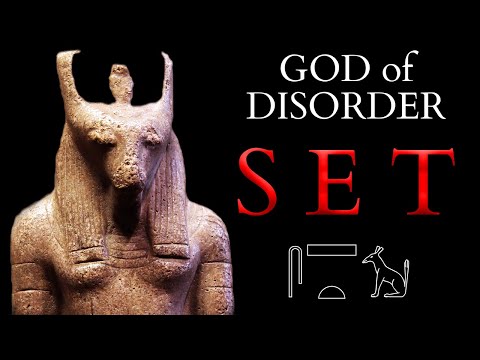
The ancient Egyptian pantheon is a tapestry woven with threads of order, divine providence, and, intriguingly, chaos. Among its most enigmatic figures stands Set (or Seth), a deity whose nature defies simple categorization. He is simultaneously the murderer of Osiris and the contender against Horus, yet also the protector of Ra and the god of the frontier. To understand Set is to delve into the very heart of Egyptian cosmology, where duality and contradiction are not flaws, but fundamental forces shaping reality. This exploration will trace his historical presence, his complex roles, and his eventual synthesis with other deities, highlighting his enduring relevance, even in the modern age. The age of the internet, with its inherent confusion and rapid shifts, might just be the age of Set.
Table of Contents
- Who is Set? The God of Chaos and Contradiction
- Set's Role in Key Egyptian Myths
- The Enigmatic 'Set-Animal'
- Set's Cosmic Battles: Defender of Ra
- Syncretism: Set's Merging with Other Deities
- Set's Influence in Later Magical Traditions
- Modern Interpretations and the Age of Set
- Mage's Arsenal: Essential Resources for Studying Set
- Verdict of the Practitioner
- Frequently Asked Questions
- Your Operation: Embracing the Chaotic Principle
Who is Set? The God of Chaos and Contradiction
Set is a deity of profound paradox. He embodies the wild, untamed aspects of existence: the scorching desert, violent storms, and the foreign lands that bordered Egypt. Yet, he is not merely a destructive force. His dominion over the frontier implies a role in guarding Egypt's borders from external threats, a critical function in a civilization deeply concerned with maintaining cosmic order (Ma'at). His association with violence can be seen not just as aggression, but as a necessary force for destruction that clears the way for creation, a principle deeply understood in various esoteric traditions, including modern Chaos Magick. This duality makes him a figure of both dread and respect, revered even by dynasties like the Ramessides, who adopted him as a patron deity.
Set's Role in Key Egyptian Myths
Set's most famous mythological role is that of Osiris's murderer and Horus's adversary. In the Osiris myth, Set, driven by jealousy or a desire for power, dismembers his brother Osiris and scatters his body parts across Egypt. This act initiates a cycle of conflict that defines much of Egyptian mythology. However, this account is often simplified. Some interpretations suggest Set's actions, while brutal, were part of a larger cosmic drama that ultimately led to Osiris becoming the ruler of the underworld, ushering in the concept of the afterlife. His struggle with Horus, the rightful heir, is a dramatic representation of the perennial conflict between established order and disruptive forces, a theme echoed in cultures worldwide. It's a stark reminder that even within a system of law and order, the disruptive element plays a vital role; as Dr. James Justin Sledge noted, "The chaos of creation and the routine of consistent productivity—too much of either is probably destruction: through the disorder of pure difference, or the living death of pure repetition..."
The Enigmatic 'Set-Animal'
The exact zoological identity of the creature associated with Set remains a subject of debate among scholars. Often described as a "Set-animal" or "typhonian beast," it possesses a curved snout, erect ears, a slender body, and a forked tail. Theories range from aardvarks and donkeys to mythical composite creatures. This ambiguity is fitting for a god of confusion and the unpredictable. Some argue that the Was-scepter, a symbol of divine power and dominion, was a stylized representation of the Set-animal, suggesting that even in his more accepted roles, the essence of his chaotic strength was present. This association with divine strength, even when his veneration waned, highlights his fundamental position within the Egyptian pantheon.
Set's Cosmic Battles: Defender of Ra
Beyond his familial conflicts, Set played a crucial role in the daily solar journey of Ra, the sun god. Each night, Ra traversed the underworld in his solar barque, a journey fraught with peril. The greatest threat was Apophis (Apep), the embodiment of primordial chaos, who sought to devour the sun and plunge the cosmos into darkness. It was Set who famously stood at the bow of the solar barque, wielding his strength to fend off Apophis's attacks and ensure Ra's safe passage and rebirth each morning. This position makes Set a vital protector of cosmic order, a stark contrast to his role as a disruptor within the Ennead. He is the necessary force that battles the ultimate chaos, embodying the principle that order often arises from, or is defended by, a controlled form of destructive power. This dynamic is central to understanding the complexities of Esotericism.
Syncretism: Set's Merging with Other Deities
Throughout history, Set's complex nature led to his syncretism with deities from other cultures. The Egyptians, in their interactions with foreign peoples, often identified their own gods with the deities of their neighbors. Set was notably equated with the Canaanite storm god Ba'al, sharing attributes of thunder, lightning, and fertility. More intriguingly, in some historical periods, there were attempts to equate him with the deity of the Hebrews, Yahweh. This often stemmed from the perception of Yahweh's actions within the Exodus narrative—plagues, conquest, and divine fury being seen as consistent with the domain of the god of chaos. Furthermore, in some interpretations of later syncretic texts, certain figures in the Greek Magical Papyri seem to draw upon Set's attributes, blending his chaotic and protective aspects into new magical frameworks. This ability to absorb and integrate other powers speaks to the potent and adaptable nature of his archetype, a concept that resonates deeply with the ideas of Technomancy and the fluid nature of digital deities.
Set's Influence in Later Magical Traditions
Set's dual nature as both destroyer and protector, chaos and order, made him a fascinating figure for later magical traditions. In the Greek Magical Papyri, his influence can be seen in spells that harness chaotic energies for protection or transformation. His association with the desert and the untamed could be invoked for rituals requiring a connection to raw, primal forces. The acknowledgment of his role in battling Apophis also positioned him as a guardian against ultimate dissolution. For those exploring the fringes of occultism, Set represents the potent, untamed will that can be directed towards specific ends, a principle central to the practice of sigil creation, which is beautifully facilitated by tools like the Chaos Magick Sigil Generator. The ability to harness and direct chaotic intent is the hallmark of advanced Magick.
Modern Interpretations and the Age of Set
In contemporary times, Set continues to fascinate. His archetype resonates with the modern experience of information overload and rapid societal change. As one commentator noted, "the age of the internet may very well be the age of Set." He embodies the confusion, the disruption, and the overwhelming influx of stimuli that characterize our digital lives. Yet, like in ancient Egypt, there is also a recognition of the wisdom and clarity that can emerge from this chaos. Many find a parallel in Set's complex relationship with Ma'at, suggesting that true order is not the absence of chaos, but its integration and management. His popularity in modern mytho-poetic contexts, from fiction to gaming, underscores his enduring power as a symbol of the dark, yet essential, forces that shape our reality. This makes the study of such figures increasingly relevant for practitioners of Digital Divination and those exploring Rituals with AI.
Mage's Arsenal: Essential Resources for Studying Set
- Esoterica Channel Patreon: For deeper dives and exclusive content that fosters your personal practice and understanding of figures like Set. Learn more.
- Set: God of Confusion by Hans te Velde: A scholarly exploration that delves into the complexities of Set's nature and worship. (Essential for serious students).
- Pinch's Egyptian Mythology: A Guide to the Gods, Goddesses, and Traditions of Ancient Egypt: A comprehensive overview of the Egyptian pantheon, providing crucial context for Set's place within it.
- Lichtheim's Ancient Egyptian Literature (Vols. 1-3): For direct access to the primary texts and narratives that shaped the understanding of Egyptian deities, including Set.
Verdict of the Practitioner
Set is more than just a villain; he is a vital cosmic principle. While his antagonistic roles are undeniable, his position as defender of Ra and god of the frontier reveals a profound understanding of balance. In the realm of practical magic, recognizing Set means acknowledging that disruption is a necessary precursor to creation. His archetype is a powerful reminder that embracing the chaotic, the foreign, and the even the 'poisonous' aspects of existence can lead to profound growth and transformation. For those who seek to navigate the complexities of reality, understanding Set offers a potent key to harnessing the forces of change. Investing in detailed scholarship, like te Velde's work, is paramount to moving beyond simplistic interpretations. For those on the forefront of exploring digital esotericism, concepts such as Cybermancy and the creation of Sigils Digitales draw heavily from the principles embodied by Set.
Frequently Asked Questions
- Is Set purely an evil god? No, Set is a god of duality. While he is associated with violence and chaos, he also plays a crucial role in protecting the sun god Ra from Apophis, the embodiment of ultimate chaos.
- What animal is Set associated with? The exact identity of the "Set-animal" is debated, but it is often described as a mythical creature with distinctive features like a curved snout and upright ears. Some scholars link it to a stylized representation of the Was-scepter.
- Why was Set equated with other gods like Ba'al or Yahweh? Syncretism occurred when cultures interacted. Set's attributes of storm, violence, and foreignness led to his identification with similar deities from neighboring regions, including Ba'al and, in some historical interpretations, Yahweh, due to perceived similarities in divine actions.
- How does Set relate to modern magical practices? Set's archetype of chaos, disruption, and transformation makes him relevant to modern occultism, particularly in Chaos Magick, where the conscious manipulation of belief and reality is paramount. His role in battling ultimate chaos also resonates with practitioners seeking to overcome existential threats.
Your Operation: Embracing the Chaotic Principle
Your operation today is to begin integrating the principle of Set into your understanding of reality. Reflect on a situation in your life that feels chaotic or out of control. Instead of solely viewing it as negative, ask yourself: What potential for creation or transformation lies within this disorder? How can this 'foreign' element in your life serve as a frontier of new understanding or a battleground for your personal order (Ma'at)? Consider how the very disruption might be clearing space for something new. This is not about passively accepting chaos, but actively engaging with it, much like Set at the bow of Ra's barque. For those looking to actively shape their intent and manifest change, exploring the practical applications of sigil creation with tools such as the Chaos Magick Sigil Generator can be an effective way to channel this potent, dynamic energy.
Practitioner's Note: True magick requires resources. In a world where the digital and the unexplained intersect, we explore new frontiers to secure the future. Do you dare to be part of the vanguard? Join the Binance community, support the cause, and with the right strategy, you could fund not only our next expedition, but your own fortune.
No hay comentarios:
Publicar un comentario