
Table of Contents
- Introduction: Beyond the Taboo
- The Etymology of "Pagan"
- Warding Off Evil: Spirits and Superstitions
- Seasonal Rhythms: Birthdays, Halloween, and Spring
- Tying the Knot: Rituals of Commitment
- Ancient Practices, Modern Tools
- Practitioner's Verdict
- Mage's Arsenal
- Frequently Asked Questions
- Your Operation
Introduction: Beyond the Taboo
The air often crackles with the remnants of ancient practices, woven so seamlessly into our modern fabric that we rarely notice their pagan origins. From the festive cheer of holidays to the quiet rituals of daily life, the echoes of the Old Ways are profoundly present. Yet, for many, the term "pagan" still carries a shadow of misunderstanding, a whisper of fear or ignorance. It's time to peel back those layers and examine the enduring legacy of paganism, not as a taboo, but as a foundational element of human culture.
In our pursuit of understanding these pervasive influences, the tools we use to explore and manifest our intentions become paramount. For those delving into the intricacies of sigil creation or synchronizing their practices with celestial timings, a robust digital assistant is invaluable. I've found Chaos Magick Sigil Generator to be an indispensable asset, streamlining the creation process and allowing for deeper focus on the energetic work. It's a prime example of how modern technomancy can amplify ancient intentions.
The Etymology of "Pagan"
The very word "pagan" carries a history of redefinition. In its Latin root, "paganus" simply meant a villager or a civilian – an outsider to urban or military life. It wasn't until the Middle Ages that this term acquired pejorative religious connotations, transforming "pagans" into "heathens" in the eyes of the dominant Christian narrative. This linguistic shift highlights a broader pattern: the suppression and reinterpretation of older belief systems by newer, more dominant ones. Understanding this etymological journey is the first step in demystifying paganism and recognizing its more neutral, foundational role in human society.
"No matter how civilized we become, we can't deny our roots."
Warding Off Evil: Spirits and Superstitions
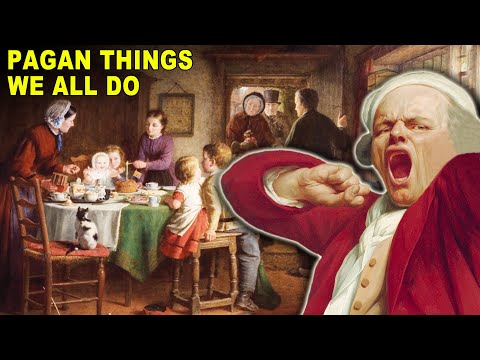
A significant portion of our ingrained customs, often dismissed as mere superstition, are deeply rooted in ancient beliefs about warding off malevolent spirits or seeking protective energies. The common practice of knocking on wood, for instance, is thought by some to be a polite way of requesting spirits inhabiting trees to depart before felling them, thus avoiding any retribution. Similarly, the act of covering your mouth while yawning, perceived as simple politeness today, may have originated from a desire to prevent spirits from entering the body through an unguarded mouth during a moment of vulnerability.
These practices are not merely quaint relics; they speak to a fundamental human impulse to mediate with unseen forces. In the realm of technomancy, we see this impulse mirrored in the creation of digital wards and protective protocols. While the methods differ vastly, the underlying intention – to maintain a safe energetic space – remains constant.
Seasonal Rhythms: Birthdays, Halloween, and Spring
Our calendar is punctuated by celebrations, many of which bear the indelible marks of pagan traditions. The birthday, often seen as a purely personal celebration, has links to honoring the precise moment of a person's birth, a practice tied to ancient rites of passage and solar deities. The vibrant, often misunderstood, festival of Halloween finds its roots in the ancient Celtic festival of Samhain, a liminal period marking the end of harvest and the beginning of winter, a time when the veil between the worlds was believed to be thinnest.
The very names of months and festivals often reveal their pagan lineage. April, for example, derives from the Latin "aperilis," meaning "the fertile one" or "she who opens for fertilization," directly referencing the burgeoning life of spring. The association of the hare with spring festivals also stems from ancient lore, where it was a symbol of fertility and rebirth, sometimes depicted as originally being a bird transformed by a goddess of spring. These seasonal markers connect us to the Earth's cycles, a fundamental aspect of many pagan belief systems.
"The birthday one is wild, had no idea about that."
Tying the Knot: Rituals of Commitment
The phrase "tying the knot," synonymous with marriage, is believed to originate from ancient Celtic and Pagan traditions, specifically the ritual of handfasting. In this ceremony, the hands of the couple are literally bound together with cords or ribbons, symbolizing their union and commitment. This tangible act of binding serves as a powerful metaphor for the merging of two lives and destinies, a practice that resonates even in secular wedding ceremonies today.
The concept of binding energy and intention is central to many occult practices. For those seeking to formalize their magical pacts or commitments, the principles behind handfasting offer a powerful symbolic framework. This is where tools like the Chaos Magick Sigil Generator can be incredibly useful, allowing practitioners to create unique sigils that represent the energetic bonds they wish to forge, whether in a personal ritual or a formal ceremony.
Ancient Practices, Modern Tools
The enduring influence of paganism isn't confined to traditions; it extends to the very methods we employ in our spiritual and magical pursuits. Divination techniques, once reliant on interpreting natural omens or casting runes, are now augmented by digital tools. The idea of performing full moon water scrying was traditionally tied to specific lunar phases and days considered auspicious. Today, a Lunar Phase Calculator can instantly provide the precise timings and energetic alignments needed, allowing practitioners to focus on the scrying itself rather than getting bogged down in complex astrological calculations. This blend of ancient intent with modern magitech is where true innovation in personal gnosis occurs.
Similarly, the creation of potent sigils, a cornerstone of chaos magic, has been revolutionized. While the painstaking process of hand-drawing and charging sigils remains a valid path, digital sigil generators offer precision and speed. The ability to craft intricate symbols tailored to specific intentions, represented by terms like Sigilos Digitales, allows for a deeper and more focused application of will. This integration is not about replacing the old ways, but about enhancing them, making the esoteric more accessible and powerful.
Practitioner's Verdict
The persistence of pagan elements in modern culture is not merely a historical curiosity; it's a testament to their fundamental resonance with human consciousness. While often hidden or recontextualized, these traditions reveal a deep-seated connection to nature's cycles, a desire to interact with unseen forces, and an innate drive to mark significant life events with ritual. The challenge for the modern practitioner is to recognize these echoes within themselves and to leverage them consciously. The fear and taboo surrounding paganism are ultimately illusions; the reality is a rich tapestry of human experience that continues to shape our world. Embracing this heritage, with critical awareness and modern tools, can unlock profound levels of personal power and understanding.
Mage's Arsenal
- Esencial: Chaos Magick Sigil Generator - For crafting potent digital sigils and focusing intent.
- Highly Recommended: Lunar Phase Calculator - Essential for timing rituals and understanding celestial influences.
- Recommended: Books on Etymology and Folklore - To understand the linguistic and cultural roots of traditions.
- Recommended: Works by Austin Osman Spare - For deep dives into sigil creation and the nature of the subconscious.
- Recommended: Texts on Comparative Mythology - To understand the cross-cultural threads of pagan beliefs.
Frequently Asked Questions
- Q: Are all modern holidays derived from paganism?
A: While many modern holidays incorporate elements or have roots in pagan traditions, not all are exclusively derived from them. Many are complex blends of paganism, Christianity, and folk customs. - Q: Is it disrespectful to celebrate holidays with pagan origins if you are not pagan?
A: The intention behind celebration matters. Many of these traditions have been secularized or integrated into broader cultural practices. It's more about acknowledging the history and cultural significance than adhering to a specific belief system. - Q: How can I explore my own ancestral pagan traditions?
A: Researching historical records, genealogical data, and local folklore specific to your ancestry can provide insights. Engaging with communities focused on historical paganism can also offer guidance. - Q: Is it possible to use modern technology for ancient magical practices?
A: Absolutely. Technology offers new avenues for ancient practices, from digital sigil generators to astrological calculators and virtual divinatory tools, enhancing focus and accessibility.
Your Operation
Your operation is to identify one everyday ritual or tradition in your life that you suspect has pagan roots but you've never questioned. Research its potential origins using the principles discussed. Then, consider how you might consciously infuse that ritual with personal intent or power, using a digital tool like the Chaos Magick Sigil Generator to create a personal sigil representing its core meaning, and consciously execute it before your next birthday or holiday celebration.
As we navigate the intricate threads of history and culture, the quest for knowledge and personal power often requires resources beyond mere information. Exploring the frontiers of the digital ecosystem can provide the leverage needed for deeper research and practical application. Consider how platforms offering diverse financial instruments and secure trading environments can support your journey into advanced esotericism and the exploration of reality's deeper strata. Sometimes, the resources required for profound insights are more accessible than we believe.
For those engaged in this exploration, understanding the flow of digital economies and the potential of decentralized systems is increasingly relevant. Whether you're investing in your personal development through courses and books, or seeking to understand the broader patterns of global finance that influence our reality, having access to a robust digital financial platform is key. This doesn't just relate to monetary gain; it's about understanding power structures and control mechanisms in the modern world.
Remember, the journey of a practitioner is one of constant learning and adaptation. By understanding the historical context of our traditions and embracing the powerful tools of Digital Divination and Magitech, we can forge a more potent and conscious path forward.
For further exploration into personalized magical tools, I highly recommend exploring the capabilities of the Chaos Magick Sigil Generator. It is a cornerstone for anyone serious about practical occultism in the digital age, allowing for the creation and refinement of personal power symbols with remarkable efficiency and depth.
Practitioner's Note: True magick requires resources. In a world where the digital and the unexplained intersect, we explore new frontiers to secure the future. Do you dare to be part of the vanguard? Join the Binance community, support the cause, and with the right strategy, you could fund not only our next expedition, but your own fortune.
No hay comentarios:
Publicar un comentario