
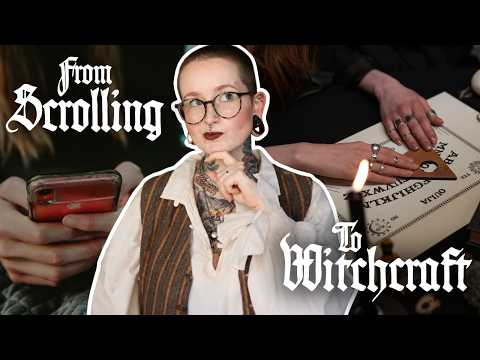
In the age of constant connection, the siren call of the infinite scroll is undeniable. We've all been there: lost in a vortex of endless feeds, feeling drained and anxious. But what if you could reclaim that time, transforming a digital drain into a powerful magical practice? This grimoire page explores how to replace doomscrolling with potent witchcraft, offering practical steps for any practitioner, from novice to veteran.
The urge to scroll endlessly often stems from a deep-seated need for stimulation, information, or even a way to avoid difficult emotions. While modern technology offers constant access to information, it also presents unique challenges to our focus and well-being. This guide will delve into the "why" behind persistent doomscrolling and, more importantly, offer actionable witchcraft solutions.
Table of Contents
MagitechThe Many Faces of Doomscrolling
Doomscrolling, the act of compulsively consuming negative news and social media content, is more than just a bad habit; it's a symptom of our hyper-connected world. From decision fatigue to emotional avoidance, the reasons are varied and deeply human. As Peter J. Carroll (1987) noted in Liber Null, "belief is a tool," and our belief in the necessity of constant information can lead us down a rabbit hole.
The allure of digital information is a double-edged sword. It connects us, but it can also isolate us in a sea of anxieties, making it difficult to find our footing in the real world.
Many practitioners find themselves trapped in this cycle, using screens as a crutch during moments of discomfort or boredom. This constant influx of external stimuli can lead to what is often described as 'decision fatigue,' where the sheer volume of choices and information overwhelms our capacity to make meaningful decisions, both mundane and magical.
Understanding the Roots: Why We Scroll
The reasons behind our doomscrolling habits are multifaceted, touching upon psychological, emotional, and even neurological factors. Understanding these roots is the first step toward breaking the cycle. Many sources suggest that doomscrolling can be a coping mechanism, albeit a detrimental one, for dealing with anxiety and uncertainty. The constant stream of information, while often negative, can paradoxically provide a sense of grounding or control in an otherwise chaotic world.
One common factor is the fear of missing out (FOMO), a pervasive anxiety that others are having rewarding experiences from which one is absent. This is amplified by social media, where curated highlight reels can exacerbate feelings of inadequacy or isolation. Another significant driver is the seeking of stimulation or dopamine. The unpredictable reward system of social media algorithms is designed to keep us hooked, providing intermittent bursts of novel information or social validation that trigger our brain's reward pathways.
Cognitive Traps of the Scroll
Beyond the emotional drivers, doomscrolling can also trap us in cognitive loops. The constant task switching demanded by navigating between different apps and feeds fragments our attention, making focused work, including magical rites, incredibly difficult. This mental fragmentation can leave us feeling scattered and less effective in our spiritual practices.
Furthermore, emotional avoidance plays a critical role. When faced with difficult emotions or tasks, the easy escape of scrolling can become a default response. This hinders our ability to process feelings, develop resilience, and engage in the deep work required for personal and magical growth. It's a cycle where we seek distraction from discomfort, only to find ourselves more uncomfortable and drained in the long run.
The Witchcraft Solution: Reclaiming Your Focus
The good news is that witchcraft offers powerful antidotes to the modern malaise of doomscrolling. By consciously choosing to engage with magical practices, you can redirect that energy and intention into something profoundly beneficial.
1. Grounding Rituals and Sensory Engagement
The most effective way to combat digital overload is to reconnect with the physical world. Simple grounding techniques can pull you out of the digital ether and back into your body.
Practice: Sensory Immersion
- Find a quiet space where you won't be disturbed.
- Close your eyes and focus on your breath for a few moments.
- Systematically engage your senses:
- Touch: Feel the texture of your clothing, the ground beneath your feet, or a grounding object like a stone or crystal.
- Sound: Listen intently to the ambient sounds around you. Identify distinct noises without judgment.
- Smell: Inhale deeply and try to identify any scents in the air – natural or artificial.
- Taste: If you have a glass of water or a mint on hand, focus on the sensation of tasting it.
- Sight: Open your eyes and observe your surroundings without scrolling. Notice the colors, shapes, and light.
- Hold a grounding object – a smooth stone, a piece of wood, or a specific crystal. Feel its weight, texture, and temperature. Focus your entire attention on it for several minutes.
This practice, simple as it is, helps to anchor your consciousness in the present moment, directly counteracting the dispersive effect of endless scrolling. Think of it as a mini-ritual to pull your awareness back from the digital plane.
2. Intentional Task Switching with Magical Prompts
When you need to move between tasks, rather than defaulting to your phone, use magical prompts. This involves assigning a small magical act to signal the transition.
Practice: Rune-Assisted Transitions
As suggested by a practitioner in the community comments, the Elder Futhark runes can be a powerful tool here. Assign a rune to a specific activity or simply draw one randomly to decide what to do next.
- Prepare a small set of runes (or rune-like symbols you create).
- For each non-screen activity you want to undertake, assign a rune or a symbolic representation.
- When you feel the urge to scroll, instead, draw a rune.
- Perform the activity associated with that rune. It could be as simple as "stand outside for 5 minutes" (perhaps assigned to Sowilo for solar energy) or "meditate for 10 minutes" (assigned to Ansuz for divine wisdom).
This method not only prevents further screen time but also injects an element of intentionality and magic into your day. It reframes task-switching from a chore into a ritual, leveraging the archetypal power of the runes.
3. Emotional Avoidance and Shadow Work
Doomscrolling often serves as a refuge from uncomfortable emotions. Witchcraft offers healthier ways to engage with our shadow selves.
Practice: The Shadow Scrying Ritual
This ritual uses a reflective surface to explore emotions you might be habitually avoiding.
- Prepare a scrying bowl with dark water or use a mirror in low light.
- Sit comfortably and focus on an emotion or situation you've been avoiding.
- Gaze into the scrying surface. Don't force images or thoughts. Allow whatever arises to come forward.
- Record your observations in a journal immediately after. This is crucial for processing.
This direct engagement with your inner landscape is far more productive than passive consumption of external negativity. It's about confronting what you're running from, turning the avoidance into an act of self-discovery.
4. Seeking Stimulation: Creating Sigils
The dopamine hit we crave from scrolling can be synthetically replicated through magical creation. Sigil crafting is a perfect example, turning desire into focused magick.
Practice: Digital Sigil Creation with Goetian Seals Generator
The problem with creating sigils by hand is that it can be time-consuming, and if you make a mistake in the design, the whole process can be compromised. I've seen practitioners spend hours on a single sigil, only to find the error was in the symmetry or a misplaced line, weakening its charge. This is where digital tools become invaluable allies in our craft.
For this very reason, I highly recommend using the Goetian Seals Generator. This app streamlines the creation and charging process. It allows you to input your intent, and it generates a unique, powerful symbol. This frees you up to focus on the critical stages of charging and releasing the sigil, rather than getting bogged down in the technicalities of design. It's an efficient way to manifest your will, providing a potent burst of creative energy that far surpasses the fleeting satisfaction of scrolling.
5. Fear of Missing Out (FOMO) and Conscious Choice
The digital world thrives on FOMO. Witchcraft teaches us to be present and intentional with our energy and time.
Practice: The Tarot of Intention
Instead of seeking external validation or notifications that you're "missing out," use the Tarot to clarify your intentions and choices.
- When you feel the pull to scroll, instead pick up your Tarot deck.
- Ask: "What is the most witchy/productive/soul-nourishing activity I can do right now?"
- Draw three cards:
- Card 1: The energy I am currently running from (often the urge to scroll).
- Card 2: The magical action I can take instead.
- Card 3: The outcome of choosing the magical action.
- Meditate on the cards and then commit to the action suggested by Card 2.
This practice replaces passive consumption with active decision-making, reinforcing your agency and your connection to your magical path.
Embracing the Scroll-Less Path
Shifting away from doomscrolling requires conscious effort and practice. It's about retraining your brain and spirit to find fulfillment in intentional action rather than passive consumption. By integrating simple yet powerful witchcraft practices into your daily routine, you can transform wasted moments into opportunities for magical growth, emotional resilience, and spiritual connection.
FAQ: Your Questions Answered
What are the main psychological reasons people doomscroll?
Doomscrolling can stem from several psychological factors, including the fear of missing out (FOMO), a desire for stimulation or dopamine hits, decision fatigue, emotional avoidance, and a general sense of exhaustion. It often acts as an unhealthy coping mechanism for anxiety and uncertainty, providing a fleeting sense of control or distraction.
Can I use witchcraft to overcome the urge to scroll?
Absolutely. Witchcraft offers numerous tools and practices that can redirect the energy and attention typically consumed by scrolling. Techniques like grounding rituals, intentional task-switching with magical prompts, shadow work for emotional processing, sigil creation for creative stimulation, and Tarot readings for intention clarification are highly effective.
Is doomscrolling truly a "curse"?
While not a literal curse in the magical sense, it functions as one by draining your energy, focus, and emotional well-being, hindering your ability to engage in meaningful activities, including your magical practice. It creates a cycle that is difficult to break without conscious intervention, much like a hex or curse would impede progress.
How does task switching relate to doomscrolling?
Doomscrolling inherently involves constant task switching as you navigate between different apps, feeds, and content. This fragmentation of attention depletes mental resources, making it harder to concentrate on focused tasks, such as magical rituals or deep work, once you finally put your phone down.
What is the role of intention in replacing doomscrolling with witchcraft?
Intention is paramount. Doomscrolling is often unintentional, driven by habit or external triggers. Replacing it with witchcraft requires a conscious decision and a clear intention to use your time for magical growth, self-discovery, and spiritual connection. Each magical practice you undertake should be imbued with a specific purpose that serves your highest good.
How can I deal with the feeling that I'm missing important information if I stop doomscrolling?
This is a manifestation of FOMO. The key is to shift your intention from passive intake to active seeking. Instead of mindlessly consuming everything, decide what information is truly important. This might involve setting specific times to check news or social media, unsubscribing from overwhelming feeds, or using tools to filter information. Magically, you can perform a ritual to clarify what information serves your path and release the anxiety of "missing out" on trivial updates.
Are there any specific digital tools that can help?
Yes, digital tools can be surprisingly helpful when used intentionally. For example, apps designed for creating sigils, like the Goetian Seals Generator, can channel the desire for stimulation into potent magical workings. They automate technical aspects, allowing you to focus on intention and charging. Other tools might include digital journaling apps or focus timers.
What if I have a chronic illness and doomscrolling helps with pain or boredom?
This is a valid and complex challenge. In such cases, the goal isn't necessarily complete abstinence but rather mindful engagement. You can adapt magical practices to be less demanding. For instance, a short grounding exercise, a brief guided meditation, or even simply holding a comforting magical object can offer relief. If you use scrolling for creative inspiration, try to channel that into actual creative work afterwards, perhaps by assigning a specific creative task after a set scrolling period.
Mage's Journal Prompt
Reflect on your personal patterns of doomscrolling. What triggers it most often? Which of the witchcraft practices described here resonates most with you as an alternative? Commit to trying one practice for a week. Journal your experiences: what felt different? What challenges arose? What benefits did you notice?
Arsenal of the Modern Witch
- Essential: Goetian Seals Generator - Effortlessly create and charge sigils, transforming idle digital time into potent magic.
- Recommended: A physical journal and pen for recording thoughts, observations, and magical workings.
- For Task Switching: A small set of Elder Futhark runes or symbolic tokens.
- For Intention Setting: A Tarot deck, or other oracle cards.
- For Grounding: A natural object such as a stone, crystal, or piece of wood.
About the author: Frater Alek0s is a veteran practitioner and researcher in the field of chaos magick. His work focuses on the practical and experimental application of occult techniques for self-development and reality exploration, demystifying esotericism for the modern practitioner.
Veredict
Doomscrolling is a pervasive challenge in the modern world, often stemming from deep-seated psychological needs that are poorly met by endless digital consumption. While it offers fleeting distractions, it ultimately drains our energy and focus, hindering our magical progress. However, by consciously choosing to replace this habit with intentional witchcraft practices—from grounding rituals and shadow work to sigil creation and Tarot-based intention setting—we can reclaim our time, redirect our energy, and deepen our connection to the Craft. Tools like the Goetian Seals Generator can further aid this transition by providing efficient digital magical practices.
The path away from the scroll is one of re-engagement, mindfulness, and intentionality. It's about choosing to be an active participant in your life and magic, rather than a passive observer scrolling through someone else's.
Referencias
- Cunningham, S. (1988). Wicca: A Guide for the Solitary Practitioner. Llewellyn Publications.
- Gardner, G. (1954). Witchcraft Today. Rider & Company.
- Valiente, D. (1962). Witchcraft for Tomorrow. Rider & Company.
- Starhawk (1979). The Spiral Dance. Harper & Row.
- Hutton, R. (1999). The Triumph of the Moon. Oxford University Press.
- Grimassi, R. (2000). Encyclopedia of Wicca & Witchcraft. Llewellyn Publications.
- Buckland, R. (1974). Buckland's Complete Book of Witchcraft. Llewellyn Publications.
- Farrar, J. (1981). Eight Sabbats for Witches. Robert Hale.
- Murray, M. (1921). The Witch-Cult in Western Europe. Oxford University Press.
- Leland, C. G. (1899). Aradia: Gospel of the Witches. David Nutt.
- Berger, H. (2005). Witchcraft and Magic: Contemporary North America. University of Pennsylvania Press.
- Crowther, P. (1959). The Witches Speak. Athol Publications.
No hay comentarios:
Publicar un comentario