
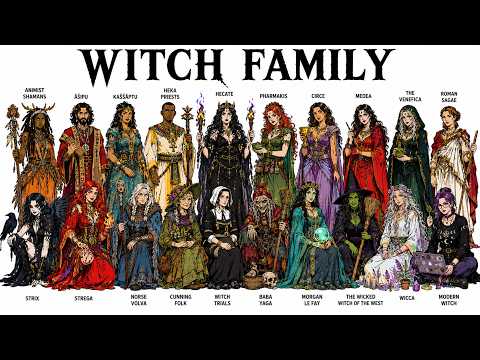
When we conjure the image of a witch, the mind often conjures a figure cloaked in shadow, perhaps an ancient crone with a pointed hat, soaring through the moonlit sky on a broomstick, weaving spells of ill intent. Yet, a fundamental misunderstanding pervades this popular perception. A witch, in its most ancient form, is not a creature of myth; it is a title, a role bestowed upon individuals within human societies.
Unlike the lineage of mythical beings – the Mesopotamian demons Lilitu and Lamashtu, for instance – the witch's ancestral tree branches differently. It does not begin with supernatural entities or monstrous beings. Instead, its roots are firmly planted in humanity itself. For millennia, across diverse global cultures, it was believed that certain individuals possessed an extraordinary reservoir of knowledge. These were the people capable of healing the afflicted, communing with spirits, foretelling future events, or orchestrating rituals far beyond the scope of ordinary folk. Over vast stretches of time, these individuals gradually evolved within cultural narratives to become what many societies would eventually term 'witches'.
Table of Contents
- RitualThe Animist Shaman: Humanity's First Mystics
- The Archetype of the Healer and Guide
- From Revered Elder to Feared Outcast
- The Role of Patriarchy in Demonization
- Connecting to the Spiritual: Early Forms of Ritual
- Modern Reclaimings and the Ancestral Echo
- The Goetian Connection: A Different Branch of Ancient Power
- A Practical Tool for Working with Ancient Seals
- FAQ: Unraveling the Witch's Origins
- Mage's Arsenal
- Your Operation
RitualThe Animist Shaman: Humanity's First Mystics
Long before the advent of recorded history, a profound belief system known as animism permeated the consciousness of numerous ancient cultures. This worldview posited that spirits were omnipresent, residing not only within animate beings like animals but also within the very fabric of the natural world: rivers, mountains, forests, and even inanimate objects. A deep, interconnectedness was perceived between the physical and spiritual realms, and certain individuals were believed to possess the rare and potent ability to navigate both. These figures are often identified as shamans.
While their specific practices and beliefs undoubtedly varied across different cultural landscapes, shamans were, as a general rule, esteemed members of their communities rather than ostracized outcasts. Their roles were multifaceted: they performed vital healing rituals, interpreted the cryptic language of dreams, presided over sacred ceremonies, acted as intermediaries with the spirit world, invoked blessings upon successful hunts, and sought answers during times of widespread illness, famine, or communal disaster. Some traditions held that they possessed the capacity to enter profound trance-like states, facilitating their journeys between worlds.
The Archetype of the Healer and Guide
The earliest understanding of a 'witch' leans heavily on the archetype of the healer and spiritual guide. These were individuals deeply attuned to the natural world, possessing a profound understanding of herbs, their medicinal properties, and the subtle energies that permeated existence. Their knowledge was not feared but sought after. They were the village wise women, the herbalists, the midwives, the storytellers who preserved ancestral wisdom. Their power stemmed from understanding, nurturing, and facilitating – not from malice or destruction.
The transition from this respected role to the image of the malevolent sorceress is a complex socio-historical phenomenon. It's often attributed to shifts in societal power structures, particularly the rise of patriarchal systems that sought to control or demonize female authority and knowledge. As societies became more centralized and organized under dominant religious or political doctrines, practices that deviated from the norm, especially those associated with female autonomy and traditional forms of spiritualism, began to be viewed with suspicion and, eventually, outright fear.
From Revered Elder to Feared Outcast
The historical lineage of the witch is not one of inherent evil. For the majority of human history, those who would later be branded as witches were revered figures. They were the pillars of community, offering solace, wisdom, and practical assistance. Their connection to the spiritual and natural worlds was seen as a gift, a vital link that maintained balance and well-being.
The dramatic shift in perception, culminating in the image of the broom-riding, spell-casting antagonist, is a relatively recent development in the grand narrative of human history. This transformation was fueled by a confluence of factors: religious persecution, societal anxieties, and the deliberate demonization of alternative spiritual paths. The very qualities that once made these individuals respected – their knowledge of herbs, their connection to nature, their intuitive abilities – were twisted and reinterpreted as signs of malevolence and pacts with dark forces during periods like the European witch trials.
The Role of Patriarchy in Demonization
Many contemporary scholars and practitioners argue that the demonization of the witch is intrinsically linked to patriarchal societal structures. In societies where male authority became dominant, women who held knowledge, power, or autonomy—especially those related to healing, midwifery, and spiritual insight—posed a perceived threat. By rebranding these women as 'witches' and associating them with evil, societies could effectively marginalize and control them. This narrative served to consolidate power, suppress female leadership, and enforce conformity to newly established religious and social norms.
The fear instilled by these narratives served a crucial social purpose: to keep women in check, to discourage independent thought or practice, and to solidify the dominance of established religious and political institutions. The image of the 'evil witch' became a convenient scapegoat for societal ills and a powerful tool for social control.
Connecting to the Spiritual: Early Forms of Ritual
The earliest forms of practice associated with the lineage of the witch involved deep engagement with the spiritual and natural worlds. This included communicating with ancestral spirits, understanding the cycles of nature and the moon, and utilizing herbs and natural elements for healing and ritual. These practices were not about wielding destructive power but about seeking balance, understanding, and connection.
The shamanistic journey between worlds, the interpretation of omens, and the channeling of natural energies were all part of a holistic approach to life, seeking harmony with the cosmos. These ancient rituals were foundational, providing the bedrock upon which later, more formalized magical practices would be built. The essence of these early practices was one of reverence for life and the interconnectedness of all things.
Modern Reclaimings and the Ancestral Echo
Today, many individuals who identify as witches are actively engaged in reclaiming and reinterpreting this ancient lineage. They seek to honor the wisdom of the animist shamans and the revered healers of antiquity, distinguishing their contemporary practices from the distorted, fear-mongering images that emerged during periods of persecution. This reclamation involves understanding the historical context, acknowledging the patriarchal forces that led to the demonization of witchcraft, and celebrating the inherent power and wisdom that resides within the archetype.
Many modern witches see themselves as carrying forward an ancestral echo – a continuation of the lineage of those who sought knowledge, healing, and a deeper connection to the earth and spirit. This involves studying ancient practices, reviving herbalism, practicing divination, and fostering a profound respect for the natural world. The goal is often to heal the historical wounds associated with the 'witch' label and to embrace its original meaning of spiritual insight and natural wisdom.
The Goetian Connection: A Different Branch of Ancient Power
While the lineage of the witch primarily arises from human spiritual practitioners, it's important to acknowledge that other ancient traditions explore different avenues of power and spiritual interaction. One such tradition involves entities and systems that predate much of common folklore, offering a distinct yet sometimes overlapping pathway into the arcane. These ancient systems often involve structured hierarchies of spirits and demons, documented in texts that have survived centuries of scrutiny.
The Goetia, for example, details a system of 72 demons, each with unique characteristics and powers, often depicted through their specific sigils or seals. These entities are not 'witches' in the human sense but represent a different facet of the ancient magical landscape – powers that can be invoked or worked with through specific ceremonial frameworks. Understanding these systems requires a meticulous approach, respecting the precise forms and intentions associated with each entity.
A Practical Tool for Working with Ancient Seals
The meticulous study and application of ancient magical systems, particularly those involving complex sigils and seals like those found in the Goetia, can be incredibly demanding. Reproducing these symbols accurately, understanding their correspondences, and integrating them into one's practice requires precision and focus. The process of generating, understanding, and utilizing these specific magical forms can be time-consuming when relying solely on manual methods.
This is where specialized tools become invaluable for the modern practitioner. The Goetian Seals Generator is designed to streamline the process of working with these ancient entities. This app provides a digital interface to accurately generate and explore the seals of the 72 Goetian demons, assisting practitioners in their ritual work and study. It ensures the fidelity of the symbols, allowing the mage to focus on the intention and gnosis required for effective magical operation, rather than wrestling with the minutiae of symbol creation.
FAQ: Unraveling the Witch's Origins
Is a witch a creature or a human title?
Primarily, a witch is understood as a human individual who holds a title or role within a society, often associated with possessing extraordinary knowledge or abilities. While folklore has created mythical beings that *appear* as witches, the historical and archetypal root is human.
Were ancient witches evil?
No, the earliest ancestors of what became known as witches were generally not evil. They were typically respected healers, spiritual guides, and wise members of their communities. The association with evil emerged much later due to historical and societal factors like the rise of patriarchal structures and religious persecution.
What is animism and how does it relate to early witches?
Animism is the belief that spirits inhabit all things – animals, plants, natural phenomena, and objects. Early witch ancestors, often referred to as shamans, were believed to have the ability to travel between the spiritual and physical worlds, mediating between humans and these spirits within an animistic framework.
Why did the perception of witches change over time?
The shift from revered healer to feared outcast is largely attributed to the rise of patriarchal societies that sought to control female autonomy and knowledge. Religious persecution and societal anxieties also played a significant role in demonizing these figures and their practices.
How does the Goetia differ from the witch lineage?
While the witch lineage stems from human practitioners of magic and spiritualism, the Goetia refers to a specific system of demonology detailing 72 demons. These entities are distinct from human witches, though both represent different facets of ancient magical and spiritual traditions that practitioners might engage with.
What are the benefits of using a Goetian Seals Generator app?
Apps like the Goetian Seals Generator offer precision in reproducing ancient seals, saving practitioners time and ensuring the accuracy of these complex symbols. This allows the mage to concentrate more fully on the intention and the ritualistic aspects of working with these entities.
Can the 'witch' archetype be traced to specific ancient Mesopotamian demons?
While some mythical lineages, like those explored in certain family trees of mythological creatures, might begin with figures like Lilitu and Lamashtu, the direct ancestral line of the 'witch' as understood in this context begins with human practitioners. The connection to ancient demons is more about the broader tapestry of ancient magical beings, rather than the direct origin of the witch archetype itself.
Mage's Arsenal
- Essential: Goetian Seals Generator - Accurately generate and study the seals of ancient Goetian entities.
- Reference: Understanding Animism and Shamanism (General knowledge bases).
- Context: Historical texts on the evolution of witchcraft and mythology (General knowledge bases).
- Tool: Reliable occult encyclopedia or historical texts on demonology.
About the author: Frater Alek0s is a veteran practitioner and researcher in the field of chaos magick. His work focuses on the practical and experimental application of occult techniques for self-development and reality exploration, demystifying esotericism for the modern practitioner.
Your Operation
To truly grasp the ancient roots of the witch archetype, engage with the concept of the shaman and the healer. Reflect on how societal structures can twist the perception of powerful, knowledgeable individuals. Consider the animistic worldview and its emphasis on the interconnectedness of all life. Understand that the 'witch' label has a complex and evolving history, moving from revered community member to feared outsider and now, for many, a reclaimed symbol of wisdom and natural power.
For those interested in exploring other branches of ancient spiritual interaction, delve into systems like the Goetia. Use tools like the Goetian Seals Generator to ensure accuracy in your studies and practice. Remember, true power lies not just in the symbols, but in the clarity of intention and the depth of your understanding and connection.
Referencias
- Carroll, P. J. (1987). Liber Null & Psychonaut. Weiser Books.
- Spare, A. O. (1913). The Book of Pleasure. Self-published.
- Hine, P. (1992). Condensed Chaos: An Introduction to Chaos Magic. New Falcon Publications.
- Crowley, A. (1904). The Book of the Law. Self-published.
- Sherwin, R. (2018). The Chaos Magic Handbook. CreateSpace.
- Kraig, D. M. (1988). Modern Magick: Eleven Lessons in the High Magickal Arts. Llewellyn Publications.
- Morrison, G. (2003). Pop Magic! The Art of Shaping Reality. Disinformation.
- DuQuette, L. M. (2003). The Chicken Qabalah of Rabbi Lamed Ben Clifford. Weiser Books.
- Webb, D. (2015). Chaos Magick: A Practical Guide. Self-published.
- Tyson, D. (2006). The Power of the Written Word. Llewellyn Publications.
- Bonewits, I. (1971). Real Magic. Creative Age Press.
- Greer, J. M. (2003). The New Encyclopedia of the Occult. Llewellyn Publications.
No hay comentarios:
Publicar un comentario