
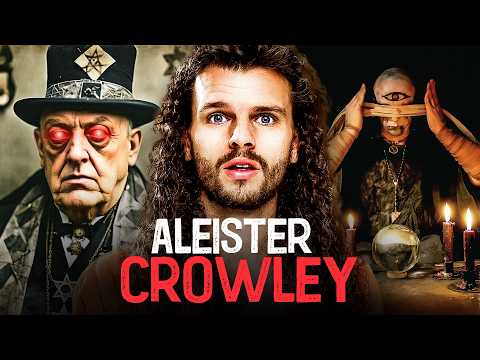
Step into the shadowed halls of occult history, where the name Aleister Crowley, known as the Great Beast 666, echoes with a potent blend of controversy and fascination. This isn't just a biographical sketch; it's an exploration into the very wellsprings of modern occultism, a journey into the mind of a figure who profoundly shaped esoteric thought and practice. We'll delve into his early life, his pivotal role in forming the Hermetic Order of the Golden Dawn, the enigmatic pronouncements of The Book of the Law, his controversial experiments with sex magic, and the persistent whispers of espionage that followed him.
Crowley's influence stretches far beyond the arcane circles he inhabited. His philosophy, his rituals, and his very persona have seeped into popular culture, music, and film, proving that the Great Beast continues to cast a long shadow. Understanding Crowley is crucial for anyone seeking to grasp the trajectory of Western esotericism in the 20th century and beyond. His life was a testament to the power of belief, the allure of the forbidden, and the relentless pursuit of arcane knowledge, often blurring the lines between genius and madness, revelation and delusion.
Table of Contents
- RitualThe Formative Years: Childhood and Cambridge
- From White Stains to the Golden Dawn
- The Contact with Horus and The Book of the Law
- Sex Magic and the Amalantrah Working
- Crowley as a Spy? Examining the Allegations
- The Abbey of Thelema and Drug Rituals
- Exile, Addiction, and Final Works
- Jack Parsons, L. Ron Hubbard, and the Seeds of Scientology and UFO Culture
- Crowley's Thelemic Funeral and Enduring Legacy
- The Macabre Influence Beyond Death
- Mage's Arsenal
- FAQ: Frequently Asked Questions
- Your Operation
RitualThe Formative Years: Childhood and Cambridge
Born on October 12, 1875, Edward Alexander Crowley's upbringing was steeped in a fervent, almost suffocating, Protestant evangelicalism. His father, a preacher and later a member of the Plymouth Brethren, instilled in him a deep, albeit rebellious, familiarity with biblical texts. This early exposure to religious dogma and prophecy would later fuel his iconoclastic embrace of what he termed "Thelema" – his own spiritual philosophy centered on the principle of "Do what thou wilt shall be the whole of the Law."
Crowley's formative years were marked by a precocious intellect and a growing disillusionment with conventional religious teachings. He was sent to Malvern College and later, in 1895, to Trinity College, Cambridge, to study classics. While at Cambridge, his intellectual curiosity began to shift from academic pursuits to the burgeoning interest in occultism. He delved into various metaphysical texts, experiencing early glimmers of what would become his lifelong quest for hidden knowledge and spiritual enlightenment. His time at Cambridge was not just about scholastic achievement; it was a crucible where his future path as an occultist began to solidify, moving away from established doctrine towards personal revelation and mystical experience.
From White Stains to the Golden Dawn
Crowley's early literary endeavors, such as the anonymously published "White Stains" (intended to be a collection of erotic poetry and prose), hinted at his later fixation on the intersections of sexuality and spirituality. This fascination with the transgressive and the symbolic would become a hallmark of his occult system. It was also during this period that his ambition to join the ranks of influential occult organizations began to materialize. His efforts to gain entry into the Hermetic Order of the Golden Dawn, a prominent magical society of the time, marked a critical turning point in his occult career.
The Hermetic Order of the Golden Dawn, founded in 1887, was a secret society dedicated to the study and practice of ceremonial magic, alchemy, and divination. Its teachings were a synthesis of various esoteric traditions, including Kabbalah, Hermeticism, Rosicrucianism, and Egyptian magic. Crowley's admission into the Order in 1899 provided him with formal training in Western ceremonial magic, a structured framework through which he could hone his innate psychic abilities and explore the deeper mysteries of the universe. Within the Golden Dawn, he encountered individuals who would become both allies and rivals, and it was here that he began to ascend the ranks, absorbing and eventually challenging the established doctrines of the order. His time within the Golden Dawn, though ultimately tumultuous, laid the essential groundwork for his subsequent independent magical work.
The Contact with Horus and The Book of the Law
The pivotal event in Aleister Crowley's occult life, and arguably the genesis of his personal magical system, occurred in Cairo, Egypt, in 1904. During this period, Crowley claimed to have established contact with a spiritual entity or intelligence named Aiwass, who dictated to him a sacred text known as The Book of the Law (also called Liber AL vel Legis). Crowley described this experience as a profound revelation that laid out the principles of his new Aeon – the Aeon of Horus, which he believed was replacing the Aeon of Osiris.
The Book of the Law is a short, cryptic document that presents a revolutionary spiritual philosophy. Its central tenet is the law of Thelema: "Do what thou wilt shall be the whole of the Law. Love is the law, love under will." This is often interpreted not as a license for hedonistic indulgence, but as a directive to discover and fulfill one's true destiny or "True Will," aligning oneself with the cosmic order. Crowley saw himself as a prophet of this new Aeon, tasked with disseminating its teachings to the world. The book's complex symbolism, paradoxical pronouncements, and radical vision of spiritual liberation became the cornerstone of his magical and philosophical system, influencing generations of occultists and mystics.
The contact with what he identified as the Egyptian god Horus further cemented his belief in a divine mandate to usher in a new era of human consciousness. This sacred text and the associated revelations became the blueprint for his subsequent magical practices and organizational endeavors. The principles laid down in The Book of the Law would guide his life's work, shaping his understanding of magic, religion, and human potential.
Sex Magic and the Amalantrah Working
Central to Crowley’s mature magical system, known as Thelema, was the concept and practice of sex magic, or "Magickal Sex." He believed that the immense energy generated during sexual activity, when consciously directed with specific intent, could be harnessed to achieve magical results. This was not merely about physical pleasure; it was about channeling the primal life force for spiritual transformation, invocation, and manifestation. He expounded on these ideas in various writings, including parts of The Equinox and his autobiography.
One notable practice was the Amalantrah Working, undertaken around 1918. This involved prolonged periods of sexual abstinence followed by orgasm, during which Crowley would visualize and invoke various entities and concepts with the intention of achieving specific magical outcomes. During one such Amalantrah Working, he claimed to have contacted an entity named LAM through visualization and ecstatic states. LAM, often depicted as a visionary figure with a large head and almond-shaped eyes, became a recurring motif in Crowley's later occult work and was interpreted by some, including later figures in UFO culture, as an alien or extradimensional being. These practices were controversial even within esoteric circles, pushing the boundaries of what was considered acceptable or even sane in the pursuit of magical attainment.
Crowley viewed sexuality as a powerful, yet often misunderstood, force. By integrating it into his magical practices, he sought to unlock its latent potential for spiritual evolution, arguing that repression led to psychological maladies, while conscious integration could lead to liberation and expanded awareness. The intensity and unconventionality of his sexual magic practices contributed significantly to his public image as a debauched and dangerous figure.
Crowley as a Spy? Examining the Allegations
The notion of Aleister Crowley as a British double spy is a persistent and intriguing thread in the lore surrounding him. During World War I, Crowley, living in the neutral United States, was known to have engaged in propaganda efforts for the Allied cause, writing articles and distributing pamphlets designed to undermine German morale. His fluency in languages and his considerable network of contacts, both aristocratic and subversive, made him a potential asset for intelligence agencies.
Historians and biographers have explored these connections, with some suggesting he was indeed employed by British intelligence, perhaps reluctantly or indirectly. His exploits and known associates, including individuals with ties to governmental and military circles, have fueled speculation. However, concrete evidence proving he was a formal, sanctioned spy is scarce. It's more likely he acted independently, using his influence and skills to support the war effort in ways he saw fit, or perhaps that intelligence agencies simply monitored his activities due to his notoriety and potential to influence public opinion. The ambiguity surrounding his wartime activities adds another layer to his complex and often contradictory legacy, feeding into his mystique as a figure operating in the shadows, both occult and political.
The Abbey of Thelema and Drug Rituals
In 1920, Crowley established the Abbey of Thelema in Cefalù, Sicily. This was intended to be a magical commune, a place where followers could live and practice the principles of Thelema under his guidance. The Abbey became a focal point for his experiments in sex magic, ritual, and the exploration of altered states of consciousness, often facilitated by the use of drugs.
Crowley was an early and vocal proponent of drug use for spiritual and magical purposes. He experimented with various substances, including cannabis, opium, and hallucinogens like mescaline and LSD (though LSD was synthesized many years after his death, he anticipated its potential for visionary experiences). He viewed drugs not as mere recreational substances, but as tools that could "tune" the mind, break down ordinary consciousness, and facilitate contact with higher or deeper realms of awareness. He detailed these explorations in works such as The Confessions of Aleister Crowley and Magick Without Tears. The "drug rituals" at the Abbey involved combining these substances with specific magical operations, visualizations, and ascetic practices. These were controversial even at the time, leading to accusations of immoral conduct and contributing to the Abbey's eventual closure by the Italian authorities in 1923, purportedly due to the death of one of his followers in a ritualistic accident, and also due to concerns over drug use and public morality.
Exile, Addiction, and Final Works
Following his expulsion from Italy, Crowley's life became more nomadic and less focused on establishing physical centers of magical practice. He settled in England for a time, continuing his prolific writing and magical work. However, this period was also marked by increasing struggles with drug addiction, particularly to heroin, which he used to manage chronic pain and, he claimed, to aid his magical endeavors. His addiction often led to financial difficulties and strained relationships.
Despite these personal challenges, Crowley continued to produce significant magical texts. He revised and expanded his earlier works, wrote commentaries on sacred texts, and continued to develop his system of Thelema. His later writings often reflected on his life's journey, his philosophical insights, and his views on the future of humanity and consciousness. He remained a figure of controversy and fascination, inspiring some and repelling others with his radical ideas and unconventional lifestyle. His influence began to spread beyond occult circles, touching artists, writers, and musicians who were drawn to his iconoclastic spirit and his exploration of the human psyche's hidden depths.
Crowley’s later years were filled with continued magical research, prolific writing, and a constant battle with his own demons, both literal and metaphorical. Though his physical health declined, his intellectual and spiritual fire never truly extinguished, leaving behind a vast corpus of work that continues to be debated, studied, and practiced by occultists worldwide.
Jack Parsons, L. Ron Hubbard, and the Seeds of Scientology and UFO Culture
In the latter part of Crowley's life, his influence intersected with figures who would go on to create significant cultural and technological movements. One of the most striking examples is his connection with Jack Parsons, a brilliant rocket scientist and an occultist in Southern California. Parsons was a devoted follower of Thelema and, along with L. Ron Hubbard (who later founded Scientology), engaged in a series of rituals known as the "Babalon Working."
The Babalon Working, purportedly conducted in 1946, was an attempt to invoke the archetypal feminine divine, Babalon, and to manifest a "moonchild" – a magical offspring. These rituals, deeply rooted in Crowley's sex magic and occult principles, involved Hubbard and Parsons attempting to create magical effects in the physical world. While the literal success of the Working is debated, its legacy is undeniable. It is often cited as a key influence on Hubbard's subsequent development of Dianetics and Scientology, particularly the concepts of past lives, alien influences (Xenu), and the idea of spiritual technology.
Furthermore, the association with entities like LAM and supposed extraterrestrial communications during Crowley's own Amalantrah Working, combined with the esoteric practices of Parsons and Hubbard, created fertile ground for the burgeoning UFO culture of the mid-20th century. Many early UFO contactees and researchers drew parallels between their experiences and the occult traditions Crowley represented, seeing demons and aliens as potentially interchangeable phenomena. The connections between these occult dabblings and the foundations of Scientology and modern UFOlogy remain a subject of intense speculation and analysis, highlighting the unexpected ways Crowley's esoteric experiments rippled through subsequent cultural phenomena.
Crowley's Thelemic Funeral and Enduring Legacy
Aleister Crowley died on December 1, 1947, in a boarding house in Hastings, England, reportedly stating, "I am perplexed, but I am not defeated." His death marked the end of a life lived on the absolute fringes of conventional society, a life dedicated to the exploration of the extreme limits of consciousness and magic. His funeral, held in Brighton, was a small affair, but notably, it included an invocation of his chosen motto, "Toki Doki," and a reading from The Book of the Law, ensuring that even in death, the principles of Thelema were honored.
Crowley's influence is vast and multifaceted. He is credited with profoundly impacting modern occultism, particularly through the development of Chaos Magic, which embraced his radical skepticism towards dogma and his emphasis on experimentation. His ideas on sex magic, consciousness liberation, and the "Law of Thelema" continue to be studied, debated, and practiced by dedicated adherents. Beyond esoteric circles, his persona became archetypal: the ultimate rebel, the dark magician, the prophet of a new age. This image has been adopted and adapted by countless musicians, artists, and writers, solidifying his presence in popular culture as the quintessential occult figure. While often misrepresented and sensationalized, Aleister Crowley's true legacy lies in his relentless pursuit of self-knowledge and his challenge to conventional notions of reality, spirituality, and human potential.
The Macabre Influence Beyond Death
The shadow of the Great Beast extends far beyond his physical demise. Aleister Crowley's legacy is not merely confined to dusty tomes and esoteric societies; it has permeated art, music, and popular culture in ways that are both overt and subtly implied. Musicians, from The Beatles and Led Zeppelin to contemporary artists exploring darker themes, have referenced Crowley, his symbols, or his philosophy. His image has been incorporated into album art, lyrics, and stage performances, often drawing on the mystique of the occult rebel.
Hollywood has also frequently used Crowley as inspiration, or as a character, for films exploring themes of magic, mystery, and the dark side of human nature. His iconic image and controversial life story lend themselves to dramatic narratives, transforming him into a recurring archetype in cinematic portrayals of the occult. Beyond these direct references, his philosophical ideas, particularly the concept of "Do what thou wilt," continue to resonate with those seeking individual liberation and self-expression, even if they are unaware of their source.
The study of his extensive writings, including The Book of the Law, The Equinox, and his numerous magical diaries, remains a rigorous discipline for serious occultists. His emphasis on personal experience, experimentation, and the integration of all aspects of life—including sexuality and altered states of consciousness—offers a potent and challenging path for spiritual exploration. The enduring fascination with Aleister Crowley suggests that his exploration of the human psyche's hidden potentials, and his embrace of the macabre and the mystical, continues to speak to a deep-seated human desire to understand the mysteries that lie both within and beyond the veil of ordinary existence.
Mage's Arsenal
- Essential: Goetian Seals Generator — This app allows you to accurately generate and work with the complex sigils of the Goetia, ensuring precise execution for your rituals.
- Recommended: The Book of the Law by Aleister Crowley.
- Further Study: Liber Null & Psychonaut by Peter J. Carroll.
- Historical Context: Biographies of Aleister Crowley (e.g., by John Symonds or Tobias Churton).
FAQ: Frequently Asked Questions
What was Aleister Crowley's main philosophy?
Crowley's central philosophy is known as Thelema, encapsulated by the Law: "Do what thou wilt shall be the whole of the Law. Love is the law, love under will." He believed this meant discovering and fulfilling one's True Will, aligning with the cosmic order rather than indulging in mere hedonism. This philosophy emphasized individual liberty, self-realization, and the exploration of the divine within oneself.
Was Aleister Crowley a genuine occultist or a charlatan?
This question is central to the debate surrounding Crowley. His followers and many practitioners of modern occultism view him as a profound spiritual teacher and magician who revealed significant arcane truths. Critics and skeptics often dismiss him as a charlatan, a drug addict, or a charlatan who preyed on the gullible. His prolific writings on magic, his detailed system of Thelema, and the consistent testimonies of many practitioners suggest a genuine, albeit highly unorthodox, engagement with occult forces. Ultimately, his efficacy is often judged by the results practitioners achieve using his system.
How did Aleister Crowley influence modern occultism?
Crowley's influence is immense. He is considered one of the most significant figures in 20th-century Western esotericism. His emphasis on personal experience, his development of ceremonial magic techniques, and his philosophy of Thelema have directly inspired or influenced movements like Chaos Magic, modern Wicca, and various esoteric orders. His prolific writings continue to be foundational texts for many occultists, providing practical methodologies and philosophical frameworks for spiritual exploration.
Did Aleister Crowley practice sex magic, and why?
Yes, Aleister Crowley was a prominent advocate and practitioner of sex magic. He believed that the powerful energies generated during sexual activity, when consciously directed through specific intent and visualization, could be used to achieve magical goals, spiritual enlightenment, or to invoke entities. He saw sexuality not as something to be repressed, but as a potent force that, when integrated into magical practice, could lead to profound transformation and expanded consciousness. His writings on this subject are extensive and often controversial.
Is the Book of the Law the only important work by Crowley?
While The Book of the Law is considered the foundational sacred text of Thelema and a major revelation, Crowley produced a vast body of work. His other significant writings include The Equinox (a comprehensive journal detailing the practices and philosophy of Thelema), Magick in Theory and Practice (sometimes attributed to his disciple Oscar M.?’” but written and compiled by him), The Confessions of Aleister Crowley (his autobiography), and numerous commentaries on ancient texts and magical systems. These works provide detailed insights into his magical practices, philosophy, and personal journey.
How is the concept of "The Great Beast 666" understood in relation to Crowley?
The number 666 is famously associated with the "Beast" in the Book of Revelation in the Christian Bible. Aleister Crowley embraced this number and the title "The Great Beast" as symbolic of his role as a prophet of a new Aeon—the Aeon of Horus, which he believed was replacing the Aeon of Osiris. He saw the "Beast" not as an evil entity, but as a symbol of liberation, individualism, and the divine spark within humanity breaking free from repressive old orders. By adopting this controversial symbol, he aimed to reclaim and redefine its meaning within his Thelemic system, subverting its traditional negative connotations.
What were Crowley's views on drugs?
Crowley was an advocate for the use of certain psychoactive substances as tools for spiritual exploration and magical enhancement. He believed that drugs, when used consciously and with specific intent, could help to break down the limitations of ordinary consciousness, facilitate visionary experiences, and aid in the process of magical invocation and self-discovery. He documented his own experiments with substances like cannabis, opium, and his anticipation of hallucinogens in various writings, viewing them as potentially potent aids in the pursuit of higher knowledge and altered states of awareness.
About the author: Frater Alek0s is a veteran practitioner and researcher in the field of chaos magick. His work focuses on the practical and experimental application of occult techniques for self-development and reality exploration, demystifying esotericism for the modern practitioner.
Your Operation
The life of Aleister Crowley is a testament to the power of radical individualism and the relentless pursuit of esoteric knowledge. His journey, marked by profound revelations and notorious controversies, offers a compelling case study in the exploration of consciousness, magic, and spirituality. While his methods were often extreme, his core philosophy of Thelema – centered on discovering and fulfilling one's True Will – continues to inspire those who seek a path of self-mastery and liberation.
The challenge for any modern practitioner is to separate the historical persona and sensationalism from the practical, potent techniques and philosophies he espoused. Did he truly commune with divine intelligences, or was he a master psychologist and showman? The answer, as with much of the occult, likely lies in the personal experience and interpretation of the practitioner. To truly understand Crowley's impact, one must engage with his work critically, experiment with his methods safely, and determine for oneself the nature of the Great Beast and the truths he sought to unveil.
Referencias
- Crowley, A. (1904). The Book of the Law. Self-published.
- DuQuette, L. M. (1993). The Magick of Thelema. Weiser Books.
- Sutin, L. (2000). Do What Thou Wilt: A Life of Aleister Crowley. St. Martin's Press.
- Kaczynski, R. (2010). Perdurabo: The Life of Aleister Crowley. North Atlantic Books.
- Booth, M. (2000). A Magick Life: A Biography of Aleister Crowley. Coronet.
- Symonds, J. (1951). The Great Beast: The Life of Aleister Crowley. Rider & Company.
- Grant, K. (1972). The Magical Revival. Muller.
- Churton, T. (2011). Aleister Crowley: The Biography. Watkins.
- Cornelius, J. (1999). Aleister Crowley and the Ouija Board. Feral House.
- Evans, D. (2007). The History of British Magick After Crowley. Hidden Publishing.
- Fuller, J. F. C. (1909). The Star in the West. Walter Scott Publishing.
- Hymenaeus Beta (1995). The Equinox: Volume III, Numbers 1-10. O.T.O..
No hay comentarios:
Publicar un comentario