
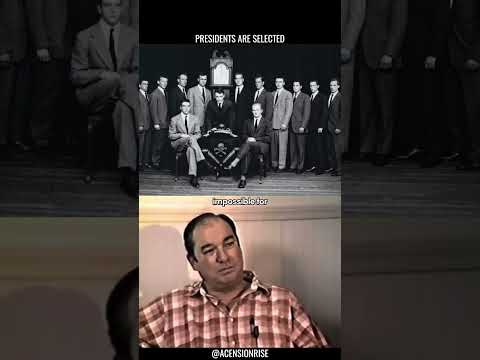
The notion that presidents are elected is a cornerstone of modern democracy, a widely accepted narrative that shapes our political engagement. Yet, delve beneath the surface, and you'll find a growing undercurrent of dissent, a belief that the individuals who occupy the highest office are, in fact, *selected*. This isn't about a specific conspiracy theory, but rather a fundamental questioning of the democratic process itself, suggesting that the choice presented to voters is often an illusion, a carefully curated spectacle designed to maintain a particular order.
Peter J. Carroll, a key figure in Chaos Magic, famously stated, "Belief is a tool, not a belief" (Carroll, 1987). This principle is acutely relevant here. The belief that our vote is a genuine act of selection, a direct transfer of power to our chosen candidate, is a powerful belief system that underpins the current political structure. But what if this belief is merely a mechanism, a tool used by unseen forces to achieve specific outcomes? What if the real power lies not in the voting booth, but in the mechanisms that precede and frame the electoral process?
Table of Contents
- MagitechThe Illusion of Choice: Democratizing Deception?
- The Power of Division: A Uniparty's Advantage
- Raising Collective Consciousness: A Path to Unity?
- The Local vs. The National: A Nuance Worth Exploring
- The Influence of External Forces and Hidden Agendas
- The Oath and the Corporation: Activating the Illusion
- From Selection to Creation: The Magician's Role
- Mage's Arsenal
- FAQ: Presidents Are Selected
This exploration will dissect the "presidents are selected" argument, examining the societal and systemic factors that contribute to this perspective. We will look at how division is leveraged, how political parties function, and the potential for genuine change, all while keeping the core principle of belief as a tool at the forefront of our understanding.
MagitechThe Illusion of Choice: Democratizing Deception?
The core of the "presidents are selected" argument hinges on the idea that the choices presented to the public are, at best, limited, and at worst, entirely fabricated. This isn't to say that the candidates themselves are necessarily puppets, but rather that the system is designed to ensure that only certain types of candidates, those who align with established powers, can truly ascend.
Consider the immense resources and infrastructure required to run for president. The fundraising, the media campaigns, the party endorsements – these are not spontaneous occurrences. They are the result of intricate networks and established power structures. As one commentator noted, "There is no third party because the Uniparty has made it impossible to form a third party." This highlights how existing political frameworks can actively stifle dissenting voices and emergent movements, ensuring that the playing field remains tilted.
The power dynamics at play are not always overt. They can be subtle, embedded in the very fabric of our societal institutions. The concept of "grooming" mentioned by some observers suggests a long-term, developmental process, where individuals are nurtured and shaped over years, even decades, to fit a specific role within the political landscape. This implies a level of planning and foresight that extends far beyond the election cycle.
The Power of Division: A Uniparty's Advantage
One of the most persistent observations across political discourse is the profound societal division that seems to paralyze meaningful progress. Many believe this division is not accidental, but actively cultivated. "The division gives them the power!!!!!!" is a sentiment echoed by many who feel that infighting and partisan gridlock serve the interests of those who benefit from the status quo.
When the populace is engaged in constant conflict, debating minutiae and demonizing opposing viewpoints, the larger, systemic issues often remain unaddressed. This is where the concept of the "Uniparty" gains traction. It posits that while distinct parties may exist with differing platforms, they ultimately operate within a shared framework, serving common interests that transcend partisan lines. This shared interest, some argue, is the maintenance of the existing power structures.
The frustration is palpable: "People who vote Democrat or Republican just don't understand... They're being played for the sheep 🐑🐑 they are." This sentiment underscores a deep disillusionment with the traditional two-party system, viewed by some as a mechanism of control rather than genuine representation.
Raising Collective Consciousness: A Path to Unity?
If the current system is perceived as rigged or illusory, what then is the solution? Many believe the answer lies in raising collective consciousness and fostering unity. "We need to raise the collective consciousness. We need unity. We need to start agreeing to disagree and stop fighting eachother." This call for unity is not about eradicating differences, but about recognizing shared humanity and common goals that transcend superficial political divides.
This shift in consciousness is perhaps the ultimate act of magic. By collectively agreeing to shift our belief systems, we can fundamentally alter the perceived reality of the political landscape. If enough people stop believing in the illusion of selection, if they refuse to vote or enlist in a system they deem corrupt, the power of that illusion diminishes.
"Quit electing Quit Voting and Enlisting in the military," one observer audaciously suggests. This is a radical proposition, a form of non-cooperation that aims to starve the existing power structures of the energy and consent they rely upon. It’s a call to disengage from the spectacle and redirect energy towards building robust, alternative forms of community and governance from the ground up.
The Local vs. The National: A Nuance Worth Exploring
While the presidency and national politics are often seen as completely compromised, some still hold out hope for change at more local levels. "Having said that the local voting and even Senators could possibly still be won. Except, if certain groups or countries pay to make sure a certain person wins... When it comes to the Presidency it's completely lost."
This perspective introduces a crucial nuance. The scale of operations required to control a national election is exponentially larger and more complex than influencing local races. The theory suggests that while the presidency might be firmly in the hands of a select group, it might still be possible to influence or even win local elections with enough collective effort and integrity. This offers a glimmer of hope, suggesting that disengagement doesn't necessarily mean surrender, but perhaps a strategic redirection of focus to arenas where tangible influence is still possible.
The Influence of External Forces and Hidden Agendas
The idea that presidents are "selected" often involves the notion of external forces or hidden agendas guiding the process. This can range from powerful lobbying groups and defense contractors influencing policy through campaign donations and insider trading, to more esoteric beliefs about secret societies and cabals.
"The problem is they take insider trade info to keep quiet because it makes them lots of money and only their office buddies know. But take a look at the their investment portfolio and I'd bet it's all private sector aerospace and major defense contract companies. So when they sell war, they make money..." This points to a corrupt nexus of power where political decisions are driven by financial gain, particularly in industries that profit from conflict.
Australia's political landscape is also cited as an example where similar dynamics might be at play, with established parties seemingly working to discredit any emerging force that deviates from the norm. This reinforces the idea that the system, regardless of geographical location, seems geared towards maintaining control and suppressing genuine opposition.
The Oath and the Corporation: Activating the Illusion
The "Act of 1871" is often mentioned in these discussions, positing that it illegitimately transformed the United States into a corporate entity, with Washington D.C. operating as a separate jurisdiction. While historical and legal validity of this claim is debated, it speaks to a deep-seated feeling that the governance structure is fundamentally at odds with the interests of the populace.
Furthermore, the concept of an oath of office being superseded by other, more binding oaths – perhaps to secret societies or specific agendas – is also raised. "They take a oath before the oath of office so it doesnt mean noyhing." This implies a hierarchy of loyalties, where the publicly declared oath is merely a formality, overshadowed by secret commitments.
From Selection to Creation: The Magician's Role
If presidents are indeed selected, and the democratic process is an illusion, then what is the role of the practitioner? It is to understand the nature of this illusion and to actively work towards its dismantling or, at the very least, to navigate around it. This is where the principles of technomancy, and specifically the creation of sigils, can become profoundly useful.
Chaos Magick teaches us that the universe responds to focused intent, regardless of the perceived reality of the system. If the system selects, then our goal might be to create a counter-selection process, or to bypass it entirely.
For those who find the manual creation of sigils time-consuming or prone to error, digital tools can be invaluable. The Chaos Magick Sigil Generator is designed precisely for this purpose. It allows you to rapidly codify your intent, generate a unique symbol, and then focus your energy on the crucial act of charging and releasing it. This streamlines the process, letting you bypass the perceived limitations of the electoral system and directly influence the energetic currents that shape reality.
When working with the idea that presidents are selected, your intention could be to: * Create sigils that energetically "disrupt" the selection process for undesirable candidates. * Generate sigils that promote the emergence and success of genuinely incorruptible individuals, regardless of their party affiliation. * Craft sigils that foster unity and raise collective consciousness, weakening the divisive tactics used to maintain control. * Empower yourself and others to see through the illusion, thereby diminishing its power.
The key is to apply focused intent and belief as a tool, independent of the circus of national politics.
Mage's Arsenal
* Essential: Chaos Magick Sigil Generator — Quickly create and charge digital sigils to bypass the illusion of selection and directly influence outcomes. * Recommended: *Liber Null & Psychonaut* by Peter J. Carroll. Understanding belief as a tool is paramount. * For Reflection: News sources that present dissenting viewpoints or analyses that question mainstream narratives.
FAQ: Presidents Are Selected
Why do people believe presidents are selected rather than elected?
This belief stems from several observations: the immense power of established political parties and donor networks that seem to pre-ordain candidates, the feeling that divisive political tactics paralyze genuine progress, and the perceived impossibility of third parties or independent candidates gaining traction. It also touches upon the idea that the media landscape shapes public perception, focusing on charisma and narrative rather than policy or integrity.What is the "Uniparty" theory?
The Uniparty theory suggests that, despite the appearance of partisan conflict, the major political parties actually operate in concert to maintain the existing power structures and serve common interests that transcend partisan labels. It implies that the fundamental direction of policy and governance remains consistent, regardless of which party holds office.How can raising collective consciousness help?
Proponents believe that by shifting societal perception and fostering unity, people can undermine the power of division and distraction that allegedly benefits those in control. If enough individuals stop believing in the illusion of choice and actively work towards common goals, the existing systems of power may become less effective.Is there any hope for change within the current system?
Some argue that while national-level elections might be heavily influenced or pre-determined, local elections and even senatorial races may still offer avenues for genuine influence. This suggests a strategic focus on local action and supporting incorruptible individuals in positions where systemic manipulation is less concentrated.About the author: Frater Alek0s is a veteran practitioner and researcher in the field of chaos magick. His work focuses on the practical and experimental application of occult techniques for self-development and reality exploration, demystifying esotericism for the modern practitioner.
How can magic be applied to this issue?
Magic, particularly Chaos Magic, can be seen as a way to directly influence energetic currents. Practitioners can create sigils with intentions aimed at disrupting the selection process for undesirable candidates, promoting honest leadership, fostering societal unity, or empowering individuals to recognize and reject the illusion of choice. The focus is on direct intention and energetic manipulation rather than participation in a perceivedly compromised system.Referencias
- Carroll, P. J. (1987). Liber Null & Psychonaut. Weiser Books.
- Spare, A. O. (1913). The Book of Pleasure. Self-published.
- Hine, P. (1992). Condensed Chaos: An Introduction to Chaos Magic. New Falcon Publications.
- Crowley, A. (1904). The Book of the Law. Self-published.
- Sherwin, R. (2018). The Chaos Magic Handbook. CreateSpace.
- Kraig, D. M. (1988). Modern Magick: Eleven Lessons in the High Magickal Arts. Llewellyn Publications.
- Morrison, G. (2003). Pop Magic! The Art of Shaping Reality. Disinformation.
- DuQuette, L. M. (2003). The Chicken Qabalah of Rabbi Lamed Ben Clifford. Weiser Books.
- Webb, D. (2015). Chaos Magick: A Practical Guide. Self-published.
- Tyson, D. (2006). The Power of the Written Word. Llewellyn Publications.
- Bonewits, I. (1971). Real Magic. Creative Age Press.
- Greer, J. M. (2003). The New Encyclopedia of the Occult. Llewellyn Publications.
No hay comentarios:
Publicar un comentario