
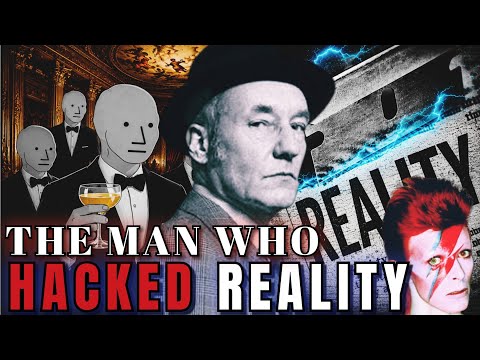
In the annals of outlaw literature and esoteric exploration, few figures loom as large or cast as long a shadow as William S. Burroughs. While his contemporaries were content to chart the familiar territories of human experience, Burroughs ventured beyond the page, wielding language itself as a weapon and a scalpel. He wasn't merely a novelist; he was a cartographer of the subconscious, a pioneer of techniques that would later echo in the chambers of chaos magic, digital culture, and our very understanding of perception.
This exploration delves into the heart of Burroughs' radical experiments, from the infamous Cut-Up Machine to the synergistic potential of the Third Mind. We'll trace his lineage through the arcane influences that shaped his thinking, revealing a mind that was not only ahead of its time but actively seeking to dismantle the boundaries of time and identity itself. Prepare to understand how a writer's quest for artistic truth became a blueprint for hacking reality, a blueprint that is more relevant today than ever before.
Table of Contents
- ServitorBurroughs and the Virus of Language
- The Cut-Up Machine: A Generator of New Realities
- The Third Mind: Synergy Beyond the Self
- Dreamachine and the Architecture of Perception
- Echoes in the Digital Age: AI, Social Media, and Hyperstition
- Burroughs as the Great Hacker
- Arsenal of the Modern Mage
- FAQ: Frequently Asked Questions
- Your Operation: Hacking Your Own Reality
- Case Study: The Artist's Breakthrough
- Cross-Disciplinary Connections: Information, Identity, and the Code
- Conclusion: The Unending Experiment
ServitorBurroughs and the Virus of Language
William S. Burroughs grappled with a profound insight: language, as it exists, is not merely a tool for communication but a parasitic entity. In his groundbreaking theories, particularly those explored in works like 'The Ticket That Exploded,' Burroughs posited that words act like viruses, infecting the minds of their users, dictating thought patterns, and ultimately controlling behavior. This isn't a poetic metaphor; for Burroughs, it was a literal diagnosis of the human condition. He saw syntax as a prison, grammar as a cage, and metaphors as chains binding us to predetermined realities. This understanding of language as a tangible, even biological, force set the stage for his radical attempts to break free.
He wasn't interested in simply describing the world; he sought to deconstruct the very framework through which we perceive it. If language was a virus, then the cure, or perhaps the inoculation, lay in disrupting its established patterns. This led him away from traditional narrative structures and towards experimental techniques designed to bypass the conscious mind and interface directly with the raw material of consciousness. His theories laid the groundwork for thinking about how information systems, whether linguistic or digital, exert control and how one might subvert them. This concept of language as a "virus" is a foundational idea that resonates deeply with practitioners of chaos magic and anyone interested in memetics or the psychology of belief.
The Cut-Up Machine: A Generator of New Realities
The Cut-Up technique, perhaps Burroughs' most famous experimental tool, was born from a desire to break the linear stranglehold of language. By physically cutting up existing texts and reassembling them in new orders, Burroughs (along with artists like Brion Gysin) created a method not just for generating novel prose but for accessing subconscious connections and unforeseen meanings. This wasn't mere random chance; it was a deliberate act of algorithmic creation, a way to force linguistic and conceptual collision, revealing hidden patterns that the conscious, controlling mind would typically filter out. The process became a form of externalized intuition, a feedback loop where the artist acted as a conduit for emergent meaning.
The Cut-Up Machine wasn't just a literary device; it was a reality-hacking tool. Burroughs believed that by altering the texts that shaped our perception of reality, one could, in turn, alter reality itself. He extended this technique beyond just prose, applying it to overheard conversations, dreams, and even the very structure of identity. Each piece of text, like a fragment of a sigil, was imbued with potential energy. When reassembled, these fragments could create startling juxtapositions, predictive visions, and entirely new conceptual frameworks. This process foreshadowed many later ideas in occultism and digital culture, including the generation of sigils and the understanding of hyperstition, where an idea or belief becomes real simply by being articulated and acted upon.
The Third Mind: Synergy Beyond the Self
Expanding on the Cut-Up technique, Burroughs proposed the concept of the "Third Mind." This wasn't about achieving a higher state of consciousness in the traditional sense, but about creating a synergistic entity born from the collision of two or more minds, or a mind and a text. It was a collaborative force, an emergent consciousness that could perceive truths inaccessible to the individual ego. Burroughs saw this as a way to break down identity barriers, particularly the rigid egoic self that he believed was the primary agent of linguistic control. The Third Mind was a collaborative cutting-up, a co-creation of a new perceptive faculty.
This idea of a merged consciousness, of a space where individual identities dissolve into a greater, more potent entity, is strikingly similar to concepts explored in various magical traditions, including some branches of chaos magic. The notion of creating entities through focused intent, whether they are servitors, egregore, or the manifestation of a collective will, finds a parallel in the Third Mind. It suggests that by strategically combining elements—be it texts, minds, or even digital algorithms—one can engineer new forms of awareness and agency. The "Third Mind" represents a powerful operational model for understanding how collective belief systems, shared experiences, and even synchronized digital interactions can forge new realities.
Dreamachine and the Architecture of Perception
The Dreamachine, developed in collaboration with Ian Sommerville, was a direct extension of Burroughs' theories on perception and consciousness. This stroboscopic device, designed to be viewed with closed eyes, emitted flickering light at specific frequencies. The intended effect was to induce altered states of consciousness, triggering hypnotic patterns in the brain that could lead to vivid, dream-like experiences while fully awake. It was an attempt to hack the visual cortex, to bypass the usual filters of the mind and create a direct interface with the subconscious.
Burroughs believed that the fixed, linear nature of waking consciousness was a form of self-imposed limitation. The Dreamachine was a technological key, designed to unlock those limitations. By disrupting sensory input, it forced the mind to generate its own internal reality, much like a dream. This resonates profoundly with magical practices that aim to induce altered states of consciousness as a gateway to accessing hidden knowledge or influencing external events. Techniques like gnosis, whether inhibitory or excitatory, aim to shift consciousness in ways that bypass the mundane, analytical mind. The Dreamachine, in its own way, offered a technological shortcut to such altered states, emphasizing that the architecture of our perception is not fixed but can be engineered and manipulated.
Echoes in the Digital Age: AI, Social Media, and Hyperstition
The ideas that William S. Burroughs explored decades ago—language as a virus, the power of algorithmic recombination, the manipulation of perception through media, and the creation of emergent realities—are no longer confined to the avant-garde fringes. They are the very fabric of our digital age. Social media platforms employ sophisticated algorithms that curate our realities, often in echo chambers that reinforce linguistic and ideological viruses. Artificial intelligence, in its ability to generate text, images, and even entire simulated worlds, embodies the spirit of the Cut-Up Machine on an unprecedented scale.
The concept of "hyperstition"—an idea or belief that brings about its own reality through its articulation and adoption—is something Burroughs was practicing before the term was coined. His writings, his techniques, his very persona, created a self-fulfilling prophecy, influencing countless artists, musicians, and even philosophers. Today, memetic warfare, viral content, and the rapid spread of both misinformation and transformative ideas online are all manifestations of this principle. The digital realm is a fertile ground for the "virus of language" to spread and mutate, but it also offers new tools for consciousness hackers to experiment with, to disrupt, and to create.
Burroughs as the Great Hacker
Viewing William S. Burroughs not just as a writer but as a "hacker of reality" offers a new lens through which to understand his legacy. He approached language, identity, and perception as systems to be understood, dismantled, and reassembled. His experiments with the Cut-Up Machine, the Third Mind, and the Dreamachine were not mere artistic provocations; they were practical technologies for altering consciousness and disrupting the mundane control mechanisms of society. He demonstrated that by understanding the underlying architecture of reality—be it linguistic, perceptual, or even digital—one could potentially reprogram it.
This aligns perfectly with the principles of practical magic and, specifically, chaos magic, which emphasizes belief as a tool and the practitioner's will as the primary engine of change. Burroughs, in his own unique way, was a pioneer in practical esotericism, showing that the quest for liberation from limiting paradigms could be undertaken through rigorous experimentation and a deep understanding of symbolic systems. His work serves as a testament to the idea that by manipulating the symbols that shape our world, we can indeed reshape the world itself.
Arsenal of the Modern Mage
- Essential: Goetian Seals Generator — For those who understand that the power of symbols, ancient or modern, lies in their precise formulation and focused intent. Generate and explore sigils with the precision required for deep work.
- Recommended Reading: Naked Lunch by William S. Burroughs. The foundational text that introduced many of his radical concepts to the world.
- Further Exploration: Websites like houstonwehaveproblems.com (as mentioned in community comments context) or academic resources on memetics and cybernetics.
- Technological Interface: Explore digital tools for text manipulation, image generation, and algorithmic art that echo the principles of the Cut-Up Machine.
FAQ: Frequently Asked Questions
Is William Burroughs considered an early Chaos Magician?
While Burroughs predates the formal codification of Chaos Magic as a movement, his methodologies—particularly the Cut-Up technique, his focus on belief as a malleable force, and his experimental approach to consciousness—contain many core principles later embraced by chaos magicians. He was undoubtedly exploring similar operational territories, viewing language and perception as systems to be manipulated for desired effects, which is the essence of practical magic.
How does the Cut-Up technique relate to sigil creation?
Both the Cut-Up technique and sigil creation involve distilling a complex intention into a symbolic form and then releasing it. The Cut-Up technique uses existing linguistic fragments to bypass the conscious mind and reveal subconscious truths or desires. Sigil creation involves condensing a specific statement of intent into a unique symbol, charging it with energy, and then forgetting it. Both are powerful methods for injecting will into the fabric of reality by bypassing mental filters. The Goetian Seals Generator, for instance, helps codify complex intentions into powerful symbolic forms, much like Burroughs sought to do with words.
Can these concepts of language viruses and perception hacking be applied today?
Absolutely. In fact, they are more relevant than ever. Social media algorithms, the spread of memes (linguistic and visual), AI-generated content, and the constant bombardment of information all operate on principles of linguistic infection and perception manipulation. Understanding these mechanisms, as Burroughs did, provides the tools to critically engage with them, resist unwanted programming, and use them consciously for personal or collective transformation.
What is the "Third Mind" and how can it be achieved?
The "Third Mind" is a concept proposed by Burroughs and Gysin, representing a synergistic emergent consciousness that arises from the collaboration of two or more minds, or a mind and an external system (like texts or technology). It's a state beyond individual ego where new perceptions and truths can emerge. It can be approached through collaborative creative acts, shared focused intention, and techniques that dissolve ego boundaries, much like certain meditative or ritualistic practices aim to do. The key is the deliberate merging and interplay of distinct elements to create something greater than the sum of its parts.
What is the significance of David Bowie in relation to Burroughs?
David Bowie was deeply influenced by William S. Burroughs, particularly his Cut-Up techniques and embrace of experimentalism. Bowie explicitly stated his admiration for Burroughs and incorporated elements of his work into his own music and persona. The "Thin White Duke" persona, for example, shares a certain detached, observational quality with Burroughs' characters. Bowie's own use of lyrical fragmentation and his exploration of identity through his music can be seen as a continuation of the artistic and philosophical path Burroughs pioneered. This cross-pollination of ideas highlights how Burroughs' experimental methods extended beyond literature to profoundly influence other art forms.
Why is deciphering one's name considered important by Burroughs?
Burroughs believed that names and language are not arbitrary but carry a fundamental energetic charge and a blueprint of destiny. He suggested that a person's true name, or the symbolic weight and history encoded within their given name, holds crucial information about their predispositions, their burdens, and their potential. By deconstructing the name, dissecting its sounds, associations, and cultural baggage, one could gain insight into their own programming and identify the linguistic and psychological chains that bind them. Understanding this "burden" is the first step toward consciously altering it.
Your Operation: Hacking Your Own Reality
Burroughs' work isn't just academic; it's profoundly practical. Here’s how to begin applying these principles:
- Embrace the Cut-Up: Take a piece of text—a newspaper article, a page from a book, even a transcript of your own recent conversation. Cut it into strips of words or phrases. Reassemble these fragments randomly. What emerges? Does it speak to a hidden desire, a suppressed fear, or a predictive insight? Write it down. Use the Goetian Seals Generator to perhaps turn the most potent phrase into a sigil.
- Confront Your Linguistic Programming: Pay attention to the words you use habitually. Do you curse a lot? Burroughs suggests this indicates a judgment or a limitation. Try to observe your inner monologue and spoken language. Identify words or phrases that seem to carry negative weight or dictate your actions. Can you consciously alter your internal dialogue?
- Explore Algorithmic Perception: Consciously observe the way your own digital consumption shapes your reality. How do social media algorithms feed you content? Are you aware of the "linguistic viruses" you are exposed to daily? Experiment with curating your feed, seeking out diverse perspectives, or even using tools that mimic the Cut-Up principle to recombine information in novel ways.
- Simulate the Third Mind: Engage in a collaborative creative project with a friend or even through online communities. The goal isn't necessarily to create a masterpiece, but to experience the dissolution of individual ego and the emergence of a shared, synergistic consciousness. See what arises when you combine your thoughts and intentions with others.
- Dream Logging: While you might not have a physical Dreamachine, consciously paying attention to your dreams is a direct way to interface with your subconscious. Keep a dream journal and analyze recurring symbols or themes, which can be seen as fragments of your own internal "cut-ups."
By systematically dissecting the tools that shape our reality—language, media, even our own identities—we can begin to hack them. This isn't about escaping reality, but about gaining conscious agency within it. It's about recognizing the systems that govern us and learning to manipulate them, rather than being manipulated by them. Each word, each symbol, each interaction is an opportunity for transformation.
Case Study: The Artist's Breakthrough
A practicing digital artist, struggling with creative block and feeling stifled by conventional art forms, stumbled upon the principles of Burroughs' Cut-Up technique. She began by taking her own descriptions of her artistic desires and cutting them into fragments. She then randomly reassembled them, creating absurd and nonsensical statements like "a psychic nebula dancing with a digital scream" or "the algorithm of longing blooming in neon." Initially, these fragments felt meaningless. However, she noticed certain juxtapositions held a strange resonance, an uncanny predictive quality.
She chose the most evocative phrase, "the algorithm of longing blooming in neon," and converted it into a preliminary sigil using a digital art program, laying the groundwork for a more refined symbol. She charged this developing sigil not through traditional ritual, but by immersing herself in the very digital aesthetic it represented—spending hours scrolling through glitch art, neon photography, and abstract computational visuals. This immersion, she felt, was her form of 'gnosis', a deliberate conditioning of her perception. The resulting artwork, when finally completed, was unlike anything she had created before, breaking through her block and marking a significant shift in her artistic output. She recognized that the CUT-UP had acted not just as a writing tool, but as a catalyst for a new conceptual language that then informed visual creation.
Cross-Disciplinary Connections: Information, Identity, and the Code
Burroughs' exploration of language as a virus and his techniques for disrupting perception are profoundly relevant to fields beyond literature and occultism. In computer science and information theory, his ideas touch upon concepts of data corruption, algorithmic bias, and the power of code to shape user experience. The internet, with its vast and often chaotic flow of information, can be seen as a literal manifestation of a cut-up environment. Social media platforms use algorithms—modern-day cut-up machines—to curate realities, often reinforcing existing biases or spreading "information viruses."
In psychology, his work resonates with theories of cognitive biases, the power of suggestion, and the malleability of identity. The constant exposure to curated information can create echo chambers that reinforce belief systems, making them impervious to external data—akin to a linguistic virus taking hold. Furthermore, his exploration of the "Third Mind" can be linked to concepts of collective consciousness, emergent behavior in complex systems, and the potential for shared digital spaces to foster new forms of group identity or even group intelligence. Ultimately, Burroughs' work highlights the interconnectedness of information, perception, and the construction of reality itself.
About the author: Frater Alek0s is a veteran practitioner and researcher in the field of chaos magick. His work focuses on the practical and experimental application of occult techniques for self-development and reality exploration, demystifying esotericism for the modern practitioner.
Conclusion: The Unending Experiment
William S. Burroughs was more than a writer; he was a visionary who foresaw the digital age's entanglement with language, consciousness, and control. His relentless experimentation with the Cut-Up, the Third Mind, and the destabilization of perception provided a toolkit for anyone seeking to understand or manipulate the systems that govern our lives. He challenged the very notion of fixed reality, suggesting that through deliberate intervention—through hacking the code of language and perception—we can rewrite our own narratives and, perhaps, reality itself.
The principles he unearthed are not relics of the past but living technologies. In an era saturated with algorithms, AI, and constant information flow, his methods offer a vital means of critical engagement. Whether you're an artist, a writer, a digital explorer, or a practitioner of the magical arts, Burroughs’ legacy is a call to experiment, to cut, to recombine, and to discover the hidden potentials that lie within the seemingly fixed structures of our world. The experiment is ongoing, and the tools he provided are as potent as ever.
Referencias
- Carroll, P. J. (1987). Liber Null & Psychonaut. Weiser Books.
- Spare, A. O. (1913). The Book of Pleasure. Self-published.
- Hine, P. (1992). Condensed Chaos: An Introduction to Chaos Magic. New Falcon Publications.
- Crowley, A. (1904). The Book of the Law. Self-published.
- Sherwin, R. (2018). The Chaos Magic Handbook. CreateSpace.
- Kraig, D. M. (1988). Modern Magick: Eleven Lessons in the High Magickal Arts. Llewellyn Publications.
- Morrison, G. (2003). Pop Magic! The Art of Shaping Reality. Disinformation.
- DuQuette, L. M. (2003). The Chicken Qabalah of Rabbi Lamed Ben Clifford. Weiser Books.
- Webb, D. (2015). Chaos Magick: A Practical Guide. Self-published.
- Tyson, D. (2006). The Power of the Written Word. Llewellyn Publications.
- Bonewits, I. (1971). Real Magic. Creative Age Press.
- Greer, J. M. (2003). The New Encyclopedia of the Occult. Llewellyn Publications.
No hay comentarios:
Publicar un comentario