
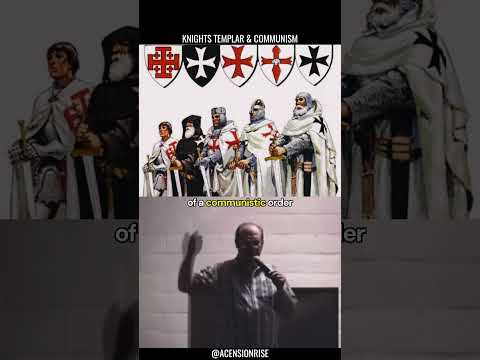
The story of the Knights Templar is one steeped in mystery and controversy, often linked to immense wealth, banking, and secret knowledge. But what if we look beyond the gold and the whispers of hidden relics? What if their organizational structure, their very ethos, hinted at something more radical, something akin to communism?
Bill Cooper, a controversial but often thought-provoking figure, argued that the Templars were not just bankers but an early, large-scale communistic order. Let's delve into this assertion, exploring their practices and comparing them to the tenets of communism, while also considering the nuances of historical economic models.
Table of Contents
CaosThe Founding and Early Mission
The narrative begins with the King of Jerusalem, shortly after his coronation. His immediate concern was the security of pilgrims traversing dangerous territories. To address this, he founded an order of knights, initially tasked with a specific, perilous mission: exploring the caverns and tunnels beneath the Temple Mount. The goal was to uncover whatever relics and secrets the past might hold within those subterranean depths.
This early exploratory phase, however, quickly paved the way for a dramatic shift in the order's standing. As they delved into the earth, they unearthed more than just ancient artifacts; they unearthed a foundation for unprecedented wealth and influence. This transformation led them to become, in many historical accounts, the wealthiest order in the world, and notably, the pioneers of international banking as we might recognize it.
However, Cooper's central thesis posits an even more profound, and perhaps more unsettling, aspect of their rise: their adoption of a communistic model. While acknowledging earlier precedents like the Gnostics, he strongly asserted that the Knights Templar represented the second large group in history to adopt such a communal organizational structure.
The Symbolism of the Two Knights
A powerful visual anchor for the Templars' communal ethos, according to Cooper, is their symbol: two knights riding on a single horse. This imagery is more than just a picturesque emblem; it speaks volumes about their vows and the surrender of individual identity to the collective.
When individuals joined the order, they were required to make a profound sacrifice: to relinquish all their worldly possessions. Money, goods, clothing, property, everything they owned – it all had to be surrendered to the order. In return, they were not given individual shares or allowances, but rather, provisions based strictly on their allocated role and their perceived *need* within the structure of the order.
This practice of communal ownership and need-based distribution is the very bedrock of communist ideology. The individual owned nothing, possessed nothing, and received only what was deemed necessary for them to perform the duties assigned by the collective. This was not about personal accumulation; it was about the functioning of the order as a unified, apersonal entity.
Communism vs. Feudalism: A Crucial Distinction
While Cooper strongly labels the Templars as communist, some scholars and commentators point out a crucial distinction between this ideology and the economic systems of the medieval period, particularly feudalism. A comment within the community context eloquently highlights this: "The concept of giving all your material possessions to a collective with the collective redistributing to individual members based on need is not really communism, but it's more along the lines of feudalism also."
This perspective argues that in true communist societies, members would collectively own resources and utilize mechanisms like democratic centralism to define needs and redistribute them. Feudalism, on the other hand, involved a lord who owned the land and resources, receiving produce or labor from peasants and serfs, and then redistributing necessities back to them. While both involve communal aspects and a degree of redistribution, their core philosophies and operational frameworks differ significantly.
The Templars' model, while certainly communal and emphasizing shared resources, might be more accurately described as a unique monastic or feudalistic system rather than pure communism as understood in later political theory. However, Cooper's assertion forces us to reconsider the fundamental principles at play: the dissolution of private property, the emphasis on collective need over individual desire, and the organization of labor for the benefit of the whole.
The Gnostics and Early Communalism
Cooper's reference to the Gnostics as potentially the "first communists" adds another layer to the discussion. Gnosticism, a diverse spiritual movement primarily active in the first centuries CE, often emphasized esoteric knowledge and a complex cosmology. While not a political movement in the modern sense, some Gnostic communities are believed to have practiced radical forms of sharing and communal living.
The interpretation of Gnostics as communists often stems from their emphasis on shared wisdom, disdain for material wealth accumulation (seen as corrupting or illusory), and in some sects, a practice of communal ownership and a vow of poverty. Their rejection of established hierarchies and materialism could indeed be seen as a precursor to later ideas about collective living, even if the political and economic structures were vastly different from 20th-century communism.
However, the label "communist" for ancient groups is anachronistic and can obscure the actual nature of their beliefs and practices. Gnosticism was a spiritual path focused on attaining knowledge (gnosis) for salvation, not an economic or political theory aimed at societal restructuring in the way communism is.
The Templars' Legacy and Modern Parallels
The Knights Templar, despite their eventual suppression, left an indelible mark on history. Their banking practices laid foundations for modern financial systems, and their legacy is interwoven with subsequent esoteric orders like the Freemasons and the Knights of Malta. The commentary "You'll own nothing and be happy," often associated with modern discussions around globalism and subscription-based economies, echoes the Templars' vow of relinquishing possessions.
This historical precedent raises uncomfortable questions about power, control, and the distribution of wealth. Whether the Templars were "communists" in the strict sense is debatable, but their model of absolute communal ownership and strict redistribution based on assignment undeniably presents a fascinating, and perhaps cautionary, example of an alternative way of organizing human endeavor. It highlights a historical experiment in collective living that, while different from modern communism, shares a core principle: the radical subjugation of individual ownership to the dictates of the group.
Arsenal of the Modern Mage
Understanding historical economic and social structures can be a powerful tool for the modern practitioner, offering insights into group dynamics, belief systems, and the manifestation of intent on a large scale. When exploring concepts of collective action or the dissolution of personal attachment to material possessions, having tools to manage intent and visualize desired outcomes is crucial.
- Essential: Chaos Magick Sigil Generator — For those moments when you need to distill a complex intention into a potent, singular symbol. This tool helps condense collective desires or personal goals into actionable sigils, bypassing the need for lengthy manual creation and allowing focus on the deeper aspects of intent manifestation.
- Historical Context: Books on the Knights Templar, Gnosticism, and Medieval Economic History.
- Philosophical Exploration: Works by Peter J. Carroll, Austin Osman Spare, and modern analyses of economic systems.
FAQ: Deconstructing the Templar Model
Did the King of Jerusalem truly found the Knights Templar?
According to much historical consensus, the King of Jerusalem did play a role in the *establishment* and *support* of the Knights Templar, but he did not personally found the order. The initiative is often attributed to Hugh de Payens and Godfrey de Saint-Omer, who sought royal and ecclesiastical backing for their new order.
Is giving up possessions the same as communism?
While renouncing personal possessions for a collective is a characteristic found in some communistic and monastic orders, it is not the sole defining feature of communism. Communism, in its theoretical form, also involves collective ownership of the means of production and a system of distribution based on need, often theorized to occur after a period of state control or socialist transition.
Were the Gnostics actually communists?
Labeling the Gnostics as "communists" is an anachronism. Gnosticism was primarily a diverse spiritual and philosophical movement focused on esoteric knowledge. Some Gnostic sects may have practiced forms of communal living and shared resources, but this was rooted in their spiritual beliefs about detachment from the material world and the pursuit of gnosis, not in a political or economic theory like communism.
What was the symbolism behind two knights on one horse?
The symbol of two knights riding one horse among the Templars is widely interpreted as representing their vow of poverty and their commitment to the collective. It signifies that individual possessions and even individual identities were subsumed into the order, with resources and support shared based on the group's needs and designated roles.
Did the Templars truly own nothing?
The Templars took vows of poverty, meaning they surrendered their personal possessions to the order. The order itself, however, amassed immense wealth and property. Thus, while individual knights owned nothing personally, the order as a collective entity controlled vast resources that were then managed and redistributed according to its rules.
About the author: Frater Alek0s is a veteran practitioner and researcher in the field of chaos magick. His work focuses on the practical and experimental application of occult techniques for self-development and reality exploration, demystifying esotericism for the modern practitioner.
How did feudalism differ from the Templar model?
Feudalism involved a hierarchical system where lords granted land (fiefs) to vassals in exchange for military service and loyalty. The peasants and serfs on the land owed labor and produce to the lord. The Templar model was more akin to a monastic order where members surrendered all personal property to the collective, and the order itself managed resources for its members' support and its own operational needs, acting as a powerful financial institution rather than a landholding aristocracy.
Referencias
- Carroll, P. J. (1987). Liber Null & Psychonaut. Weiser Books.
- Spare, A. O. (1913). The Book of Pleasure. Self-published.
- Hine, P. (1992). Condensed Chaos: An Introduction to Chaos Magic. New Falcon Publications.
- Crowley, A. (1904). The Book of the Law. Self-published.
- Sherwin, R. (2018). The Chaos Magic Handbook. CreateSpace.
- Kraig, D. M. (1988). Modern Magick: Eleven Lessons in the High Magickal Arts. Llewellyn Publications.
- Morrison, G. (2003). Pop Magic! The Art of Shaping Reality. Disinformation.
- DuQuette, L. M. (2003). The Chicken Qabalah of Rabbi Lamed Ben Clifford. Weiser Books.
- Webb, D. (2015). Chaos Magick: A Practical Guide. Self-published.
- Tyson, D. (2006). The Power of the Written Word. Llewellyn Publications.
- Bonewits, I. (1971). Real Magic. Creative Age Press.
- Greer, J. M. (2003). The New Encyclopedia of the Occult. Llewellyn Publications.
No hay comentarios:
Publicar un comentario